


























Views
Downloads

Indefinite Pronouns Worksheet | Grade 5 Essential Practice
Paste this activity's link or code into your existing LMS (Google Classroom, Canvas, Teams, Schoology, Moodle, etc.).
Students can open and work on the activity right away, with no student login required.
You'll still be able to track student progress and results from your teacher account.
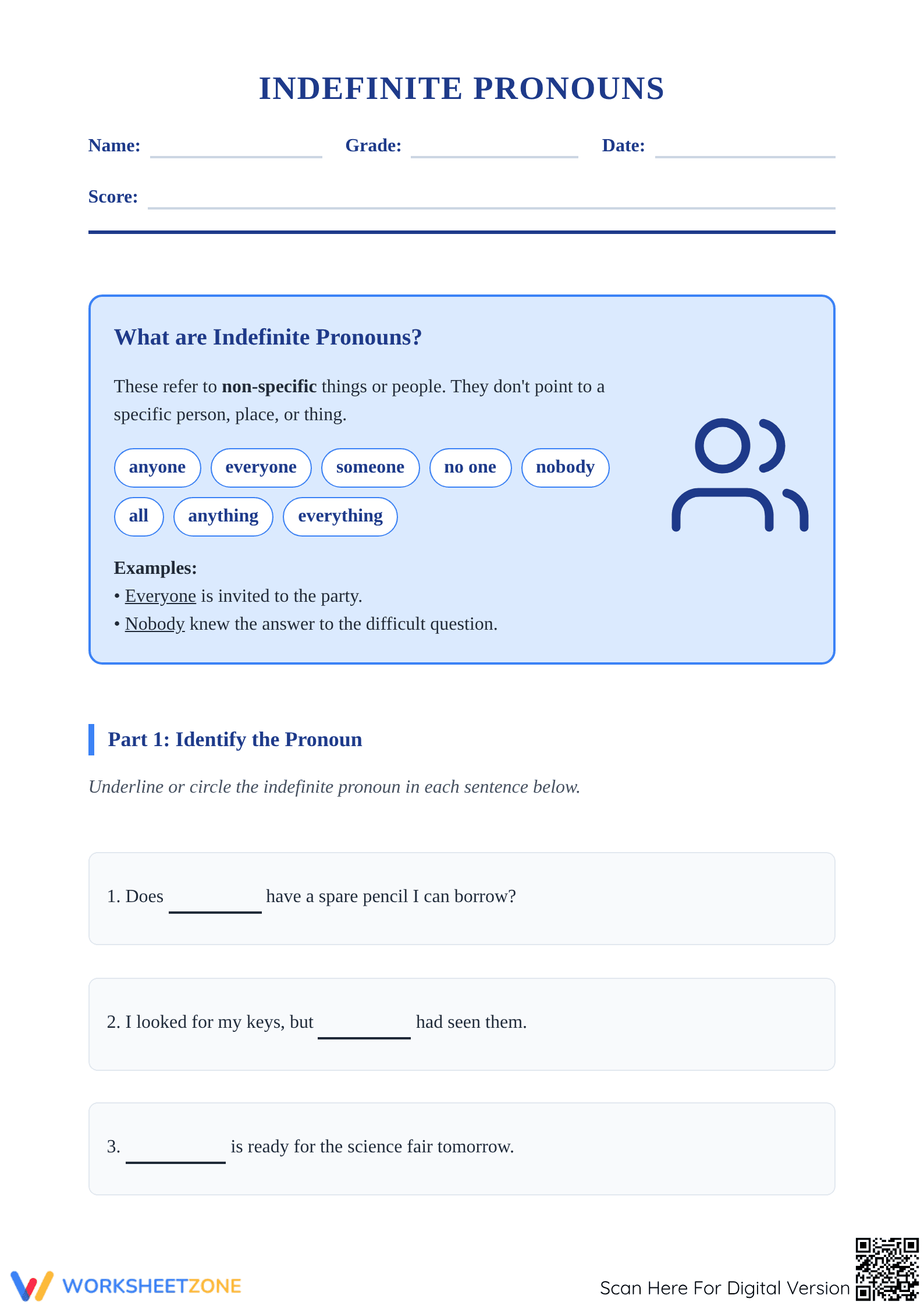
This Grade 5 indefinite pronouns worksheet provides a comprehensive framework for students to identify and use non-specific pronouns like anyone, everyone, and nobody. By engaging with 15 targeted exercises, learners develop the grammatical precision necessary for clear communication. The resource ensures students understand how these pronouns function without pointing to specific individuals or objects.
At a Glance
- Grade: 5 · Subject: ELA
- Standard:
CCSS.ELA-LITERACY.L.5.1— Use standard English grammar conventions to identify and apply indefinite pronouns correctly- Skill Focus: Indefinite Pronouns
- Format: 3 pages · 15 problems · Answer key included · PDF
- Best For: Independent practice or quick formative assessment
- Time: 20–30 minutes
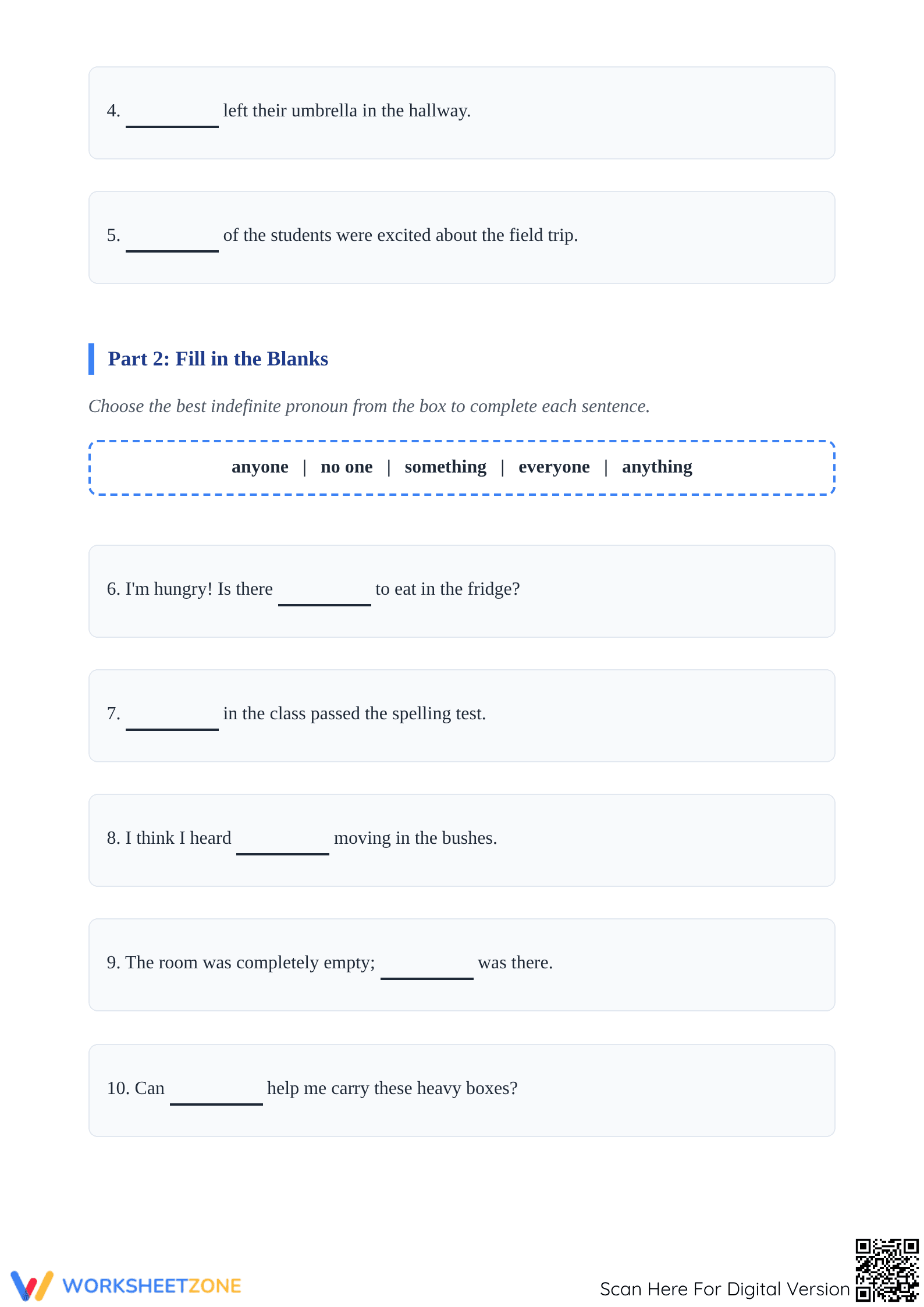
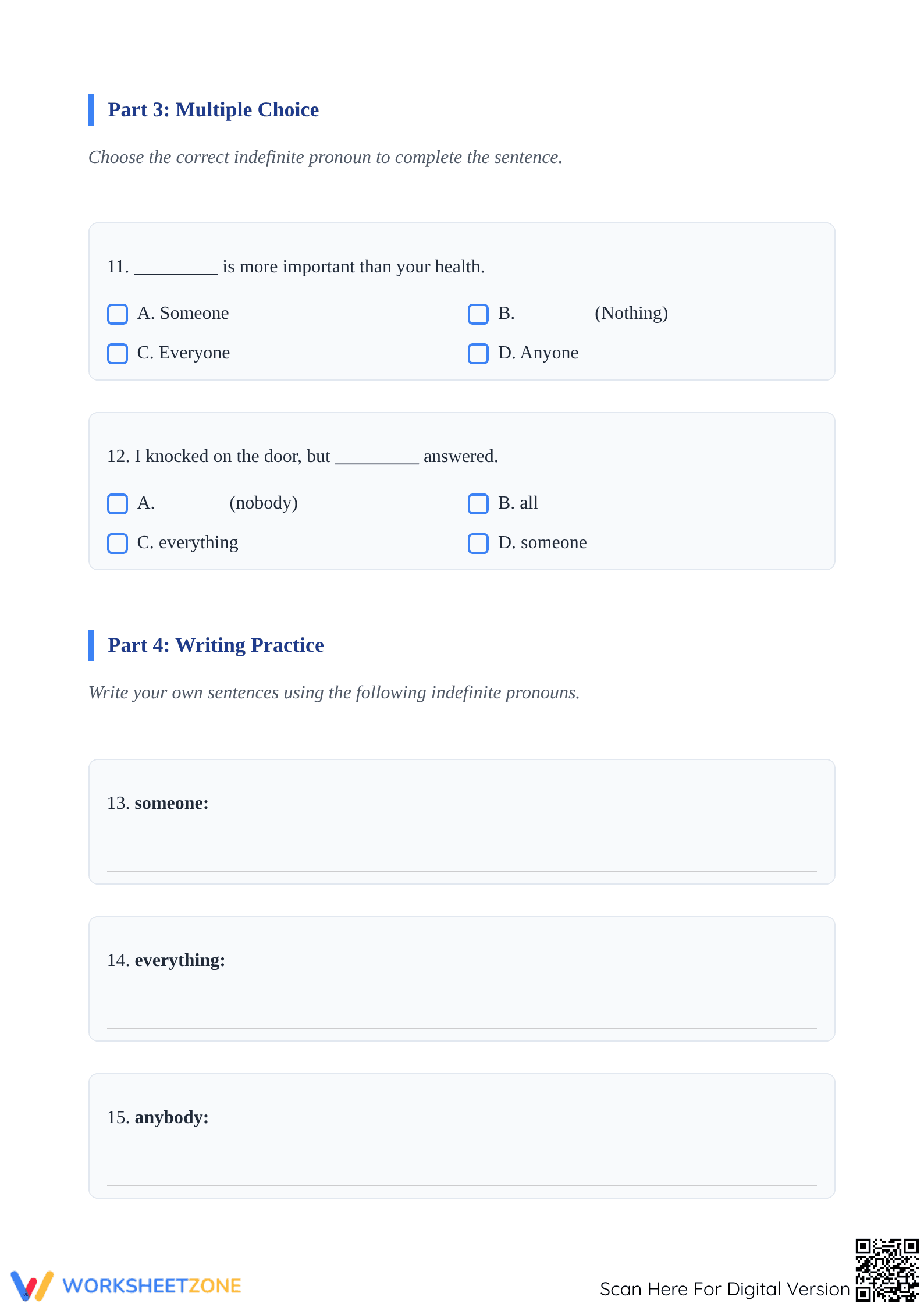
This three-page PDF includes a clear instructional header defining indefinite pronouns with a visual word bank. The 15 tasks are divided into four distinct sections: pronoun identification, fill-in-the-blank sentences with a word bank, multiple-choice selection, and original sentence construction. A full answer key is provided for every page, allowing for immediate feedback or self-grading during classroom instruction.
The zero-prep design allows teachers to integrate this resource into their schedule in under two minutes. First, print the three-page set for each student. Second, distribute the worksheets during the independent practice phase of your grammar lesson. Finally, use the included answer key to review the 15 items as a whole class or for rapid individual grading. It is an ideal solution for unexpected sub plans or literacy centers.
This resource is aligned with CCSS.ELA-LITERACY.L.5.1, which requires students to demonstrate command of the conventions of standard English grammar and usage. Specifically, it targets the ability to use various pronoun types to ensure sentence clarity and variety. Both standard codes can be copied directly into lesson plans, IEP goals, or district curriculum mapping tools to track student progress toward mastery.
Use this worksheet as a formative assessment following a direct instruction lesson on parts of speech. Observe students during Part 1 to see if they can distinguish indefinite pronouns from nouns or personal pronouns. The expected completion time is 20 to 30 minutes, making it perfect for a literacy center or a quiet morning work assignment that requires minimal teacher intervention.
This resource is designed for 5th-grade students mastering grammar mechanics. It is also highly effective for English Language Learners (ELL) who need structured practice with non-specific referents. Pair this worksheet with a pronoun anchor chart or a short reading passage to reinforce the concept in context and provide students with a natural pairing resource for their writing folders.
According to research by Fisher & Frey (2014) on the gradual release of responsibility, structured practice is vital for internalizing complex grammatical rules like those governing indefinite pronouns. This worksheet facilitates that transition by moving from simple identification to independent sentence generation. By focusing on CCSS.ELA-LITERACY.L.5.1, the resource ensures that Grade 5 students build the foundational command of conventions necessary for middle-school writing. The inclusion of 15 varied tasks allows for multiple points of engagement, which aligns with evidence-based instructional design for language acquisition. Educators can rely on this tool to provide the practice phase of instruction, ensuring students can apply non-specific pronouns accurately in diverse sentence structures. This systematic approach to grammar instruction is a hallmark of high-quality, standards-aligned curriculum materials used in modern American classrooms to improve student outcomes.


