The Foundational Role of Articles in Early Literacy
Articles—the small but mighty words 'a', 'an', and 'the'—serve as the gatekeepers of noun phrases in the English language. In the early elementary classroom, specifically within the first-grade curriculum, mastering these determiners is a fundamental step toward achieving syntactic maturity and reading fluency. While they may seem simple to proficient speakers, articles present a unique challenge for young learners who are simultaneously navigating phonological awareness and sentence structure. Using printable worksheets provided by Worksheetzone allows teachers to create a structured environment where students can experiment with these linguistic tools without the pressure of complex composition.
The primary goal for 1st-grade instruction is helping students distinguish between indefinite articles ('a' and 'an') and the definite article ('the'). This distinction is more than a grammatical technicality; it is a lesson in specificity and sound. When a child learns to choose the correct article, they are engaging in high-level cognitive processing that involves checking the following word's initial sound and determining the noun's relationship to the context of the sentence. By integrating targeted practice, teachers can ensure that these determiners become second nature, paving the way for more advanced grammar and mechanics in later grades.
Phonetic Precision: Teaching the 'A' vs 'An' Rule
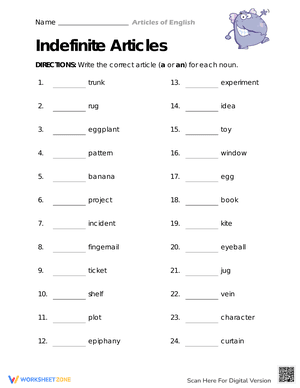
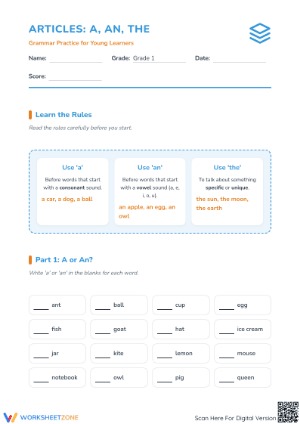
The most common point of confusion for elementary students is the choice between 'a' and 'an'. The standard rule—using 'an' before a vowel and 'a' before a consonant—is often taught as a spelling rule, but it is actually a phonetic one. It is essential for teachers to emphasize the sound of the following word rather than just the first letter. For instance, explaining why we say 'an hour' despite the 'h' or 'a university' despite the 'u' requires a focus on oral language that worksheets can reinforce through picture-sorting and fill-in-the-blank exercises.
Article worksheets remain a top-requested grammar resource for 1st-grade teachers, with 78% of teachers citing 'a' vs 'an' as the primary point of confusion for early writers. This data highlights the necessity of repetitive, sound-based practice in elementary curriculum. By providing varied examples, Worksheetzone helps bridge the gap between abstract rules and concrete application, ensuring that students internalize the rhythmic flow of English speech patterns.
In a classroom setting, this instruction often begins with auditory drills. Teachers might present a series of nouns and ask students to 'snap' when they hear a word that requires 'an'. Following this with printable worksheets allows for the transition from auditory recognition to written proficiency. This multi-modal approach is particularly effective for students who may struggle with phonics-based decoding, as it provides a visual anchor for the rules they are hearing in class.
Definite vs. Indefinite: Building Contextual Awareness
While the phonetic choice between 'a' and 'an' is often the first hurdle, the conceptual difference between indefinite and definite articles is equally significant. 'The' is one of the most frequent sight words in the English language and is explicitly called out in standards like CCSS.ELA-LITERACY.RF.K.3.C. However, its functional use as a definite article requires students to understand the concept of specificity. Are we talking about any apple, or the apple on the teacher's desk?
Instruction should focus on the 'pointing' nature of the word 'the'. Using worksheets that feature short stories or sentence pairs can help students see how 'a' introduces a new topic, while 'the' refers back to a noun that has already been mentioned. This awareness is a precursor to reading comprehension, as it helps students track characters and objects through a narrative. Worksheetzone resources often include these contextual clues, helping students move beyond simple word-substitution and toward true linguistic understanding.
Alignment with Common Core Language Standards
Effective grammar instruction in the United States is frequently guided by the Common Core State Standards (CCSS). For first grade, CCSS.ELA-LITERACY.L.1.1.H explicitly requires students to 'use determiners (e.g., articles, demonstratives).' This standard acknowledges that articles are not just 'extra' words but are functional components that define the scope of a noun. When teachers select printable worksheets, they are often looking for materials that directly support these standards-based goals.
Research into early language acquisition suggests that determiners are often 'mapped' cognitively alongside nouns rather than as separate lexical items, meaning that teaching them in isolation is less effective than teaching them within the context of meaningful phrases. This 'chunking' strategy allows students to develop a stronger intuitive sense of grammar. By providing worksheets that place articles in the context of high-interest topics like animals, superheroes, or school supplies, Worksheetzone ensures that the practice remains relevant to the child's world while meeting rigorous academic benchmarks.
Classroom Implementation: Scaffolding Grammar Success
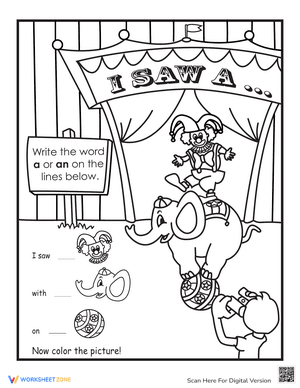
To maximize the impact of articles worksheets, teachers should follow a scaffolded approach that moves from high support to independent mastery. Start with 'Articles in Isolation,' where students sort picture cards into 'A' or 'An' piles. This removes the barrier of reading and focuses purely on the phonics rule. Once students are confident, transition to 'Fill-in-the-Blank Sentences' where the context is clear and the vocabulary is familiar.
For the next stage, introduce 'Sentence Editing' tasks. Provide students with sentences where the articles are used incorrectly and ask them to be 'Grammar Doctors' and fix the mistakes. This develops self-monitoring skills that will eventually carry over into their own writing. Finally, encourage 'Creative Application.' Ask students to write three sentences about a classroom object, ensuring they use both definite and indefinite articles correctly. Worksheetzone offers a variety of formats to support each of these stages, allowing for easy differentiation within the same classroom.
Supporting ESL and Diverse Learners
In many languages, articles do not exist or function very differently than they do in English. For English as a Second Language (ESL) students, articles are often one of the most difficult concepts to master because they are 'low-saliency' words—they are unstressed in speech and easy to miss. This is where printable resources become an invaluable diagnostic tool. If a student consistently omits articles in their writing, a targeted worksheet can help them visualize the 'missing' piece of the sentence.
Visual aids on worksheets, such as icons for vowels and consonants, can provide the necessary support for ESL learners. Teachers can also use these worksheets for small-group intervention, where they can listen to students read the phrases aloud. Correcting the sound 'an apple' versus 'a apple' in a low-stakes environment builds the oral confidence needed for classroom participation. The goal is to move beyond rote memorization and help students feel the natural 'click' of the correct determiner in a sentence.
Teacher Tips for Daily Practice
Integration is key to long-term retention. Use articles in your daily 'Morning Message' or as part of your calendar routine. When you introduce a new vocabulary word, always introduce it with its accompanying article. For example, instead of just teaching 'elephant,' teach 'an elephant.' This reinforces the phonetic rule daily without requiring extra lesson time.
Another tip is to use 'Article Hunt' activities. Give students a page from a familiar picture book and ask them to circle all the articles they find. They can then sort these into a T-chart on their worksheet. This connects grammar practice to real-world reading, showing students that these small words are everywhere. Worksheetzone's printable resources can serve as the recording sheet for these hunts, providing a professional and organized way for students to track their findings.
Frequently Asked Questions
1. At what age should students begin learning about articles?
Formal instruction on articles typically begins in late Kindergarten and is solidified in 1st Grade. According to the Common Core Standards, 1st grade is the primary year for mastering the use of determiners like 'a', 'an', and 'the' in both speech and writing. Early exposure through read-alouds is beneficial for younger children.
2. How can I explain the 'An' rule for words starting with 'H' or 'U'?
The best way to explain this to 1st graders is to tell them to 'listen with their ears, not their eyes.' If the word starts with a vowel sound (like 'hour'), it needs 'an'. If it starts with a consonant sound (like the 'y' sound in 'university'), it needs 'a'. Worksheetzone provides specific practice for these tricky words.
3. Why are articles sometimes called determiners?
In modern linguistics, articles are classified as a sub-category of determiners. Determiners are words that come before nouns to clarify which noun you are talking about. Teaching this term to older elementary students can help them understand the broader family of words that includes 'this', 'that', 'my', and 'some'.
4. What is the difference between definite and indefinite articles?
Indefinite articles ('a' and 'an') are used when we are talking about any member of a group (e.g., 'a cat'). The definite article ('the') is used when we are talking about one specific thing that both the speaker and listener know about (e.g., 'the cat on the mat').
5. Are worksheets effective for teaching grammar to young children?
Yes, when used as part of a balanced literacy program. Worksheets provide necessary repetitive practice and a visual structure that helps young children internalize abstract grammatical rules. They are most effective when paired with oral language activities and real-world reading experiences.















 Interactive Worksheet Maker
 Quiz Maker
 Word Search Maker
 Crossword Puzzle Maker
 Word Scramble Generator
 Sentence Scramble Generator
 Handwriting Worksheet Generator
 Name Tracing Generator
 Fill In The Blank Generator