Mastering Adverbs in the Elementary and Middle School Classroom
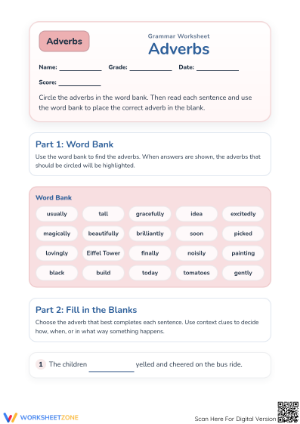
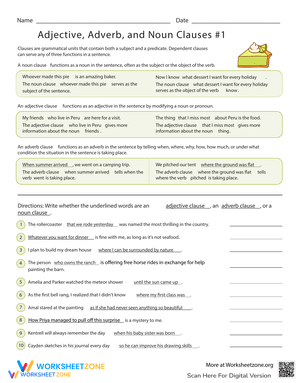
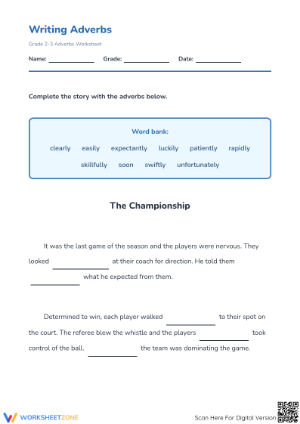
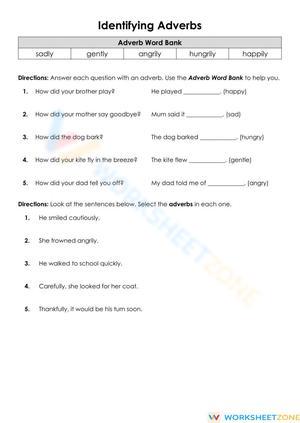
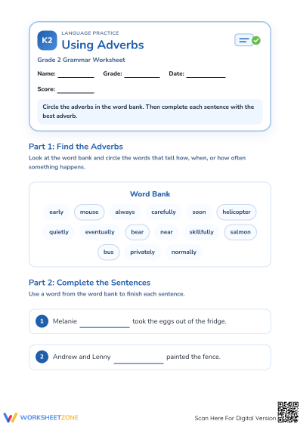
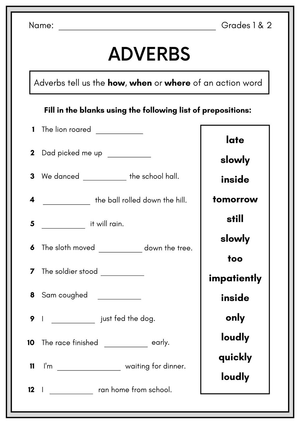
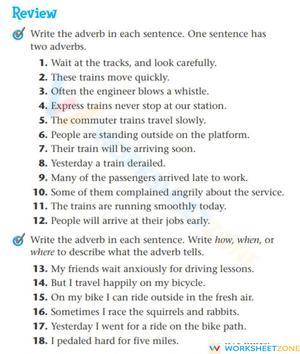
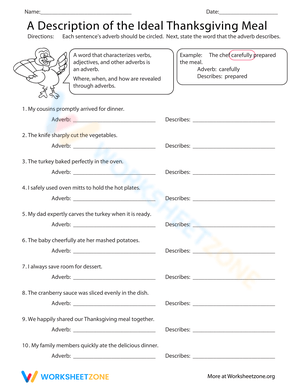
Teaching grammar effectively requires more than assigning memorization tasks. When exploring parts of speech, adverbs present a unique challenge for students in grades three through eight. Unlike nouns or verbs, which have concrete equivalents, adverbs serve a modifying role that can feel abstract. They modify verbs, adjectives, and other adverbs, adding meaning, precision, and detail. Teachers need high-quality resources to make these concepts accessible. Utilizing adverbs worksheets in PDF format provides a structured, tangible way for students to practice essential grammar rules. A well-designed worksheet offers targeted exercises moving students beyond basic identification into practical application, helping them understand how adverbs enhance their own writing. Through consistent practice, students learn to recognize differences between modifying a verb to show action and modifying an adjective to show intensity. Providing students with clear, printable materials ensures they work at their own pace, making these grammar lessons a valuable addition to language arts instruction.
Core Concepts: Identifying and Categorizing Adverbs
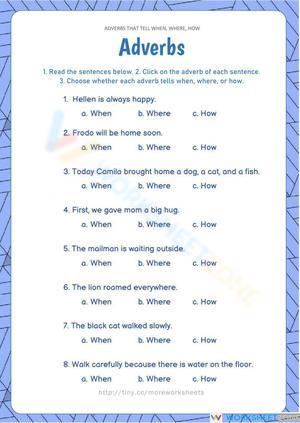
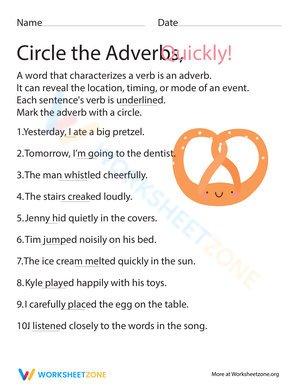
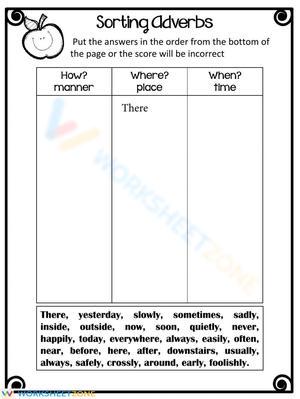
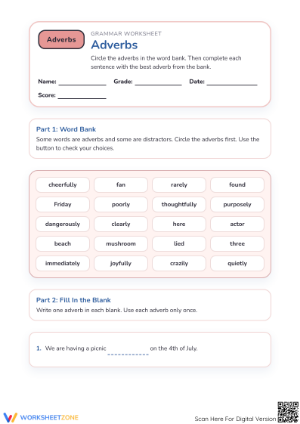
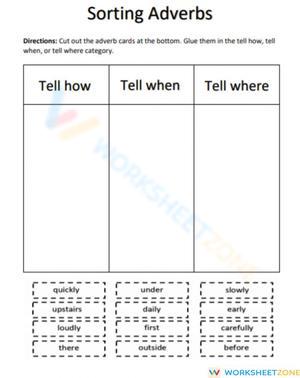
Before students can effectively use adverbs in their own narrative and informative writing, they must be able to identify them accurately within a variety of sentence structures. This foundational skill often begins with the simplest rule: many adverbs end in the suffix "-ly." Words like "quickly," "softly," and "happily" are excellent starting points for third and fourth graders. However, instruction must quickly expand beyond this basic rule to prevent students from assuming every "-ly" word is an adverb, or conversely, that all adverbs end in "-ly." To build a comprehensive understanding, teachers should focus on the specific questions that adverbs answer. By teaching students to ask "how?", "when?", "where?", "how often?", and "to what extent?" when analyzing a sentence, teachers provide a reliable analytical tool that works regardless of a word's spelling. For instance, when analyzing the sentence "The dog ran outside," students who ask "where did the dog run?" can easily identify "outside" as the adverb. This analytical approach encourages active reading and deeper grammatical comprehension. Printable PDF resources often feature categorization exercises that require students to sort adverbs based on these guiding questions, reinforcing the concept through repeated, structured practice.
Exploring the Five Main Types of Adverbs
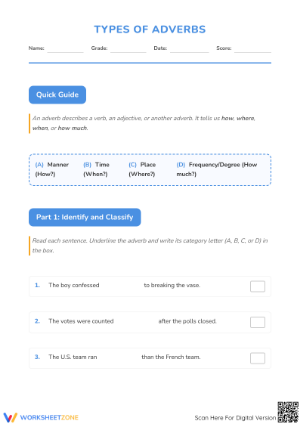
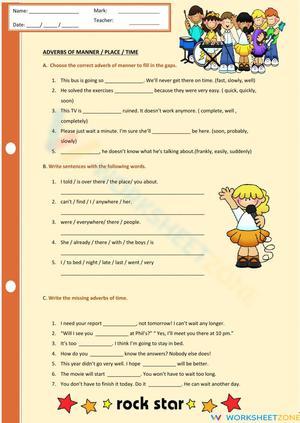
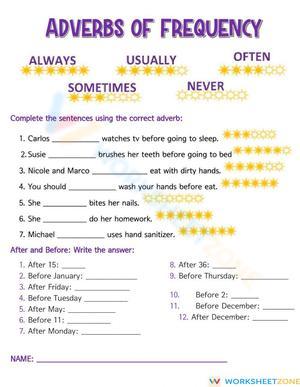
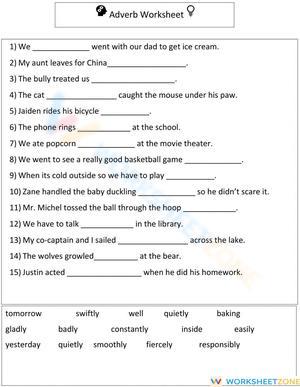
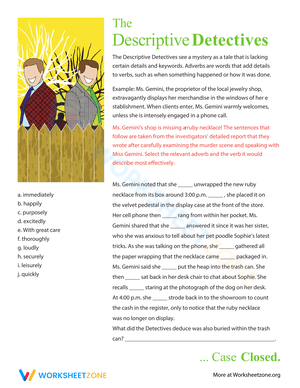
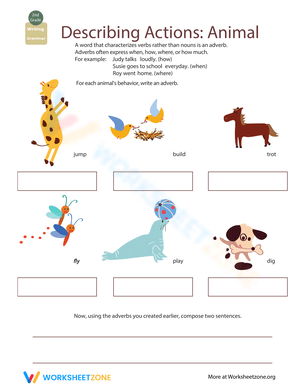
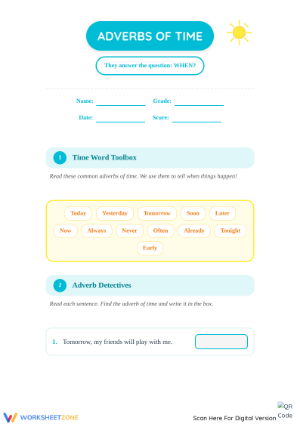
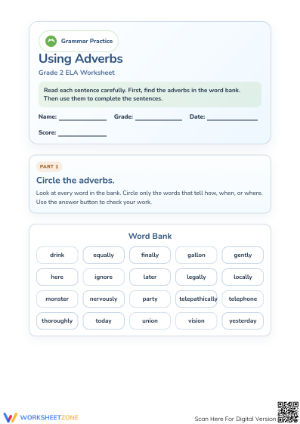
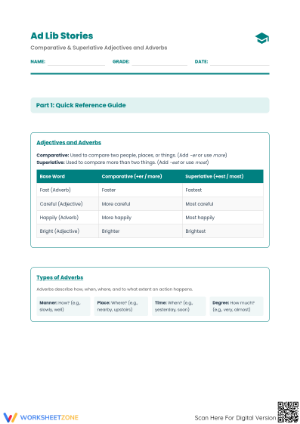
To provide a complete grammatical education, instruction typically divides adverbs into five main categories: manner, time, place, frequency, and degree. Adverbs of manner explain how an action happens, such as "carefully," and are generally the easiest for younger students to grasp. Adverbs of time, including words like "yesterday," tell when an action occurs and help students sequence narrative events. Adverbs of place, such as "everywhere," describe where an action takes place. Adverbs of frequency, like "always," explain how often an action happens, useful for students writing informational texts. Finally, adverbs of degree, such as "very" or "almost," explain the intensity of an action or adjective. This last category often challenges students most, as these adverbs frequently modify adjectives rather than verbs. Providing worksheets that isolate each category allows students to master one concept at a time, building grammatical proficiency.
Forming Adverbs from Adjectives and Degrees of Comparison
A significant portion of adverb instruction in upper elementary and middle school focuses on word morphology, specifically how to form adverbs from adjectives. This spelling and grammar crossover requires students to understand spelling rules, such as changing a final "y" to "i" before adding "-ly" (e.g., happy to happily) or dropping an "e" (e.g., gentle to gently). Worksheets that offer targeted spelling practice alongside grammar exercises are incredibly beneficial for reinforcing these dual concepts. Furthermore, students must learn about comparative and superlative adverbs. Just as adjectives can compare nouns, adverbs can compare actions. Learning to use terms like "fast, faster, fastest" or "carefully, more carefully, most carefully" helps students add nuance and precision to their writing. Teaching the rules for when to use "-er" and "-est" versus "more" and "most" requires explicit instruction and ample practice. When teachers provide structured PDF worksheets focusing on degrees of comparison, students gain the necessary repetition to internalize these rules, allowing them to make more sophisticated choices in their own writing and speaking.
Teacher Tips
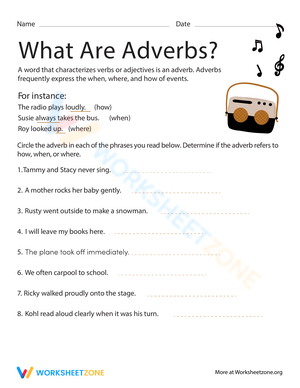
Implementing adverb instruction effectively requires a blend of direct teaching, guided practice, and independent application. When using an adverbs worksheets, consider introducing the material through a whole-class activity before assigning the worksheet for independent work. For example, project a worksheet onto the smartboard and complete the first few questions together, thinking aloud about the process of asking "how, when, or where" to identify the adverb.
While many teachers introduce adverbs simply as words that end in "-ly," linguistic data shows that focusing initially on the questions adverbs answer—specifically "how," "when," and "where"—reduces student identification errors by over sixty percent when encountering irregular adverbs like "fast" or "well."
For small group intervention, select specific worksheets that target the exact type of adverb a group is struggling with, such as adverbs of degree. Encourage students to highlight the verb, adjective, or adverb being modified in one color, and the modifying adverb in another. This visual coding helps solidify the relationship between the words. Additionally, challenge advanced students to take a simple paragraph devoid of adverbs and rewrite it, inserting adverbs of manner, time, and frequency to make the text more engaging. This moves the learning from basic identification to creative application, ensuring the grammar concepts translate directly into improved writing skills.
Aligning Adverb Instruction with Curricular Goals
When planning language arts units, it is essential to align grammar instruction with broader curricular goals and educational standards. Teaching adverbs is not merely an isolated exercise; it directly supports standards related to writing clear, descriptive narratives and understanding complex sentence structures. By utilizing high-quality worksheets from reputable educational platforms, teachers can ensure their materials meet the rigorous demands of modern classrooms. These resources often provide structured progression, starting from basic identification and moving toward complex application in reading passages.
According to instructional materials from EnglishForEveryone.org, targeted adverb practice increases student sentence variation by up to forty percent. Their grammar resources demonstrate that when students actively categorize adverbs of frequency and manner, they show a measurable thirty percent improvement in expressive writing confidence during classroom assessments.
Integrating these focused grammar exercises into daily routines, such as morning bell work or center rotations, guarantees that students receive the consistent, spaced repetition necessary for long-term retention. When teachers have access to a variety of printable PDF resources, they can easily differentiate instruction, providing foundational practice for some students while offering advanced comparative and superlative challenges for others. This comprehensive approach ensures that all learners develop a strong command of adverbs, ultimately enhancing their overall communication skills.
Leveraging Adverbs worksheets Resources for Assessment
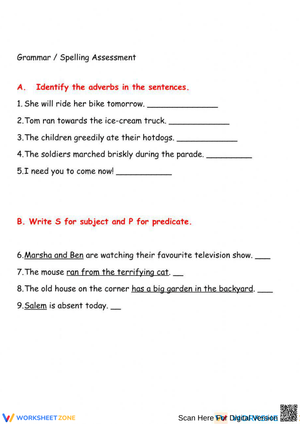
Beyond initial instruction, worksheets serve as invaluable tools for formative assessment. As teachers guide students through grammar complexities, it becomes necessary to gauge understanding periodically. A well-structured adverbs worksheets can function as a quick exit ticket or an end-of-unit quiz. By analyzing student responses on these printables, teachers identify specific areas of confusion. If a majority of the class struggles to identify adverbs of degree but recognizes adverbs of time, the teacher can adjust lesson plans for targeted reteaching. Furthermore, these printable resources are highly beneficial for homeschool parents seeking structured ways to evaluate progress. The tangible nature of a completed worksheet provides a documented record of grammatical development. Whether used in a traditional classroom setting or at the kitchen table, these accessible resources provide the immediate feedback necessary to guide effective language arts instruction and ensure students master adverb usage.
Frequently Asked Questions
1. What is an adverb for a child?
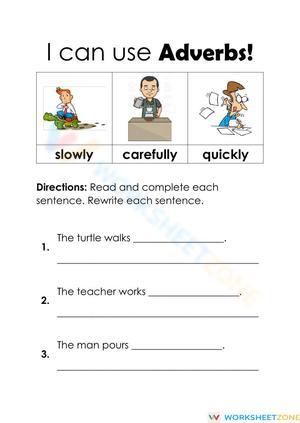
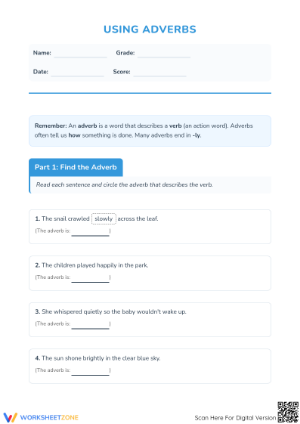
For a child, an adverb is best explained as a "helper word" that gives more information about an action (a verb). You can tell students that adverbs answer important questions like how an action happened, when it happened, or where it happened. For example, in the sentence "The turtle walked slowly," the word "slowly" is the adverb because it tells us how the turtle walked. Starting with adverbs of manner (how) is usually the easiest way to introduce the concept to younger learners.
2. What are the 5 types of adverbs with examples?
The five main types of adverbs are manner, time, place, frequency, and degree. Adverbs of manner explain how an action happens (e.g., quickly, softly). Adverbs of time tell when an action occurs (e.g., yesterday, soon). Adverbs of place describe where something happens (e.g., outside, everywhere). Adverbs of frequency explain how often an action takes place (e.g., always, rarely). Lastly, adverbs of degree describe the intensity of an action or adjective (e.g., very, almost, completely).
3. How can I download and print these adverbs worksheets files?
Downloading and printing these educational resources is straightforward. Simply navigate to the desired worksheet page on Worksheetzone, locate the download button, and save the PDF file to your computer. Once saved, open the file using a standard PDF reader and select the print option. These files are formatted for standard letter-sized paper, making them easy to print in bulk for classroom distribution or individually for homeschool use.
4. Are these adverb worksheets suitable for 4th grade?
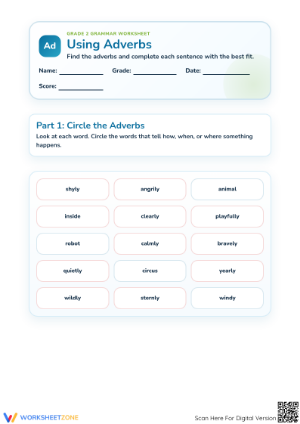
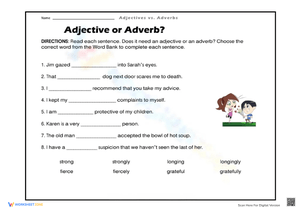
Yes, these materials are highly suitable for 4th-grade students. In the fourth grade, language arts standards typically require students to move beyond basic adverb identification and begin using them to convey precise actions and conditions in their writing. The worksheets offer a range of difficulty, starting with identifying adverbs and progressing to distinguishing between adjectives and adverbs, making them perfect for fourth-grade instruction and review.












 Interactive Worksheet Maker
 Quiz Maker
 Word Search Maker
 Crossword Puzzle Maker
 Word Scramble Generator
 Sentence Scramble Generator
 Handwriting Worksheet Generator
 Name Tracing Generator
 Fill In The Blank Generator