


























Views
Downloads

Grade 1 Portuguese Articles — Printable No-Prep Worksheet
Paste this activity's link or code into your existing LMS (Google Classroom, Canvas, Teams, Schoology, Moodle, etc.).
Students can open and work on the activity right away, with no student login required.
You'll still be able to track student progress and results from your teacher account.
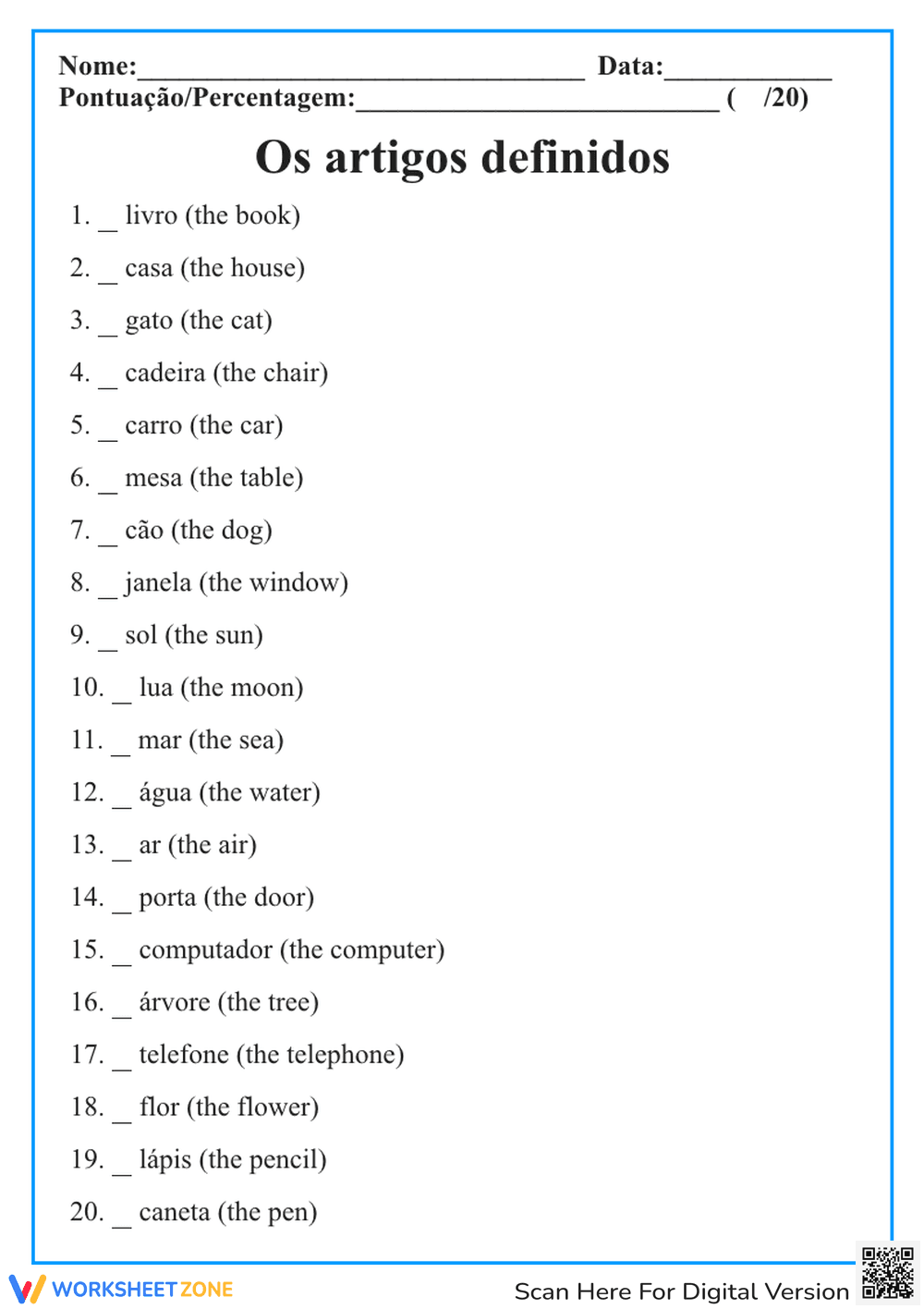
This Grade 1 Portuguese worksheet helps students master definite articles (o, a) through 20 targeted fill-in-the-blank exercises. By identifying the gender and number of common nouns, learners build foundational grammar skills essential for bilingual literacy. Each Portuguese word includes an English translation to support vocabulary acquisition and comprehension during independent practice.
At a Glance
- Grade: 1 · Subject: Portuguese
- Standard:
CCSS.ELA-LITERACY.L.1.1— Demonstrate command of the conventions of standard grammar and usage when writing- Skill Focus: Definite Articles (o, a)
- Format: 1 page · 20 problems · Answer key included · PDF
- Best For: Introductory grammar and bilingual vocabulary practice
- Time: 15–20 minutes
The worksheet features a clean, single-page layout containing 20 specific noun-identification tasks. Each item provides a blank space for the definite article, followed by a Portuguese noun and its English equivalent in parentheses (e.g., "livro (the book)"). This structure provides immediate context, allowing students to focus on the grammatical relationship between the article and the noun's gender.
Teachers can implement this resource in under two minutes. Simply print the PDF, distribute it to students, and allow them to work through the 20 examples. Because the English translations are provided on the page, students can often complete the work with minimal teacher intervention, making it an ideal choice for morning work, fast-finishers, or emergency sub plans.
This resource aligns with `CCSS.ELA-LITERACY.L.1.1`, which requires students to demonstrate command of the conventions of standard grammar and usage. While specific to Portuguese, the exercise mirrors the linguistic development goals of identifying and using articles correctly within a sentence structure. This standard code can be copied directly into lesson plans, IEP goals, or district curriculum mapping tools.
Use this worksheet as a formative assessment after an introductory lesson on masculine and feminine nouns in Portuguese. It serves as an excellent "check for understanding" to see if students can distinguish between "o" and "a" based on word endings. Alternatively, assign it as a homework reinforcement activity to solidify the connection between Portuguese vocabulary and their English counterparts.
This resource is designed for first-grade students in dual-language immersion programs or introductory World Language classrooms. It is particularly effective for English-dominant learners who need the scaffolding of translated terms. Pair this worksheet with a visual anchor chart displaying common masculine and feminine noun endings to provide additional support for struggling learners.
Research from Fisher & Frey (2014) emphasizes the importance of scaffolded practice in language acquisition, particularly the use of "I Do, We Do, You Do" models. This worksheet provides the "You Do" independent practice phase by offering 20 consistent opportunities to apply the rule of definite articles. By including English translations, the resource reduces cognitive load, allowing Grade 1 students to focus specifically on the grammatical convention of CCSS.ELA-LITERACY.L.1.1. According to the RAND AIRS 2024 report, high-quality, focused grammar worksheets contribute significantly to syntactic awareness in early bilingual learners. This specific tool ensures that students engage with high-frequency nouns like "casa" and "livro," building a functional lexicon while mastering the essential mechanics of Portuguese articles. It is a reliable, evidence-based addition to any early elementary language curriculum.


