Understanding the Three Types of Verbals
Teaching grammar to middle and high school students requires materials that are clear, engaging, and highly structured. When it comes to advanced parts of speech, verbals often present a significant challenge for learners. Verbals are words formed from verbs but used as entirely different parts of speech within a sentence. Because they look like verbs but act like nouns, adjectives, or adverbs, students frequently misidentify their function. Providing your classes with a comprehensive verbals worksheets is an excellent way to guide them through the nuances of sentence structure. By breaking down the concepts into manageable practice exercises, teachers can help students differentiate between the three distinct types of verbals: gerunds, participles, and infinitives. Mastery of these concepts improves reading comprehension and elevates students' writing by encouraging sentence variety.
Before diving into complex sentence diagramming, establish a strong foundational understanding of what verbals are. A verbal will never function as the main verb of a clause. When utilizing a verbals worksheets, start by having students identify the actual main verb of the sentence. Once the main verb is boxed, any remaining verb-like words are likely verbals. This process of elimination reduces cognitive load and gives students a reliable strategy. From there, you can introduce the specific characteristics of gerunds, participles, and infinitives, ensuring that students have ample opportunity to practice identifying each type in isolation.
Teaching Gerunds as Nouns
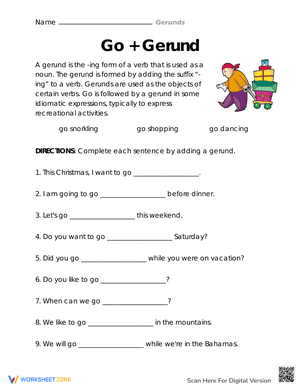
A gerund is a verb form ending in "-ing" that functions exclusively as a noun. Because it acts as a noun, a gerund can serve as a subject, a direct object, an indirect object, or an object of a preposition. For example, in the sentence "Swimming is my favorite hobby," the word "swimming" is the subject. Teaching students to recognize gerunds requires shifting their focus toward the role the word plays in the sentence framework. A high-quality verbals worksheets will typically include exercises that isolate gerunds, asking students to label its noun function. This targeted practice is necessary for building confidence before introducing other verbals.
When planning instruction around gerunds, it is highly effective to use substitution exercises. If a student is unsure whether an "-ing" word is a gerund, ask them to replace the word with a common noun, such as "pizza" or "homework." If the sentence remains grammatically correct, the target word is functioning as a gerund. Additionally, teachers can incorporate resources from Super Teacher Worksheets to provide structured practice that reinforces these identification strategies. By offering clear examples, teachers can ensure that students grasp the concept of gerunds.
Identifying Participles and Participial Phrases
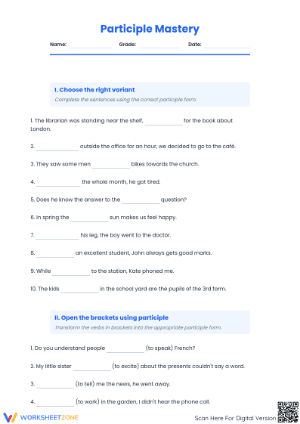
While gerunds function as nouns, participles are verb forms that function as adjectives. They come in two primary forms: present participles, which end in "-ing," and past participles, which typically end in "-ed," "-en," "-d," "-t," or "-n." For example, in the phrase "the running water," "running" is a present participle modifying the noun "water." The primary instructional challenge is the overlap between gerunds and present participles. A targeted verbals worksheets can provide side-by-side comparison exercises, forcing students to analyze whether the "-ing" word names a thing (gerund) or describes a noun (participle).
To further support student understanding, teachers should emphasize the concept of participial phrases. A participial phrase consists of the participle and any modifiers associated with it. For instance, in "Exhausted from the marathon, the runner collapsed," the phrase modifies "the runner." When using a verbals worksheets, encourage students to draw an arrow from the participle directly to the noun it modifies. Drawing on structured examples, such as those found in Math Worksheets 4 Kids, provides the repetition needed for students to recognize these patterns.
Navigating Infinitives and Their Functions
The infinitive is the base form of a verb, almost always preceded by the word "to," as in "to run," "to jump," or "to learn." Unlike gerunds and participles, which have singular grammatical functions, infinitives are highly versatile. They can function as nouns, adjectives, or adverbs. For example, in "To succeed is her goal," the infinitive functions as a noun subject. In "She has a book to read," it acts as an adjective modifying "book." In "He ran to win," it serves as an adverb modifying the verb "ran." This versatility makes infinitives the most complex verbal to classify.
When introducing infinitives, explicitly teach the difference between an infinitive phrase and a prepositional phrase beginning with "to." A prepositional phrase will always be followed by a noun object, whereas an infinitive will be followed by a verb. A comprehensive verbals worksheets should include discrimination exercises. Furthermore, utilizing resources from English-Grammar.at can help students practice the differences between using gerunds and infinitives after certain main verbs.
Common Student Misconceptions with Verbals
One of the most frequent hurdles in teaching verbals is helping students unlearn the idea that any word ending in "-ing" is automatically an action verb. Because early literacy instruction heavily focuses on "-ing" words as present progressive verbs, middle and high school students often struggle to reclassify these words as nouns or adjectives. Using a verbals worksheets that explicitly contrasts present progressive verb phrases with gerunds and participles addresses this misconception head-on. Teachers should provide side-by-side examples to highlight the contextual differences.
One of the most effective ways to clarify verbals for struggling learners is teaching them the substitution method. When students encounter an "-ing" word, having them replace it with a simple noun like "apples" can instantly reveal if it is functioning as a gerund. If the sentence still retains its basic grammatical structure, the word is a gerund; if the sentence breaks down, it is likely a present participle modifying a nearby noun.
Another common misconception involves the infinitive marker "to." Students frequently confuse infinitives with prepositional phrases, leading to errors in sentence analysis. To combat this, teachers must reinforce the rule that infinitives are always followed by a verb base. Visual aids and anchor charts are incredibly beneficial in this regard.
Classroom Implementation
Integrating a verbals worksheets into your curriculum requires a strategic approach to maximize student engagement. Rather than distributing a massive packet of worksheets all at once, consider introducing one type of verbal at a time. Begin with a mini-lesson on gerunds, followed by guided practice using a specific worksheet focused solely on gerunds. Once the class demonstrates proficiency, move on to participles, and finally, infinitives. After all three types have been taught in isolation, utilize comprehensive review worksheets that require students to distinguish between the three.
When students utilize targeted anchor charts alongside their verbals worksheets, mastery of the 3 verbal types improves significantly. According to Lexia Learning, providing explicit visual references for gerunds, participles, and infinitives helps learners correctly identify sentence functions during independent practice.
These worksheets are highly adaptable and can be used in a variety of instructional settings. For small-group intervention, a teacher might work with struggling readers to identify verbals in simpler sentences, slowly increasing the complexity. For enrichment, advanced students could be tasked with writing their own sentences using specific verbal phrases.
Assessing Mastery of Verbals
Formative assessment is an essential component of teaching verbals. As students work through their verbals worksheets, teachers should actively monitor their progress, checking for common errors and providing immediate feedback. One effective formative assessment strategy is to have students use different colored highlighters for each type of verbal—for example, yellow for gerunds, pink for participles, and green for infinitives. This allows the teacher to quickly scan the room and assess understanding at a glance.
For summative assessment, teachers can design tests that mirror the format of the verbals worksheets used during instruction. These assessments should include a mix of multiple-choice questions, sentence diagramming, and original writing prompts. Asking students to write a paragraph incorporating at least one gerund, one participle, and one infinitive is a fantastic way to evaluate their ability to apply the concepts in context.
Frequently Asked Questions
1. What is the difference between a gerund and a present participle?
A gerund is a verb form ending in "-ing" that functions entirely as a noun within a sentence, such as a subject or direct object. A present participle also ends in "-ing," but it functions as an adjective modifying a noun.
2. How can I tell if an infinitive is a noun, adjective, or adverb?
To determine the function of an infinitive, analyze its role. If it acts as the subject or object, it is a noun. If it modifies a noun, it is an adjective. If it modifies a verb or adjective, it is an adverb.
3. Why is it important for middle school students to learn about verbals?
Understanding verbals allows students to construct more complex, mature, and varied sentences. It also improves reading comprehension, as students can better decode the grammatical structure of advanced texts.
4. Can a single sentence contain more than one type of verbal?
Yes, a sentence can contain multiple verbals. For example, in the sentence "Running to catch the bus, she wanted to avoid being late," you have a participle, infinitives, and a gerund.
5. How should I introduce a verbals worksheets to my class?
Start by teaching and practicing one type of verbal at a time. Provide clear examples, use visual anchor charts, and guide the class through the first few exercises together before assigning independent practice.















 Interactive Worksheet Maker
 Quiz Maker
 Word Search Maker
 Crossword Puzzle Maker
 Word Scramble Generator
 Sentence Scramble Generator
 Handwriting Worksheet Generator
 Name Tracing Generator
 Fill In The Blank Generator