


























Views
Downloads
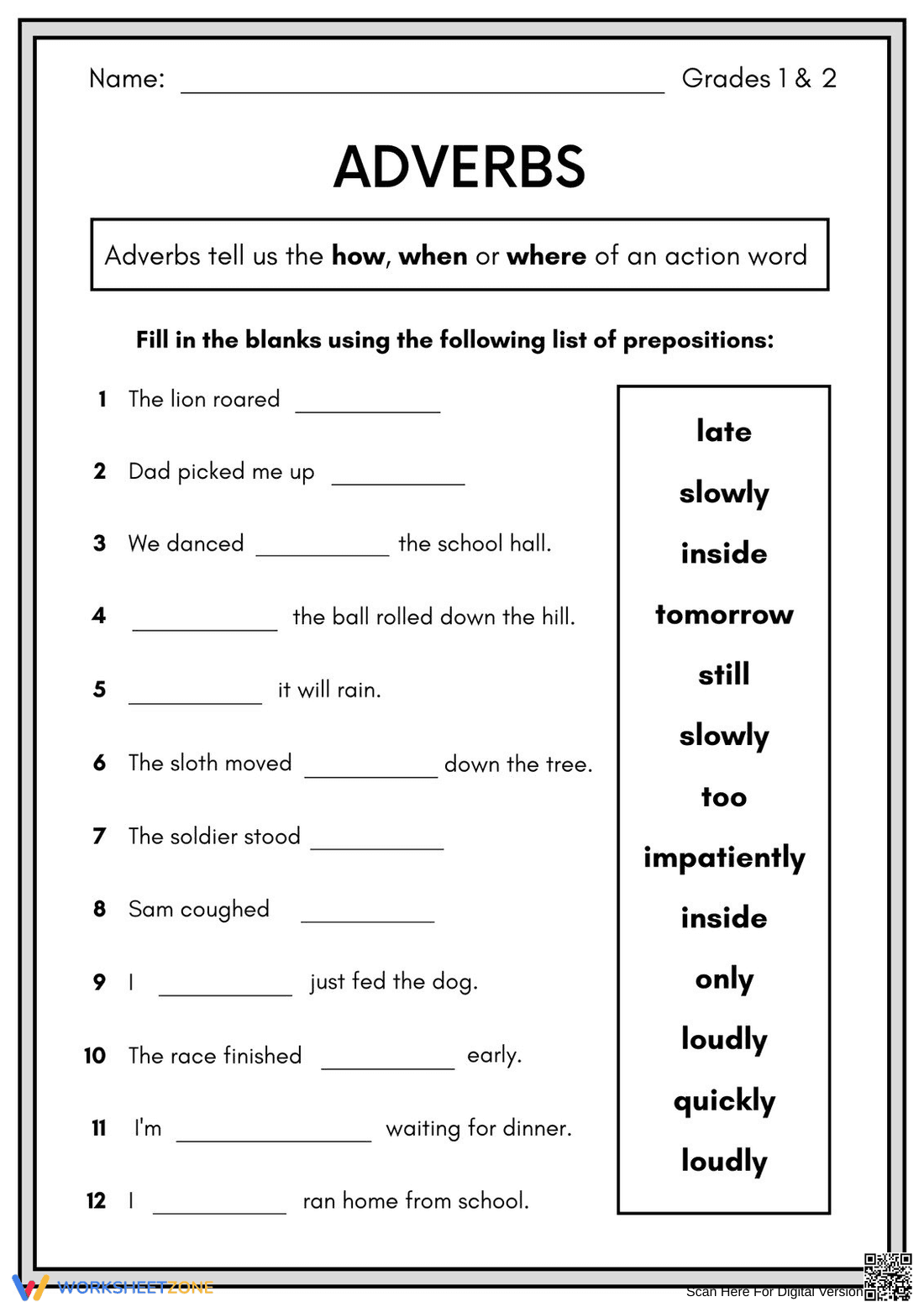

Adverbs Worksheet | Grade 1-2 Essential Practice
Paste this activity's link or code into your existing LMS (Google Classroom, Canvas, Teams, Schoology, Moodle, etc.).
Students can open and work on the activity right away, with no student login required.
You'll still be able to track student progress and results from your teacher account.
This Grade 1-2 adverbs worksheet provides foundational grammar practice by helping young learners identify words that describe how, when, or where an action occurs. By completing 12 targeted sentences, students develop a stronger grasp of sentence structure and descriptive language, ensuring they can modify verbs accurately in their own writing and speech.
At a Glance
At a Glance
- Grade: 1-2 · Subject: ELA
- Standard:
CCSS.ELA-LITERACY.L.2.1.E— Use adjectives and adverbs to modify verbs and nouns correctly- Skill Focus: Adverb identification and usage
- Format: 1 page · 12 problems · Answer key included · PDF
- Best For: Independent practice or quick grammar review
- Time: 15–20 minutes
What's Inside
This single-page PDF features a clear definition of adverbs followed by a word bank containing 12 options. Students must select the most appropriate adverb to complete sentences like "The lion roared ____." The layout is clean and distraction-free, including a dedicated space for student names and grades, making it easy to collect and grade.
Zero-Prep Workflow
Teachers can implement this resource in under two minutes. Simply print the required number of copies (1 minute), distribute them to students for a morning warm-up or bell-ringer (30 seconds), and review the answers as a whole group to provide immediate feedback (5 minutes). It is an ideal "grab-and-go" option for substitute folders.
Standards Alignment
The primary focus is `CCSS.ELA-LITERACY.L.2.1.E`, which requires students to use adjectives and adverbs and choose between them depending on what is to be modified. This worksheet specifically targets the adverbial component of the standard. Both standard codes can be copied directly into lesson plans, IEP goals, or district curriculum mapping tools.
How to Use It
Use this worksheet as a formative assessment after a direct instruction lesson on parts of speech. Observe if students can distinguish between "how" adverbs (slowly) and "when" adverbs (tomorrow). It also works well as a literacy center activity where students work in pairs to justify their word choices. Completion typically takes 15 to 20 minutes.
Who It's For
This resource is designed for first and second-grade students beginning their journey with descriptive grammar. It is also highly effective for English Language Learners (ELL) who need concrete examples of how adverbs function within simple sentence frames. Pair this with a visual anchor chart showing different types of adverbs for maximum impact.
According to the RAND AIRS 2024 report on elementary literacy, structured grammar practice that isolates specific parts of speech is critical for developing syntactic awareness in early readers. This worksheet aligns with those findings by focusing exclusively on adverbs (how, when, where) through 12 contextualized sentence completion tasks. By mapping directly to CCSS.ELA-LITERACY.L.2.1.E, the resource ensures that Grade 1 and 2 students are meeting national benchmarks for language conventions. Research from Fisher & Frey (2014) emphasizes that gradual release models, supported by clear word banks and scaffolded sentence frames, allow students to move from recognition to application more effectively. This printable PDF provides that necessary bridge, offering a high-utility tool for teachers to measure student mastery of verb modification without the burden of extensive preparation or complex instructions. It serves as a reliable instrument for both initial instruction and targeted intervention.


