


























Views
Downloads
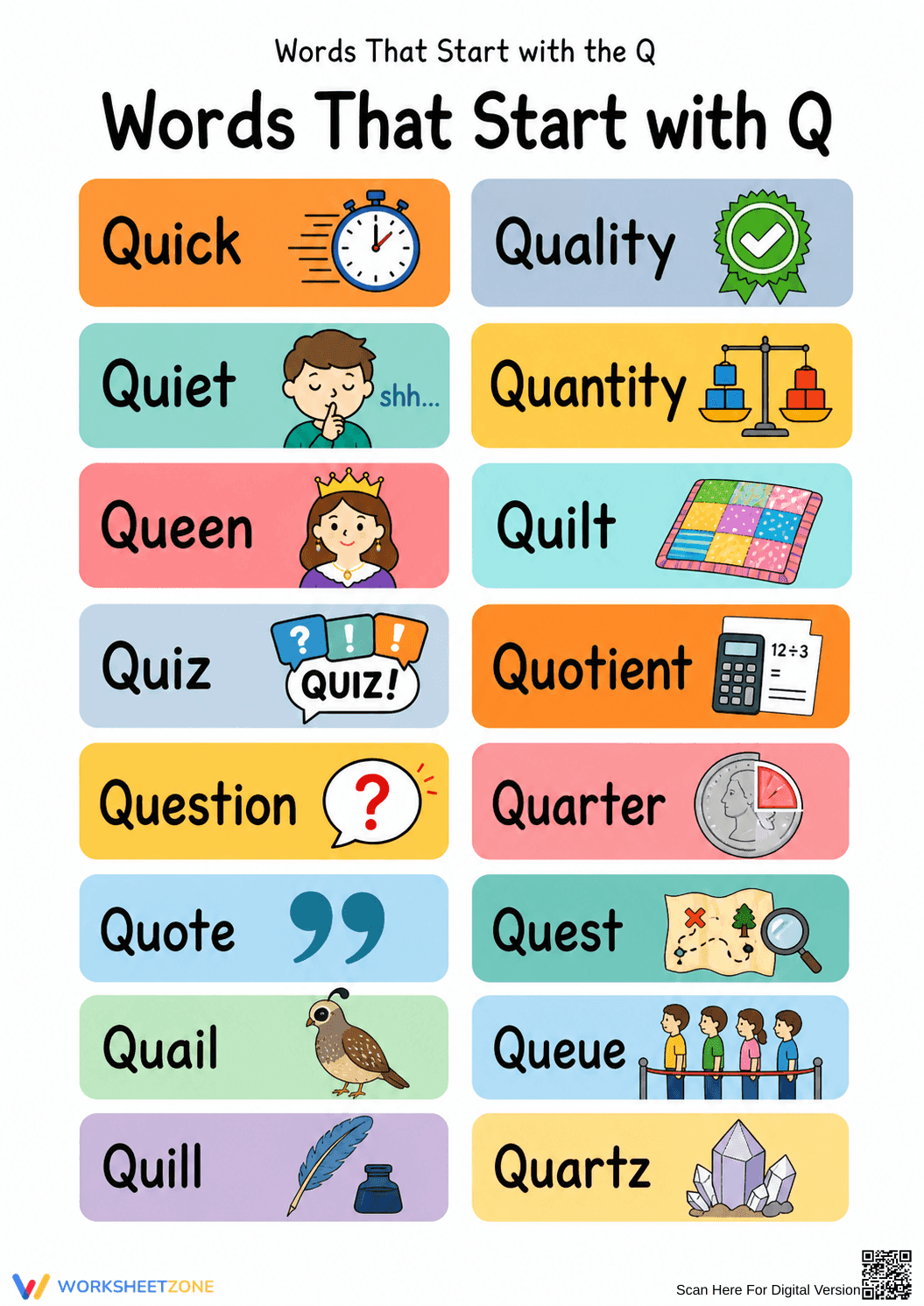

Printable Letter Q Words Worksheet | Grade 1-3 Phonics
Paste this activity's link or code into your existing LMS (Google Classroom, Canvas, Teams, Schoology, Moodle, etc.).
Students can open and work on the activity right away, with no student login required.
You'll still be able to track student progress and results from your teacher account.
This visual vocabulary resource helps early readers master the unique beginning sound of the letter Q. Pairing clear text with engaging illustrations builds phonics skills and expands everyday vocabulary. The structured layout provides immediate visual context, supporting independent reading and writing development.
At a Glance
- Grade: 1–3 · Subject: ELA
- Standard:
CCSS.ELA-LITERACY.RF.1.3— Apply grade-level phonics and word analysis skills.- Skill Focus: Beginning Sounds (Letter Q)
- Format: 1 page · 16 vocabulary words · No answer key needed · PDF
- Best For: Anchor chart or reference
- Time: 5–10 minutes
This single-page printable features 16 carefully selected words beginning with the letter Q, such as "queen," "quiet," and "quotient." Each term is paired with a full-color illustration to support comprehension. The resource functions perfectly as a visual word bank, providing immediate spelling and meaning support for young learners.
Zero-Prep Workflow
- Print (1 min): Download the PDF and print in color, or project it directly onto a smartboard.
- Distribute (1 min): Hand out copies for student writing folders or display prominently at a literacy center.
- Review (3 min): Read the words together, emphasizing the "kw" sound produced by the "qu" spelling pattern.
With under two minutes of total teacher prep time, this resource is highly effective for immediate classroom use or as a reliable addition to emergency sub plans.
Standards Alignment
This resource aligns with CCSS.ELA-LITERACY.RF.1.3: "Know and apply grade-level phonics and word analysis skills in decoding words." It specifically targets the identification and pronunciation of initial consonant sounds and common spelling patterns. A supporting focus on vocabulary acquisition helps students connect spoken words to their written forms. Both standard codes can be copied directly into lesson plans, IEP goals, or district curriculum mapping tools.
How to Use It
Introduce this visual guide before a creative writing assignment to give students a ready-made word bank of Q-words. During independent reading or literacy centers, students can reference the chart to decode unfamiliar words or verify spelling. As a formative assessment tip, observe students during writing tasks to see if they independently apply the "qu" spelling pattern when attempting to write words like "quick" or "quiet." Expected completion time for an introductory review is 5 to 10 minutes.
Who It's For
This resource is primarily designed for first through third-grade students developing foundational phonics and vocabulary skills. It serves as an excellent differentiation tool for English Language Learners (ELLs) and visual learners who benefit from picture-text associations. Pair this chart with a targeted direct instruction lesson on consonant digraphs or a phonics-based reading passage to reinforce the target sound in context.
Mastering specific phoneme-grapheme correspondences, such as the unique beginning sound of the letter Q, is a critical step in early literacy development. According to Fisher & Frey (2014), providing students with clear visual scaffolds and explicit vocabulary instruction significantly improves their ability to decode and comprehend unfamiliar texts. This resource directly supports CCSS.ELA-LITERACY.RF.1.3 by helping students apply grade-level phonics and word analysis skills in a meaningful context. By integrating visual cues with targeted vocabulary, educators can reduce cognitive load and facilitate faster, more accurate word recognition. Consistent exposure to illustrated word banks encourages independent problem-solving during reading and writing tasks, ultimately fostering greater confidence in young learners. Incorporating these evidence-based visual supports ensures that foundational phonics instruction remains accessible, engaging, and highly effective for diverse classroom populations across early elementary grades.


