




























Views
Downloads
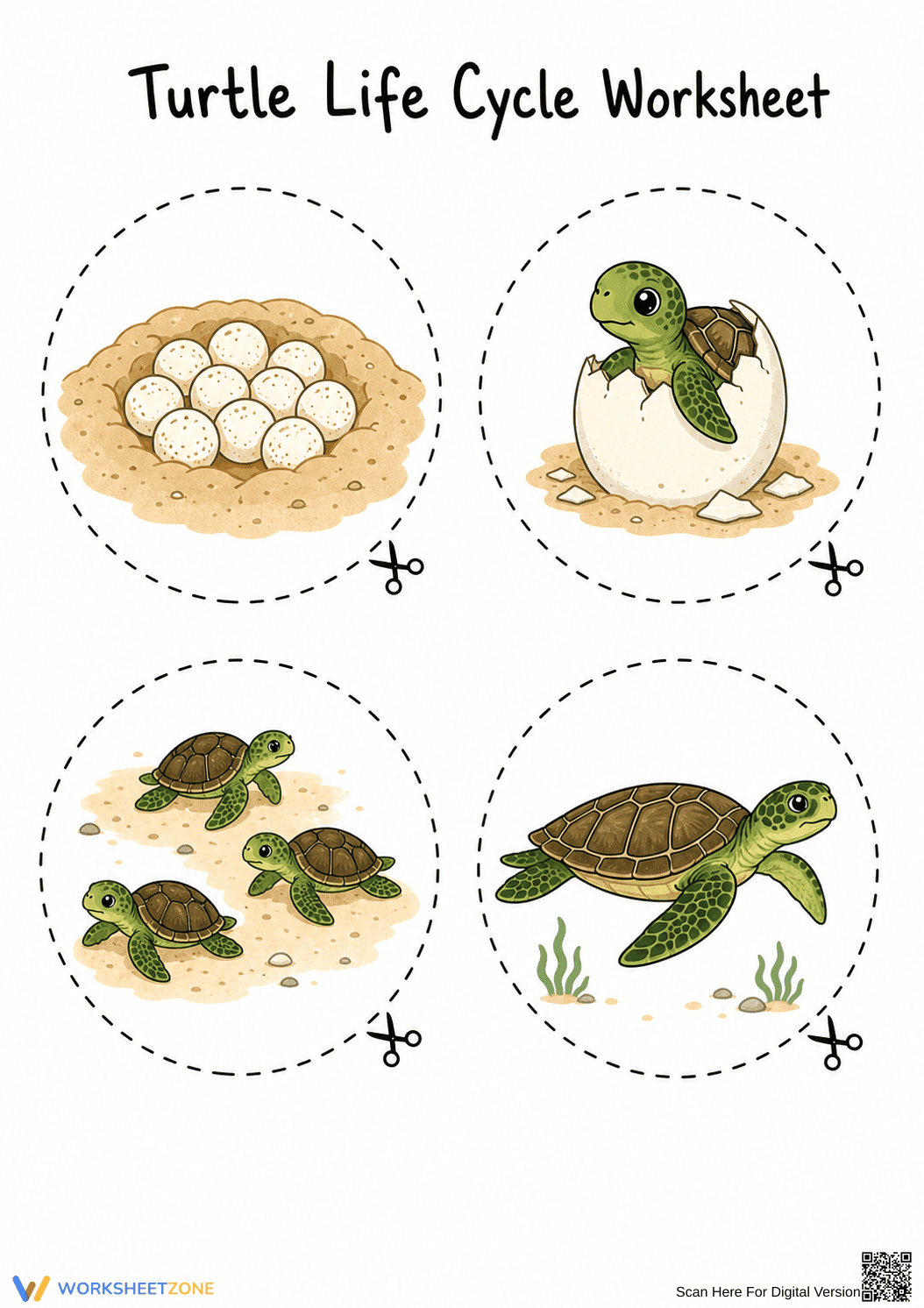

Grade 3 Turtle Life Cycle — Printable No-Prep Worksheet

Paste this activity's link or code into your existing LMS (Google Classroom, Canvas, Teams, Schoology, Moodle, etc.).
Students can open and work on the activity right away, with no student login required.
You'll still be able to track student progress and results from your teacher account.
This printable Grade 3 science worksheet helps students visualize and sequence the turtle life cycle. By cutting and arranging four distinct developmental stages—from eggs in a nest to a fully mature adult—students actively build their understanding of biological growth and reproduction.
At a Glance
- Grade: 3 · Subject: Science
- Standard:
3-LS1-1— Develop models describing unique and diverse organism life cycles- Skill Focus: Life Cycle Sequencing
- Format: 1 page · 4 problems · No answer key · PDF
- Best For: Independent practice
- Time: 15–20 minutes
This single-page resource features four illustrated stages of a sea turtle's life: eggs buried in sand, a hatchling emerging, juvenile turtles, and a fully grown adult. Each illustration is enclosed in a dashed circle with a scissor icon, indicating a cut-and-paste activity. Students color the images, cut them out, and paste them in chronological order on construction paper or in a science journal.
Zero-Prep Workflow
- Print (1 minute): Simply print the single-page PDF for each student. No special materials are required beyond standard classroom scissors and glue.
- Distribute (1 minute): Hand out the worksheets along with blank paper or direct students to open their interactive science notebooks.
- Review (3 minutes): Briefly discuss the four stages shown in the illustrations before letting students work independently. Total teacher prep time is under two minutes, making this an excellent emergency sub plan or quick transition activity.
Standards Alignment
Aligned to 3-LS1-1: "Develop models to describe that organisms have unique and diverse life cycles but all have in common birth, growth, reproduction, and death." This cut-and-paste activity serves as a physical model of the growth process. Supporting standard 3-LS4-3 addresses how organisms survive in their habitats. Both standard codes can be copied directly into lesson plans, IEP goals, or district curriculum mapping tools.
How to Use It
Interactive Notebooks: Have students cut out the four stages and glue them in a circle in their science journals, drawing arrows between each stage to emphasize the continuous nature of a life cycle.
Science Centers: Laminate the cutouts and use them as a reusable sequencing center where students order the cards and verbally explain the progression to a partner. As a formative assessment, observe whether students correctly place the hatching stage immediately after the nest of eggs. Expected completion time is 15 to 20 minutes.
Who It's For
This resource is primarily designed for early elementary and Grade 3 students learning about animal biology and life cycles. The highly visual nature of the worksheet makes it exceptionally well-suited for English Language Learners (ELLs) and students who benefit from hands-on, tactile learning experiences. It pairs perfectly with a read-aloud book about sea turtles or a direct instruction lesson on marine habitats.
Understanding biological progressions through visual sequencing is a fundamental component of early science education. Aligned with the standard 3-LS1-1, this activity requires students to develop models describing unique and diverse organism life cycles. According to Fisher & Frey (2014), incorporating tactile, hands-on tasks like cut-and-paste sequencing significantly improves vocabulary retention and conceptual comprehension in elementary science classrooms. By physically manipulating the four stages of development—from eggs to adulthood—young learners transition from passive observation to active modeling. This kinesthetic approach reinforces the universal biological concepts of birth, growth, reproduction, and maturity in a highly accessible format. Engaging with these visual models ensures that students build a robust framework for understanding natural systems, which ultimately prepares them for more complex ecological and environmental studies in subsequent grade levels.


