


























Views
Downloads
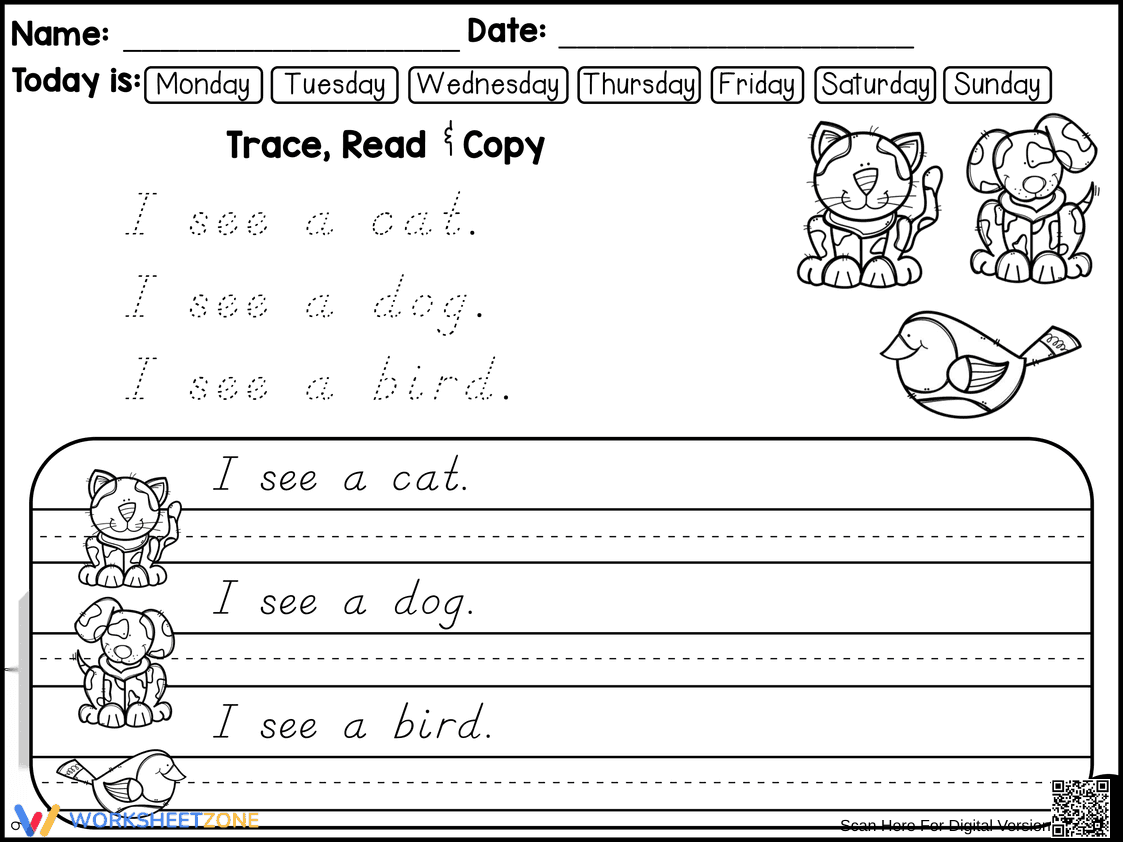

Grade 1 D'Nealian Handwriting — Printable No-Prep Worksheet
Paste this activity's link or code into your existing LMS (Google Classroom, Canvas, Teams, Schoology, Moodle, etc.).
Students can open and work on the activity right away, with no student login required.
You'll still be able to track student progress and results from your teacher account.
This Grade 1 handwriting worksheet provides targeted practice with D'Nealian manuscript by having students trace and copy simple sentences. By focusing on the repetitive "I see a..." sentence structure, early learners build fine motor control, reinforce high-frequency sight words, and develop proper letter formation habits in a single activity.
At a Glance
- Grade: 1 · Subject: ELA
- Standard:
CCSS.ELA-LITERACY.L.1.1.A— Print all upper- and lowercase letters- Skill Focus: D'Nealian handwriting and sentence copying
- Format: 1 page · 6 problems · No answer key · PDF
- Best For: Morning work or literacy centers
- Time: 10–15 minutes
This single-page resource features a structured "Trace, Read & Copy" format. The top half includes three simple sentences written in dotted D'Nealian font for guided tracing. The bottom half provides standard primary writing lines with dashed midlines, accompanied by matching animal illustrations, where students independently copy the sentences. A day-of-the-week selection box adds a quick calendar skills check.
This resource offers a zero-prep workflow:
- Print (1 minute): The black-and-white PDF requires no special formatting.
- Distribute (1 minute): The visual cues make the task immediately obvious to students.
- Review (0 minutes): No formal answer key is needed; teachers can assess neatness at a glance.
Total prep time is under two minutes, making this an excellent option for emergency sub plans.
This worksheet aligns directly with CCSS.ELA-LITERACY.L.1.1.A, which requires students to print all upper- and lowercase letters. By practicing these letters within the context of complete sentences, students also reinforce basic print concepts and spacing. Both standard codes can be copied directly into lesson plans, IEP goals, or district curriculum mapping tools.
Deploy this worksheet as a calming morning work activity as students enter the classroom, allowing them to settle in with a familiar, structured task. Alternatively, use it during literacy centers as an independent station while the teacher conducts guided reading groups. As a formative assessment tip, observe students while they work on the bottom half of the page to ensure they are starting their letters from the top down and correctly utilizing the dashed midline for lowercase letters. Expected completion time is 10 to 15 minutes.
This resource is ideal for first-grade students refining their manuscript skills, specifically those learning the D'Nealian handwriting style. The repetitive sight words provide built-in differentiation for emerging readers who benefit from predictable text. Pair this worksheet with a whole-group anchor chart on proper pencil grip or a direct instruction mini-lesson on spacing between words to maximize its effectiveness.
Developing automaticity in handwriting is a critical foundational skill that directly impacts a student's ability to produce written compositions later in their academic career. According to a comprehensive EdReports 2024 analysis of early literacy curricula, explicit and consistent handwriting practice reduces the cognitive load required for letter formation, freeing up working memory for higher-order tasks like spelling and sentence generation. This worksheet supports that developmental milestone by targeting CCSS.ELA-LITERACY.L.1.1.A, ensuring students can accurately print all upper- and lowercase letters. By combining tracing with independent copying, the activity bridges the gap between guided support and independent execution. The integration of high-frequency sight words further reinforces reading fluency simultaneously. Providing structured, daily opportunities for this type of targeted motor-skill practice is essential for building the physical stamina and muscle memory required for successful, legible writing throughout elementary school.


