


























Views
Plays

Grade 1 Realistic Fiction Comprehension Printable
Paste this activity's link or code into your existing LMS (Google Classroom, Canvas, Teams, Schoology, Moodle, etc.).
Students can open and work on the activity right away, with no student login required.
You'll still be able to track student progress and results from your teacher account.
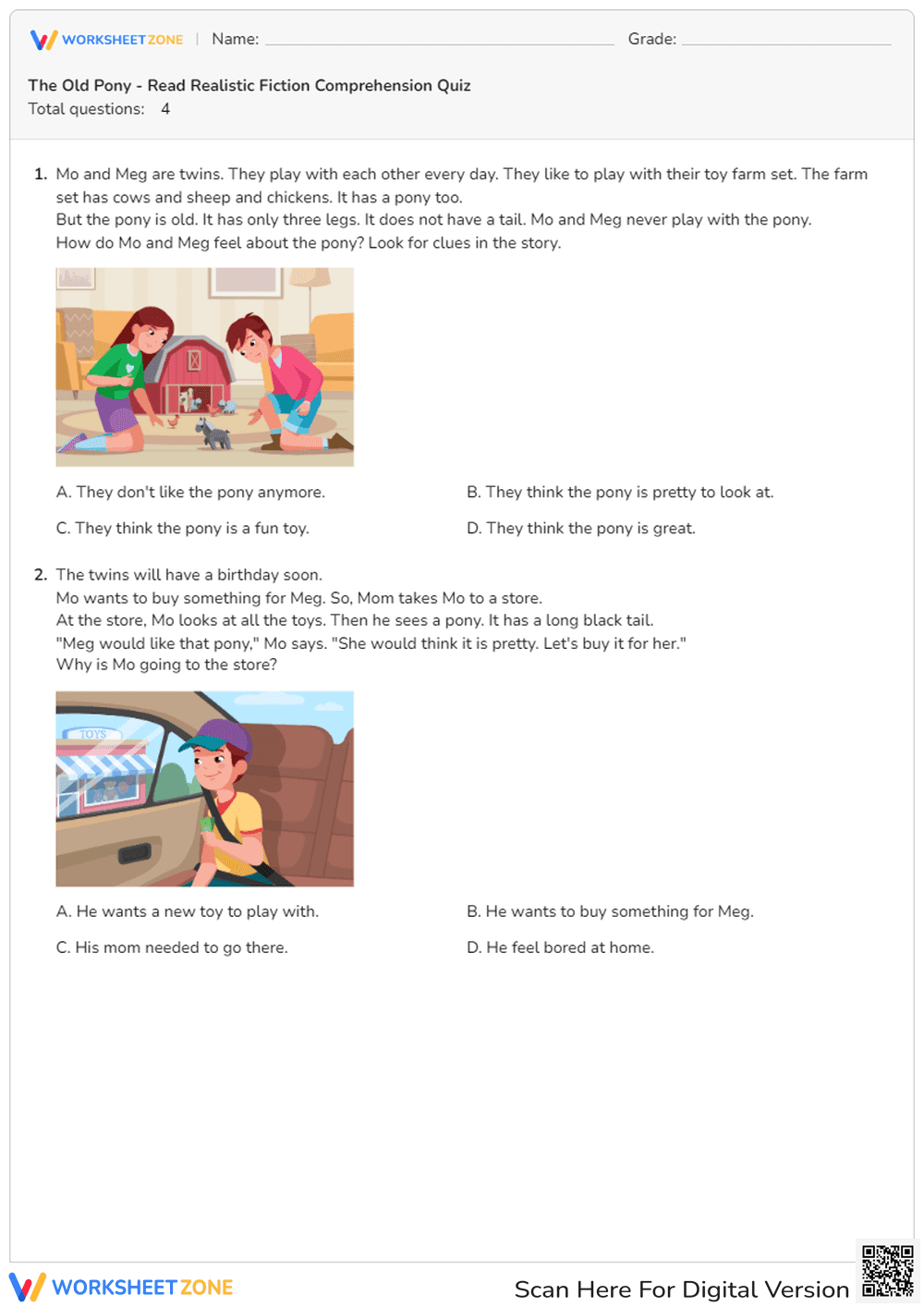
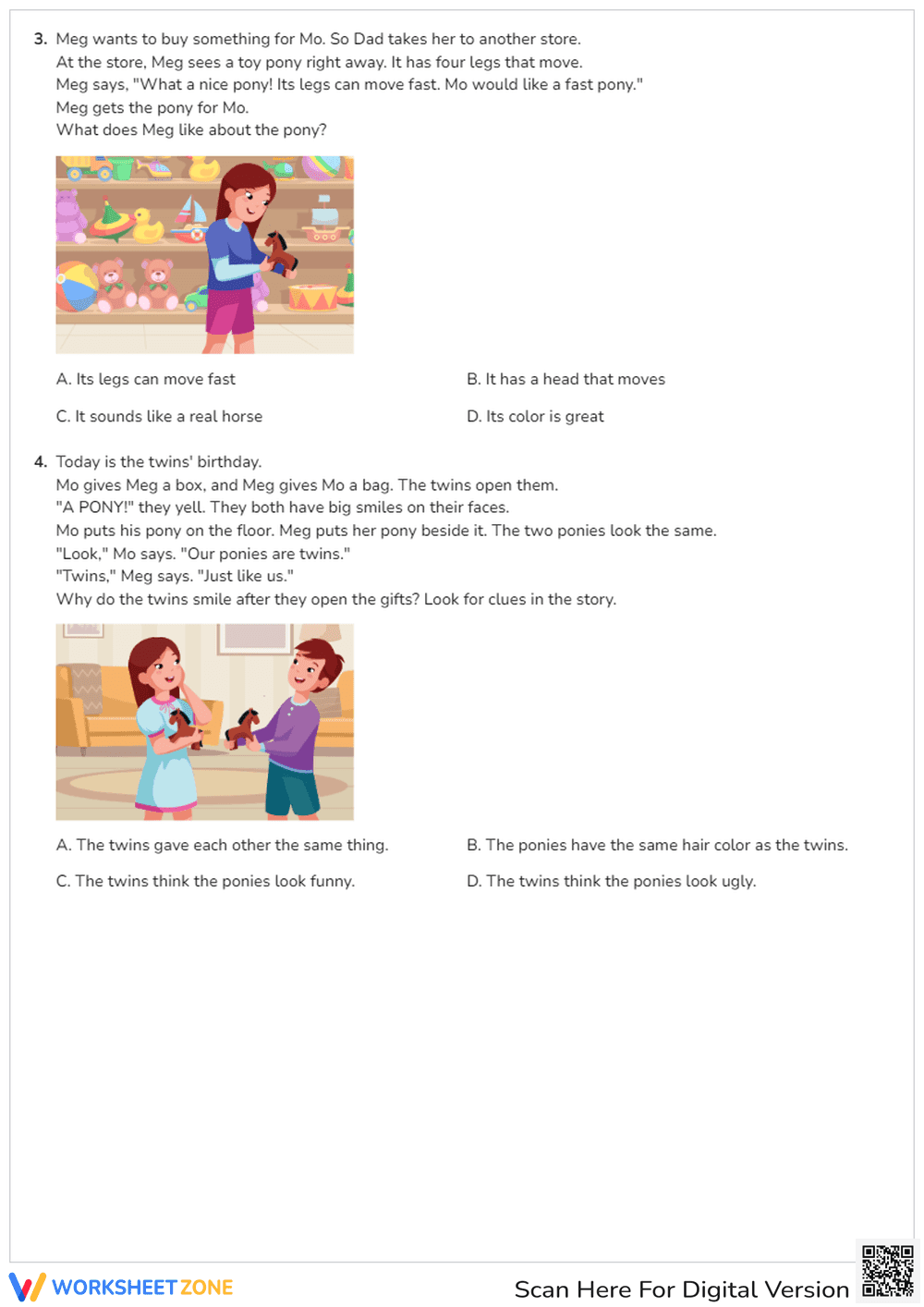
This realistic fiction reading comprehension worksheet helps first-grade students practice identifying key details and using text clues to answer questions. By reading short, engaging passages about a pair of twins and their birthday gifts, young learners build foundational literacy skills and improve their ability to draw basic conclusions from a story.
At a Glance
- Grade: 1 · Subject: ELA
- Standard:
CCSS.ELA-LITERACY.RL.1.1— Ask and answer questions about key details in a text.- Skill Focus: Reading Comprehension
- Format: 2 pages · 4 problems · Answer key included · PDF
- Best For: Independent practice or assessment
- Time: 10–15 minutes
Inside this resource, educators will find a two-page reading quiz featuring a continuous realistic fiction story broken into four manageable sections. Each section is paired with a vibrant illustration and a multiple-choice question that prompts students to look back at the text for clues. The layout is highly visual and accessible for early readers, providing clear sentence structures and relatable scenarios. A complete answer key is included to make grading fast and straightforward.
This worksheet is designed for a smooth, zero-prep classroom experience:
- Print (1 minute): Simply download the PDF and print the two-page assessment. No special formatting or cutting is required.
- Distribute (1 minute): Hand out the quiz to students during your literacy block or reading centers. The instructions are self-explanatory.
- Review (3 minutes): Use the included answer key to quickly check student responses or review the answers together as a whole class.
With a total teacher prep time of under two minutes, this resource is an excellent addition to any emergency sub plan or busy Friday schedule.
This worksheet is tightly aligned to CCSS.ELA-LITERACY.RL.1.1, which requires students to ask and answer questions about key details in a text. It also supports early reading fluency and comprehension by encouraging students to use context clues to understand character motivations. Both standard codes can be copied directly into lesson plans, IEP goals, or district curriculum mapping tools.
Teachers can utilize this resource in several ways. It serves perfectly as a formative assessment after direct instruction on finding text evidence, allowing you to gauge which students are successfully using clues from the story. Alternatively, it can be placed in an independent reading center for quiet practice. While students work, observe whether they are actively looking back at the text or simply guessing the multiple-choice options. Expected completion time is between 10 and 15 minutes.
This worksheet is ideal for first-grade students who are transitioning from emergent reading to more independent comprehension tasks. The visual supports and short text chunks provide built-in scaffolding for students reading slightly below grade level, while still challenging on-level readers to synthesize information. It pairs wonderfully with an anchor chart on finding clues in the text or a whole-group read-aloud focused on realistic fiction.
Developing early literacy skills requires consistent opportunities for students to interact with meaningful texts. According to a RAND AIRS 2024 report, providing young readers with structured, text-dependent questions significantly improves their ability to process and retain information. This worksheet directly supports that research by aligning with CCSS.ELA-LITERACY.RL.1.1, prompting students to ask and answer questions about key details in a text. By breaking a realistic fiction story into manageable segments and pairing each with a targeted multiple-choice question, the resource reduces cognitive overload while maximizing comprehension practice. Students learn to rely on text evidence rather than background knowledge alone, a critical step in their reading development. This targeted approach ensures that foundational reading skills are reinforced effectively, giving educators a reliable tool for both instruction and assessment in the early elementary classroom.


