


























Views
Downloads

Printable Oak Tree Life Cycle Worksheet | Grade 3 Science
Paste this activity's link or code into your existing LMS (Google Classroom, Canvas, Teams, Schoology, Moodle, etc.).
Students can open and work on the activity right away, with no student login required.
You'll still be able to track student progress and results from your teacher account.
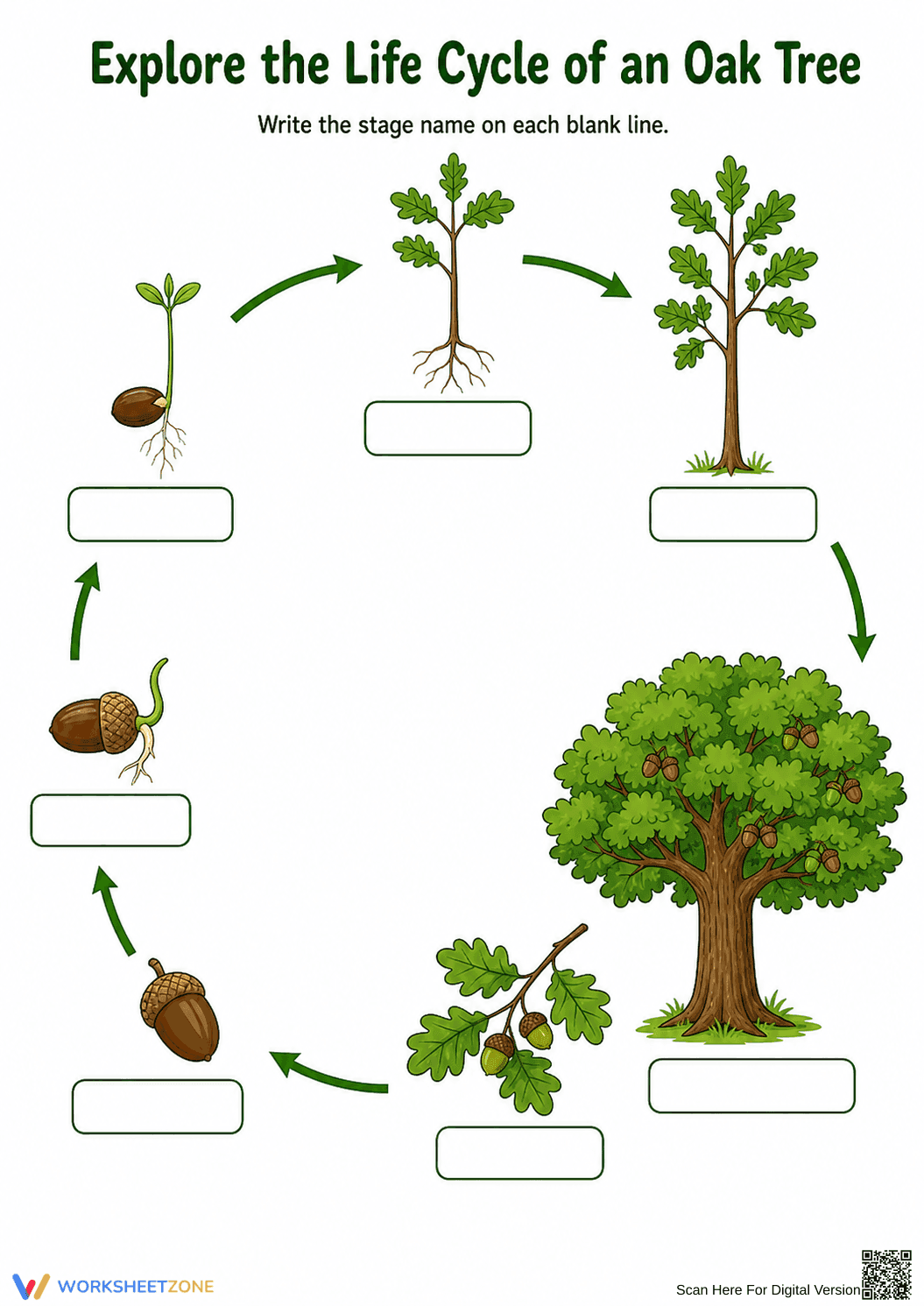
This Grade 3 science worksheet helps students visualize and sequence the developmental stages of an oak tree. By labeling a clear, circular diagram, learners identify key phases from acorn germination to mature tree reproduction. This focused activity reinforces foundational biology concepts regarding plant growth and life cycles.
At a Glance
- Grade: 3 · Subject: Science
- Standard:
3-LS1-1— Develop models describing diverse life cycles.- Skill Focus: Sequencing plant life cycle stages
- Format: 1 page · 7 problems · Answer key included · PDF
- Best For: Independent practice or science centers
- Time: 10–15 minutes
This single-page resource features a full-color illustration of an oak tree's life cycle. Students fill in seven blank text boxes corresponding to distinct developmental stages, from acorn to mature tree. Clear directional arrows guide students through the biological progression, making the visual model easy to interpret. An answer key is provided for accurate grading.
This resource requires minimal teacher preparation:
- Print (1 minute): The single-page PDF format is optimized for quick printing or digital distribution.
- Distribute (1 minute): Hand out the diagram during a science block or place it in a designated center folder.
- Review (3 minutes): Use the included answer key to quickly verify student responses or project it for whole-class self-correction.
With under two minutes of total setup time, this worksheet serves as an excellent emergency sub plan or a reliable independent task while the teacher works with small groups.
This activity aligns directly with Next Generation Science Standard 3-LS1-1: Develop models to describe that organisms have unique and diverse life cycles but all have in common birth, growth, reproduction, and death. By completing the diagram, students actively engage with a model demonstrating these universal biological phases within a specific plant species. Both standard codes can be copied directly into lesson plans, IEP goals, or district curriculum mapping tools.
Deploy this worksheet during the core instructional phase of a life cycles unit. After direct instruction on seed germination, students complete the diagram to solidify their understanding. Alternatively, use it as a formative assessment. While students work, observe whether they correctly identify the transition from seedling to sapling, providing targeted intervention if reversed. Expected completion time is 10 to 15 minutes.
Designed for third-grade students, this resource is highly adaptable for visual learners and English Language Learners who benefit from pictorial support. The clear imagery reduces cognitive load, allowing students to focus purely on the scientific sequence. It pairs exceptionally well with hands-on seed planting activities or introductory reading passages.
Effective science instruction relies heavily on visual models to communicate complex biological processes to young learners. According to a ScienceDirect TpT Analysis, integrating clear, sequential diagrams significantly improves student retention of cyclical concepts compared to text-only instruction. This worksheet directly supports standard 3-LS1-1 by requiring students to develop models describing diverse life cycles. When learners actively label the stages of an oak tree, they transition from passive observers to active participants in scientific modeling. This hands-on interaction with visual data strengthens their cognitive mapping of birth, growth, reproduction, and death. By providing a structured, visually appealing format with explicit directional cues, educators can ensure that foundational life science principles are firmly established. This targeted practice not only builds immediate vocabulary but also prepares students for more advanced ecological studies and systems thinking in subsequent grade levels.


