


























Views
Downloads
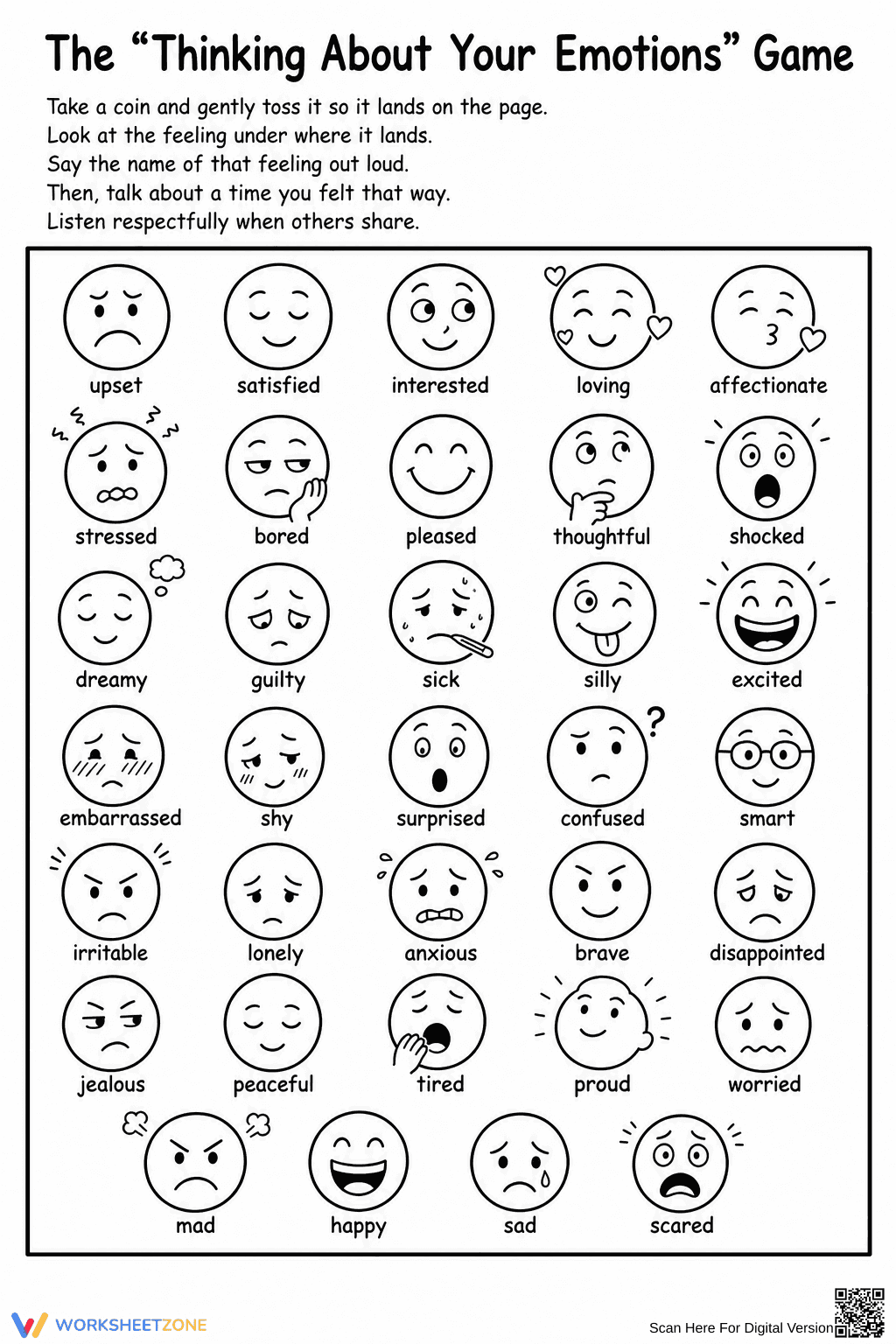

Grade 12 Emotional Awareness — Printable No-Prep Worksheet
Paste this activity's link or code into your existing LMS (Google Classroom, Canvas, Teams, Schoology, Moodle, etc.).
Students can open and work on the activity right away, with no student login required.
You'll still be able to track student progress and results from your teacher account.
This Grade 12 emotional awareness worksheet gives students a structured way to identify and articulate feelings. By playing a simple coin-toss game, learners recognize 34 emotions, share personal experiences, and develop active listening skills essential for collaborative discussions.
At a Glance
- Grade: 12 · Subject: English
- Standard:
CCSS.ELA-LITERACY.SL.11-12.1— Participate effectively in collaborative discussions and express ideas clearly.- Skill Focus: Emotional Awareness
- Format: 1 page · 34 problems · No answer key · PDF
- Best For: Social-emotional learning and group therapy
- Time: 15–30 minutes
This single-page resource features a grid of 34 expressive faces, labeled with emotions ranging from "happy" to "affectionate" and "thoughtful." The worksheet includes self-explanatory instructions for a coin-toss game prompting students to identify the landed emotion, verbalize it, and share a relevant anecdote. Because it relies on personal reflection, no answer key is required.
Designed for immediate classroom implementation, this activity requires virtually no teacher setup:
- Print (1 minute): Generate copies for small groups. The black-and-white design prints cleanly and quickly.
- Distribute (1 minute): Hand out sheets and a coin or small token for each group.
- Review (1 minute): Read the four instruction lines aloud to establish rules for respectful listening.
With under three minutes of total prep time, this worksheet serves as an excellent warm-up or reliable emergency sub plan.
This activity aligns with CCSS.ELA-LITERACY.SL.11-12.1: "Initiate and participate effectively in a range of collaborative discussions with diverse partners, building on others' ideas and expressing their own clearly." It supports social-emotional learning by requiring empathy and active listening. Both standard codes can be copied directly into lesson plans, IEP goals, or district curriculum mapping tools.
Teachers can utilize this game during advisory periods to build classroom community before core instruction. It functions beautifully as an icebreaker where students share in small groups. As a formative assessment tip, educators can observe groups to evaluate active listening and articulation of personal experiences. The activity typically takes 15 to 30 minutes to complete.
This resource is ideal for high school seniors and adults working on social skills or communication goals. It differentiates naturally by allowing participants to share at their comfort level, making it accessible for diverse learners. It pairs perfectly with direct instruction on emotional intelligence or interpersonal communication.
Developing a robust emotional vocabulary is a critical component of mature communication and collaborative success. This worksheet targets CCSS.ELA-LITERACY.SL.11-12.1, helping students participate effectively in collaborative discussions and express ideas clearly. According to Fisher & Frey (2014), structured peer-to-peer dialogue frameworks significantly improve students' ability to articulate complex thoughts and engage in empathetic listening. By gamifying the identification of 34 distinct emotional states, this resource lowers the affective filter, encouraging reluctant communicators to share personal narratives in a low-stakes, supportive environment. The physical act of tossing a token combined with the visual cues of the expressive faces provides a highly effective multimodal approach to social-emotional learning. This method not only reinforces vocabulary acquisition but also builds the essential interpersonal competencies required for post-secondary academic and professional environments, ensuring learners can navigate complex social dynamics with confidence.


