


























Views
Downloads


Teen Number Train Worksheet | Grade K-1 Printable
Paste this activity's link or code into your existing LMS (Google Classroom, Canvas, Teams, Schoology, Moodle, etc.).
Students can open and work on the activity right away, with no student login required.
You'll still be able to track student progress and results from your teacher account.
Help students master the tricky teen sequence with this hands-on math activity. Students trace, cut, and paste numbers 11 through 19 into the correct train cars, building both numerical fluency and fine motor coordination. This resource ensures young learners can confidently identify and order numbers beyond the first ten.
At a Glance
- Grade: Kindergarten · Subject: Math
- Standard:
K.CC.A.2— Count forward beginning from a given number within the known sequence- Skill Focus: Teen number identification and ordering
- Format: 2 pages · 9 problems · Answer key included · PDF
- Best For: Independent math centers and morning work
- Time: 15–20 minutes
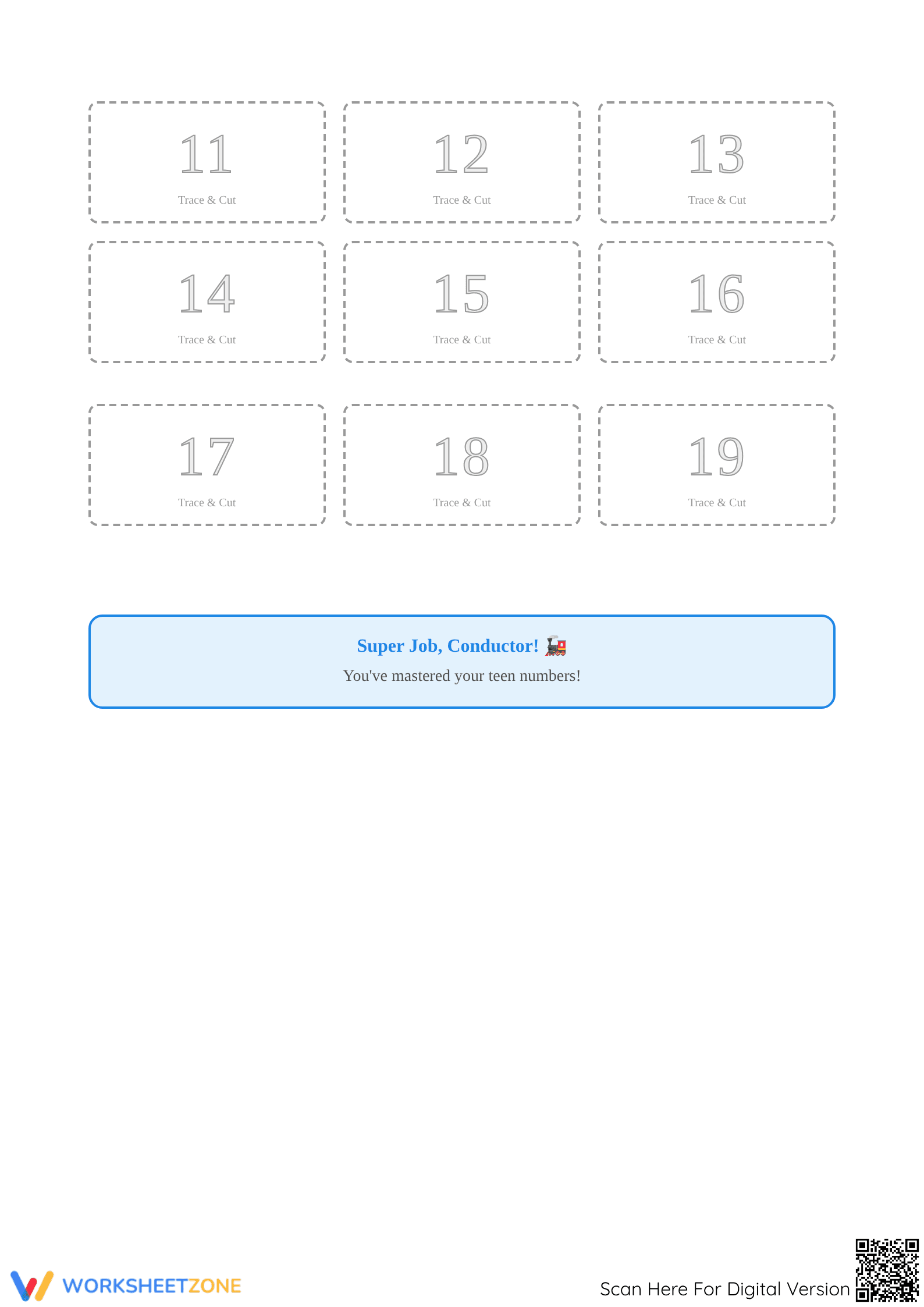
This two-page resource features a colorful train engine leading nine empty cars, each waiting for its corresponding passenger. The second page provides nine dotted-font number squares (11-19) for tracing. Once students finish tracing, they cut out the squares and paste them onto the train in chronological order.
Implementing this activity requires minimal effort from the educator. First, print the two pages (30 seconds). Second, distribute to students along with scissors, glue, and a pencil (1 minute). Third, facilitate a quick peer-review session or use the included answer key for immediate feedback (30 seconds). The entire setup takes under two minutes.
This resource is aligned to K.CC.A.2: Count forward beginning from a given number within the known sequence (instead of having to begin at 1). It also supports K.NBT.A.1 by reinforcing the structure of numbers 11-19 as ten ones and some further ones. Both standard codes can be copied directly into lesson plans, IEP goals, or district curriculum mapping tools.
Use this worksheet as a formative assessment during a unit on counting to 20. Observe students as they paste the numbers to see if they recognize the sequence or if they rely on counting from one. It also serves as an excellent fast-finisher task for students who complete their primary lesson early and need purposeful practice.
Designed for Kindergarten and Grade 1 students, this worksheet is ideal for learners who are moving beyond basic counting. The tracing component provides necessary scaffolding for those still developing their writing skills. Pair this activity with a teen number anchor chart or a counting song to provide a multi-sensory learning experience.
Research from the RAND AIRS 2024 study emphasizes that tactile activities, such as cut-and-paste exercises, significantly improve retention of abstract numerical concepts in early childhood. By engaging multiple senses, students create stronger neural connections between the visual symbol of a number and its place in a sequence. This worksheet focuses on the critical transition from single digits to the base-ten system. Specifically, the K.CC.A.2 alignment ensures that students understand the relative position of teen numbers. These middle numbers are often the most difficult for Kindergarteners to master due to their irregular names. Providing a structured, visual framework like a train helps alleviate this cognitive load. This evidence-based approach to number sense development is essential for preparing students for more complex operations in first grade and beyond.


