





























Paste this activity's link or code into your existing LMS (Google Classroom, Canvas, Teams, Schoology, Moodle, etc.).
Students can open and work on the activity right away, with no student login required.
You'll still be able to track student progress and results from your teacher account.


Talking Turkey: Complete Figurative Language and Idioms

Paste this activity's link or code into your existing LMS (Google Classroom, Canvas, Teams, Schoology, Moodle, etc.).
Students can open and work on the activity right away, with no student login required.
You'll still be able to track student progress and results from your teacher account.
This Grade 5 figurative language worksheet builds student mastery in distinguishing similes, metaphors, and personification while interpreting common idioms. Through 14 scaffolded tasks, learners analyze Thanksgiving-themed phrases, match everyday expressions to literal definitions, and craft original figurative sentences to demonstrate authentic comprehension of nonliteral language.
At a Glance
- Grade: 5 · Subject: English Language Arts
- Standard:
L.5.5.b— Recognize and explain the meaning of common idioms, adages, and proverbs- Skill Focus: Distinguishing figurative language types and explaining idioms
- Format: 2 pages · 14 problems · Answer key included · PDF
- Best For: Mid-unit figurative language review and reinforcement
- Time: 20–30 minutes
What's Inside
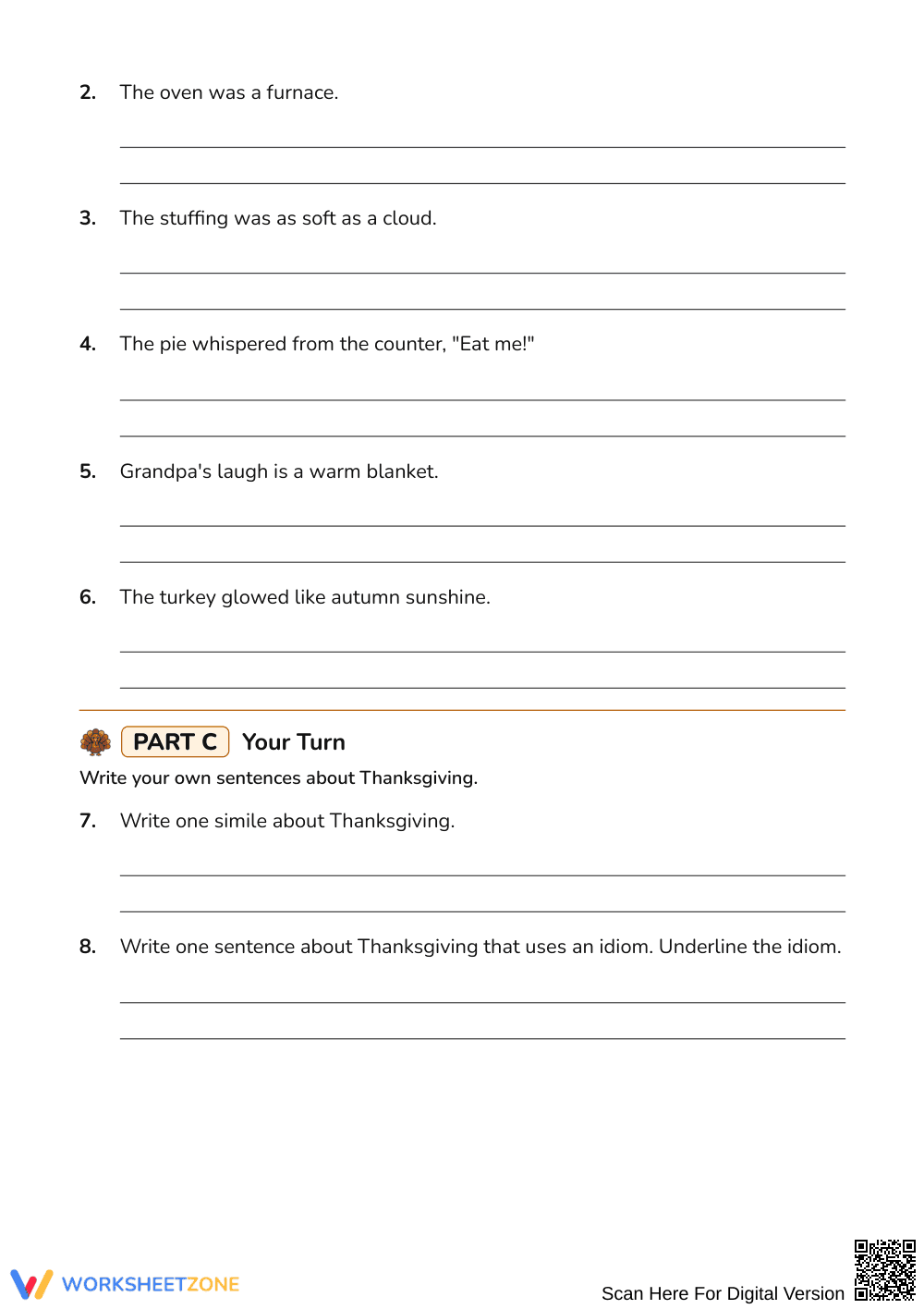
The 2-page worksheet opens with a reference box defining similes, metaphors, personification, and idioms with mentor examples. Part A presents 6 idiom matching items. Part B contains 6 classification items where students identify figurative devices and write brief explanations. Part C provides 2 generative writing prompts requiring students to write original similes and idiom sentences, supported by a complete 2-page answer key.
Skill Progression
- Guided Practice (Part A, 6 problems): Students consult the reference box to match figurative idioms to exact definitions, building contextual recognition.
- Supported Practice (Part B, 6 problems): Learners evaluate sentences, classify each as a simile, metaphor, or personification, and defend answers with written explanations.
- Independent Practice (Part C, 2 problems): Students apply knowledge autonomously by generating original Thanksgiving sentences with similes and idioms.
This sequence reflects gradual release of responsibility, guiding learners from modeled recognition to independent creative execution.
Standards Alignment
This resource aligns with `L.5.5.b`: Recognize and explain the meaning of common idioms, adages, and proverbs. Additionally, the practice supports `L.5.5.a` by challenging students to interpret similes and metaphors in context. Both standard codes can be copied directly into lesson plans, IEP goals, or district curriculum mapping tools.
How to Use It
Deploy this worksheet after direct instruction on nonliteral language devices. During guided reading or small-group rotations, have students complete Part A before discussing Part B reasoning in pairs; observe whether students rely on indicator words like "like" or "as" when defending similes versus metaphors. Expected completion time is 20 to 30 minutes.
Who It's For
This activity serves general education fifth-grade classrooms, English language learners acquiring conversational idioms, and special education students requiring structured reference charts. Differentiate by highlighting keywords in Part B for striving readers or pairing the sheet with a mentor text passage showcasing descriptive seasonal narratives.
According to Fisher & Frey (2014), intentional figurative language instruction that scaffolds learning from guided device identification to purposeful independent sentence construction significantly enhances metacognitive reading comprehension and semantic precision. This comprehensive Grade 5 ELA worksheet aligns with standard L.5.5.b by engaging students across 14 systematic tasks designed to recognize and explain the meaning of common idioms, adages, similes, and metaphors. By pairing an anchored reference box with explicit rationale prompts and creative writing tasks, the learning progression guides elementary students from basic recognition to deep interpretive ownership. Educational research highlights that systematic gradual release methods reinforce durable schema development, allowing intermediate readers to deconstruct complex nonliteral nuances, decipher unfamiliar figures of speech across informational and literary grade-level texts, and expand their overall expressive vocabulary development through contextualized daily classroom language practice in authentic learning environments.


