




























Views
Downloads
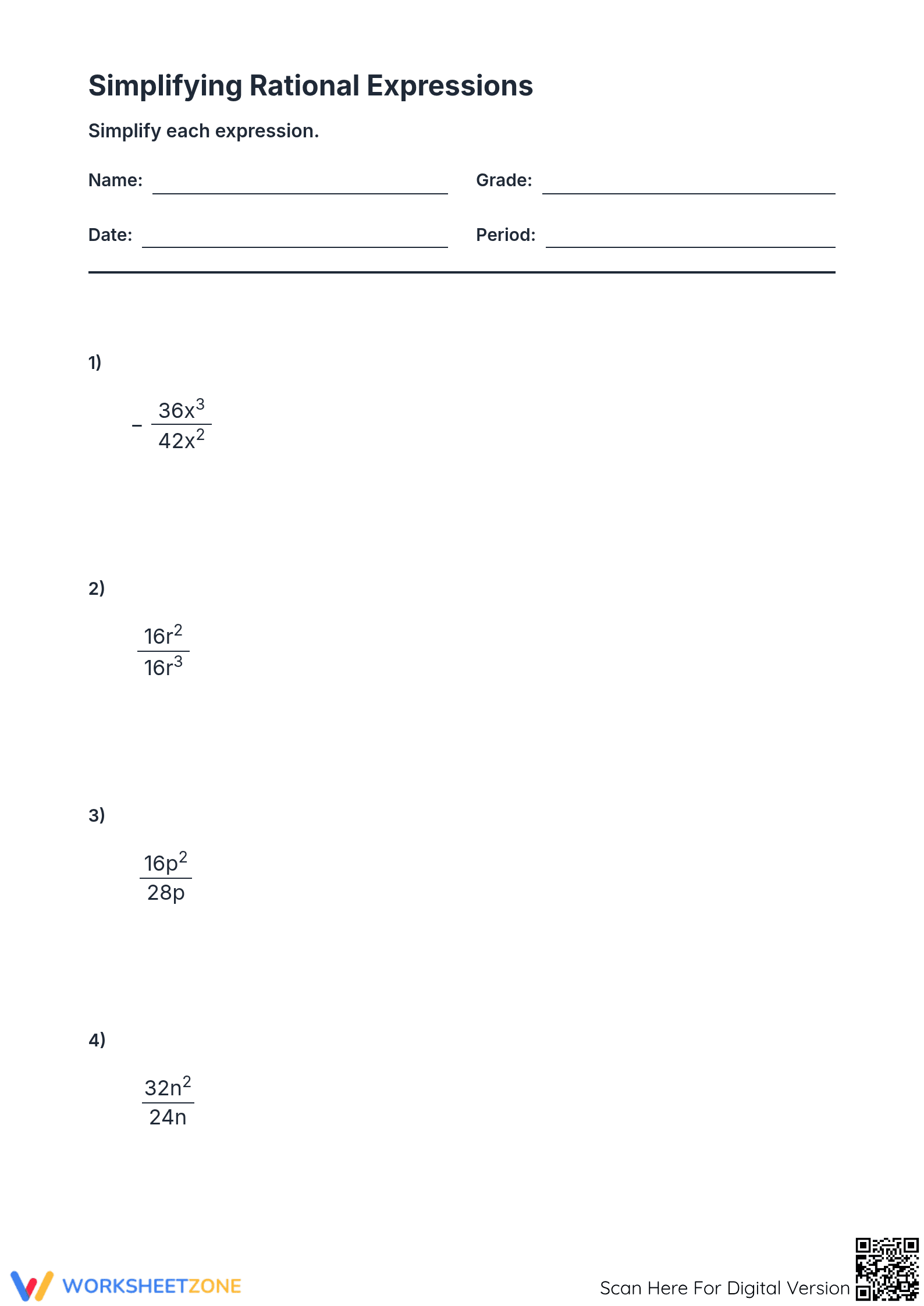
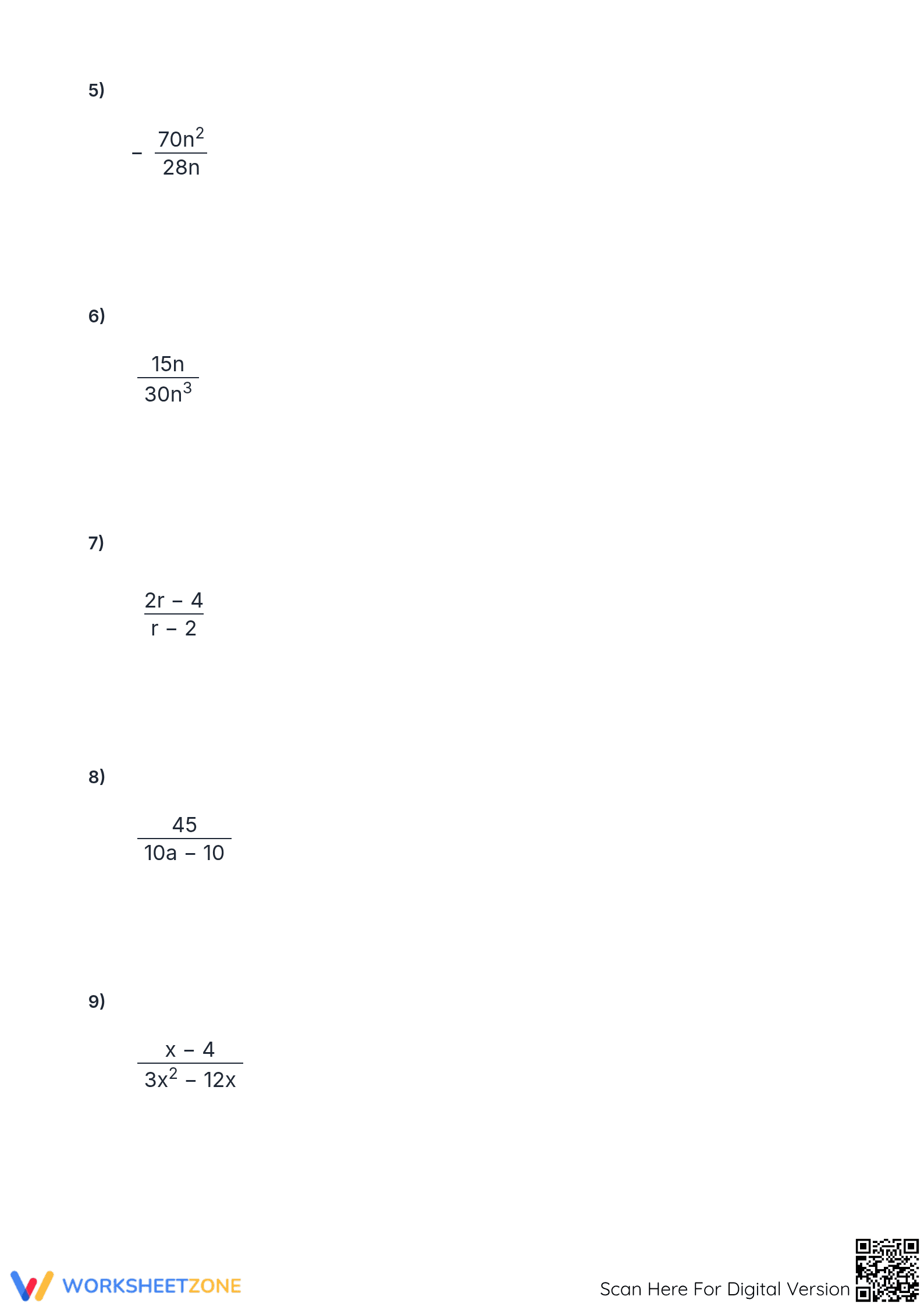

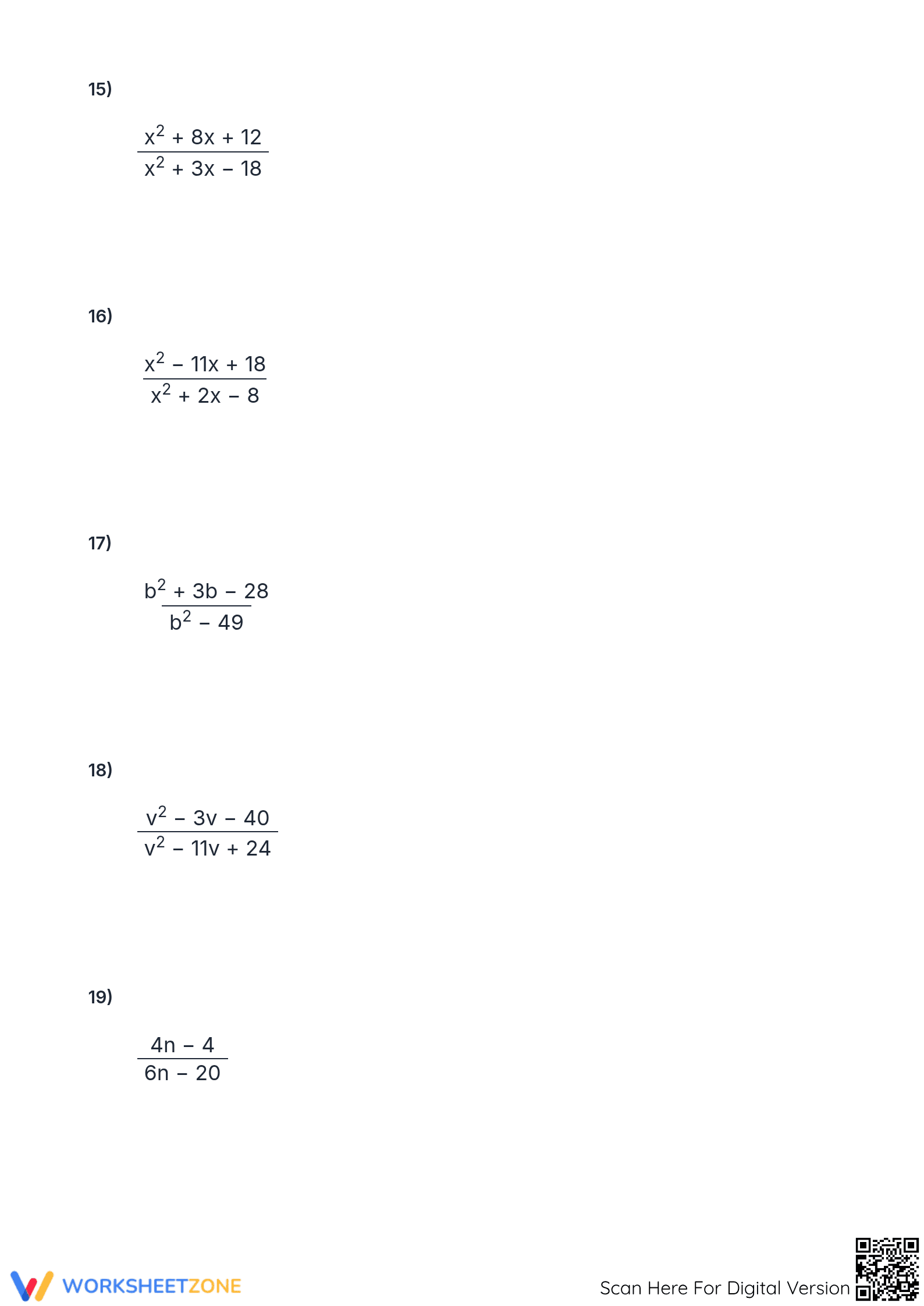


Printable Simplifying Rational Expressions Worksheet: Grades 9-10

Paste this activity's link or code into your existing LMS (Google Classroom, Canvas, Teams, Schoology, Moodle, etc.).
Students can open and work on the activity right away, with no student login required.
You'll still be able to track student progress and results from your teacher account.
Mastering rational expressions requires a strong foundation in factoring and algebraic division. This comprehensive worksheet provides students with targeted practice to simplify complex fractions by identifying and canceling common factors. By working through these exercises, learners develop the fluency needed for advanced calculus and higher-level mathematics applications in real-world scenarios.
At a Glance
- Grade: 9–10 · Subject: Algebra
- Standard:
HSA-APR.D.6— Rewrite simple rational expressions in different forms using factoring and division techniques- Skill Focus: Simplifying Rational Expressions
- Format: 5 pages · 24 problems · Answer key included · PDF
- Best For: High school algebra students mastering factoring
- Time: 45–60 minutes
Inside this five-page PDF, you will find 24 carefully sequenced problems that transition from basic monomial division to complex trinomial factoring. Each page provides ample white space for student work, ensuring clear steps are visible for teacher review. A full answer key is provided on the concluding pages, allowing for immediate feedback or self-grading in a classroom setting.
The worksheet follows a logical skill progression to scaffold learning:
- Guided Practice (Problems 1-8): Focused on monomials and basic GCF factoring with 8 entry-level tasks to build procedural confidence.
- Supported Practice (Problems 9-16): Includes rational expressions involving trinomials and difference of squares factoring applications.
- Independent Practice (Problems 17-24): High-complexity problems requiring GCF extraction before trinomial decomposition can occur.
Aligned primarily to `HSA-APR.D.6`, this resource requires students to rewrite simple rational expressions into reduced forms. It also supports `HSA-SSE.A.2` by demanding the use of the structure of an expression to identify ways to rewrite it. Both standard codes can be copied directly into lesson plans, IEP goals, or district curriculum mapping tools.
Use this worksheet during the independent practice phase of a lesson on rational functions. It serves as an excellent formative assessment tool; observe if students are correctly factoring trinomials before attempting to cancel terms. Expect students to spend approximately 2 minutes per problem, making this a perfect full-period activity or a multi-day homework assignment.
This resource is ideal for Grade 9-10 algebra students, including those in Honors or accelerated tracks. It provides necessary rigor for college-readiness while offering clear scaffolding for students who may need a refresher on factoring polynomials. Naturally pair this with a factoring anchor chart to reinforce the underlying algebraic properties during instruction.
Algebraic fluency through structured practice is essential for secondary math. According to the ScienceDirect TpT Analysis (2024), mastery of standard HSA-APR.D.6 improves when materials provide procedurally aligned tasks moving from low to high cognitive demand. Simplifying rational expressions requires students to view complex expressions as units manipulated through factoring. This worksheet provides 24 opportunities to apply the property of identity and division. Educators use the answer key to identify factoring misconceptions or sign management errors, common hurdles in this domain. Integrating these exercises ensures students achieve prerequisite skills for Pre-Calculus. The 24 problems represent a comprehensive set of challenges that mirror high-stakes assessment formats, ensuring students are prepared for standardized testing environments and rigorous college-level coursework in STEM fields.


