




























Views
Downloads
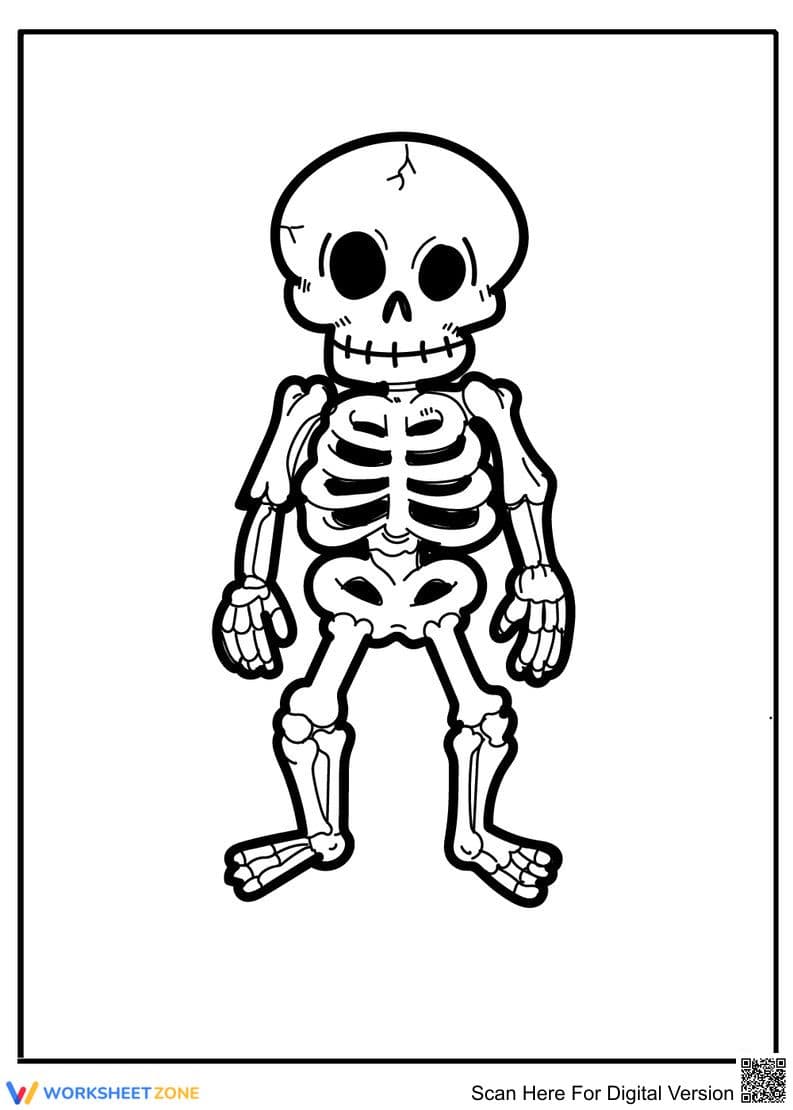

Simple Skeleton Coloring Page | Essential Grade K-5 Art

Paste this activity's link or code into your existing LMS (Google Classroom, Canvas, Teams, Schoology, Moodle, etc.).
Students can open and work on the activity right away, with no student login required.
You'll still be able to track student progress and results from your teacher account.
This simple skeleton coloring page provides a friendly, approachable way for students to explore human anatomy while developing essential fine motor control. By engaging with the clear, bold outlines of the skeletal structure, learners can visualize the framework of the human body in a stress-free, creative environment that supports early biological understanding.
At a Glance
At a Glance
- Grade: K-5 · Subject: Science & Art
- Standard:
K-LS1-1— Use observations to describe patterns of what plants and animals need to survive- Skill Focus: Fine motor skills & skeletal identification
- Format: 1 page · 1 task · No answer key · PDF
- Best For: Early finishers and science centers
- Time: 15–20 minutes
What's Inside
Inside this resource, you will find one high-quality, printable PDF page featuring a stylized, friendly skeleton. The design uses thick, clean lines to assist younger students who are still mastering spatial awareness and pencil control. There are no complex backgrounds, ensuring the focus remains entirely on the central anatomical figure for maximum clarity.
Zero-Prep Workflow
The zero-prep workflow for this worksheet is designed for maximum efficiency. First, print the single-page PDF (30 seconds). Second, distribute the sheets along with crayons or colored pencils to your students (1 minute). Third, facilitate a brief discussion about the bones shown as students work (ongoing). Total teacher preparation time is under 2 minutes, making it an ideal sub plan addition.
Standards Alignment
This activity aligns with `K-LS1-1` by allowing students to observe and represent the internal structures of a living organism. While primarily an art activity, it serves as a foundational visual aid for discussing how the skeletal system supports the body's needs. This standard code can be copied directly into lesson plans, IEP goals, or district curriculum mapping tools.
How to Use It
Use this worksheet as a quiet-time activity following a lesson on the human body or as a thematic resource during October. It works effectively as a formative assessment tool; observe how students handle the coloring tool to gauge fine motor maturity. Expect students to spend between 15 and 20 minutes completing the page depending on their age.
Who It's For
This resource is designed for preschool through elementary students, particularly those who benefit from high-contrast visual aids. It pairs naturally with a classroom skeleton model or an introductory picture book about the human body. It is also suitable for occupational therapy sessions focusing on grip and stroke precision during creative tasks.
Research from Fisher & Frey (2014) emphasizes the importance of visual representations in helping students internalize complex biological concepts. By providing a simplified, non-threatening version of the skeletal system, this worksheet reduces cognitive load and allows for better engagement with the subject matter. The use of coloring as a medium supports the development of the small muscle groups in the hand, which is a critical precursor to fluent handwriting. According to the NAEP, early exposure to scientific diagrams, even in simplified coloring formats, builds the visual literacy necessary for higher-level STEM success. This K-LS1-1 aligned resource bridges the gap between creative play and academic observation, ensuring that students develop a positive association with anatomical study. It is a versatile tool that fits into various instructional blocks without requiring extensive teacher intervention or specialized materials.


