


























Views
Downloads


Printable Short O Vowel Sounds Worksheet | Grade 1-2
Paste this activity's link or code into your existing LMS (Google Classroom, Canvas, Teams, Schoology, Moodle, etc.).
Students can open and work on the activity right away, with no student login required.
You'll still be able to track student progress and results from your teacher account.
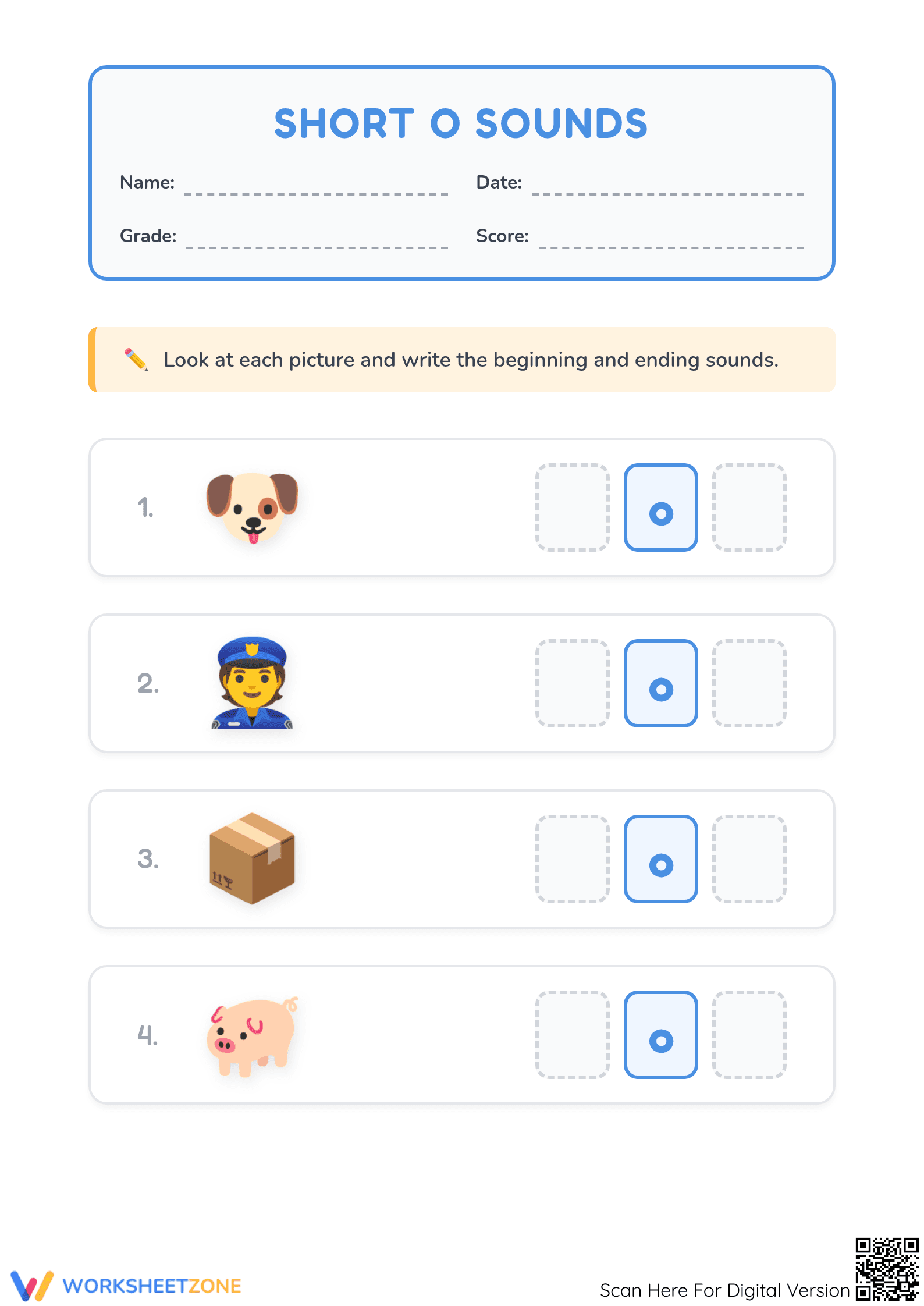
This Grade 1 and Grade 2 phonics worksheet helps students master the short 'o' vowel sound through targeted CVC word construction. By identifying beginning and ending consonant sounds for visual prompts, learners strengthen their phonemic awareness and spelling accuracy. This essential resource ensures students can isolate and pronounce every sound within a single-syllable word.
At a Glance
- Grade: 1-2 · Subject: English Language Arts
- Standard:
CCSS.ELA-LITERACY.RF.1.2.C— Isolate and pronounce initial, medial vowel, and final sounds in words- Skill Focus: Short 'o' CVC word completion
- Format: 2 pages · 10 problems · Answer key included · PDF
- Best For: Independent phonics practice and morning work
- Time: 10–15 minutes
What's Inside
This 2-page PDF features 10 distinct exercises centered on the short 'o' sound. Each problem provides a high-quality visual illustration—such as a dog, box, or fox—alongside a three-box letter frame. The medial 'o' is pre-filled, requiring students to supply the missing onset and rime. A comprehensive answer key is included to facilitate quick grading or student self-correction.
Skill Progression
- Guided practice: The first few items use highly familiar imagery like "dog" and "cop" to build student confidence with 1:1 letter-sound correspondence.
- Supported practice: Middle problems introduce slightly more complex visual cues, requiring students to segment sounds without additional word banks or hints.
- Independent practice: The final page challenges students to complete the remaining 6 items entirely on their own to demonstrate mastery of the short 'o' phoneme.
This sequence follows a gradual-release model to ensure learners move from recognition to independent production.
Standards Alignment
The primary focus is `CCSS.ELA-LITERACY.RF.1.2.C`, which requires students to isolate and pronounce initial, medial vowel, and final sounds in spoken single-syllable words. By writing the missing consonants, students demonstrate their ability to segment phonemes within a CVC structure. Both standard codes can be copied directly into lesson plans, IEP goals, or district curriculum mapping tools.
How to Use It
Use this worksheet as a formative assessment after a direct instruction lesson on short vowels. Observe if students struggle more with the initial or final consonant to identify specific phonemic gaps. Alternatively, assign it as a "no-prep" morning work activity to reinforce spelling patterns. Completion typically takes 10 to 15 minutes depending on student proficiency.
Who It's For
This resource is designed for first and second-grade students developing foundational literacy skills. It is particularly effective for English Language Learners (ELLs) who benefit from visual-to-word associations. Pair this worksheet with a short 'o' anchor chart or a decodable reader to provide a comprehensive literacy experience.
Phonemic awareness is a critical predictor of long-term reading success, as highlighted in the NAEP framework and recent literacy research. This worksheet targets CCSS.ELA-LITERACY.RF.1.2.C by requiring students to segment and encode the initial and final sounds of short 'o' CVC words. According to Fisher & Frey (2014), providing students with visual scaffolds alongside phonics tasks supports the development of the orthographic mapping process, where students link sounds to written symbols. By focusing on the medial sound, this activity reinforces the stability of vowel sounds while challenging students to manipulate the surrounding consonants. The 10-task format provides sufficient repetition to move the skill toward automaticity without causing cognitive fatigue. Educators can utilize the included answer key to provide immediate feedback, a practice proven to accelerate learning gains in early elementary settings. This resource serves as a reliable tool for both general education and intervention groups.


