


























Views
Downloads
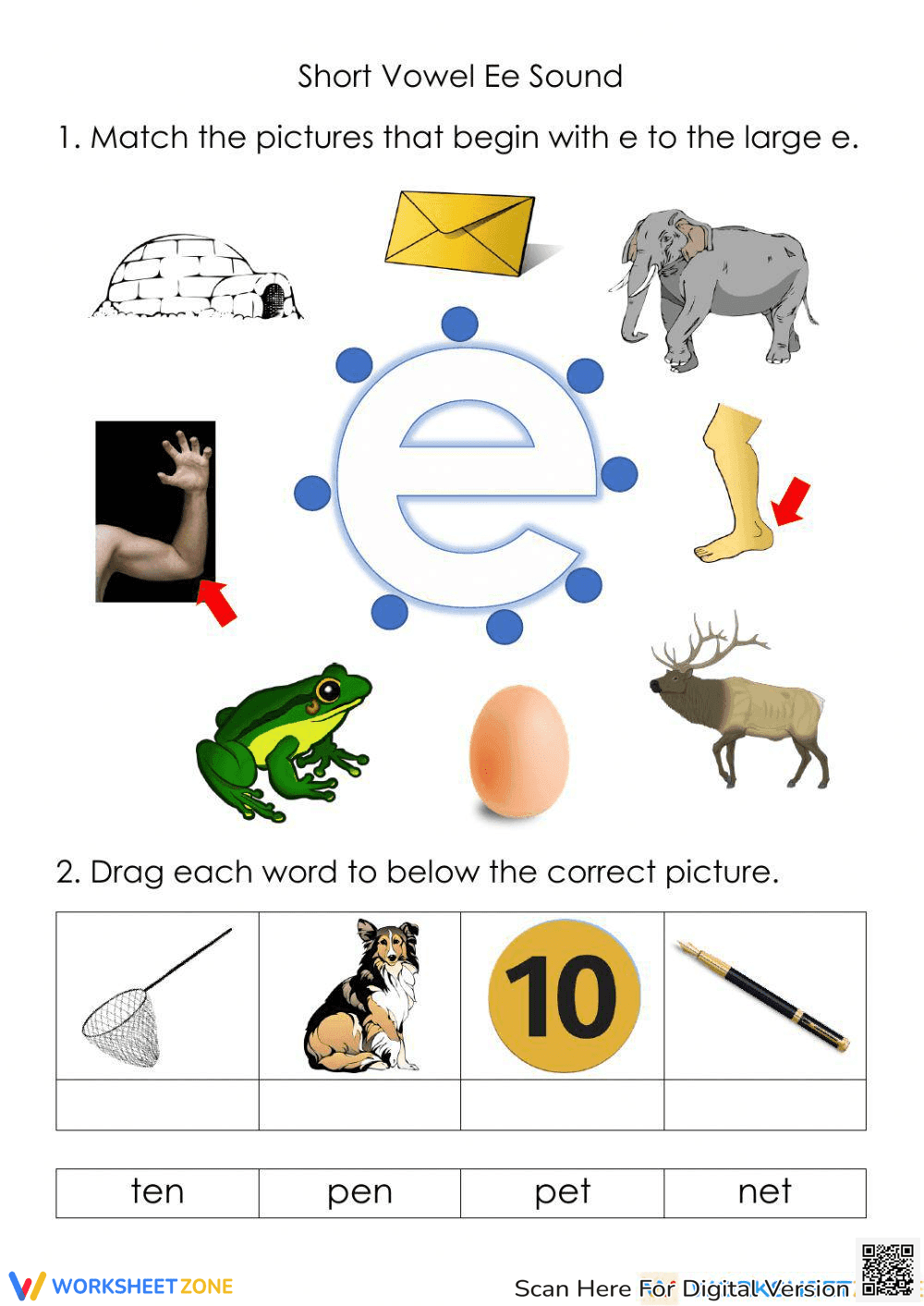

Printable Short Vowel Ee Phonics Worksheet | Grade 2-3
Paste this activity's link or code into your existing LMS (Google Classroom, Canvas, Teams, Schoology, Moodle, etc.).
Students can open and work on the activity right away, with no student login required.
You'll still be able to track student progress and results from your teacher account.
Strengthen foundational literacy skills with this focused short vowel Ee practice sheet. By engaging with initial and medial vowel sounds through matching and word association, learners develop the phonetic awareness necessary for fluent reading. This resource provides an effective way to reinforce vowel recognition in any Grade 2 or 3 curriculum.
At a Glance
- Grade: 2–3 · Subject: English Language Arts
- Standard:
CCSS.ELA-LITERACY.RF.2.3.A— Distinguish long and short vowels when reading regularly spelled one-syllable words- Skill Focus: Short Vowel Ee Recognition
- Format: 1 page · 12 problems · Answer key included · PDF
- Best For: Independent phonics practice and literacy centers
- Time: 10–15 minutes
What's Inside
This phonics resource features two activity sections. The first task requires students to match five pictures starting with the short "e" sound to a central anchor letter. The second task focuses on medial vowel sounds, challenging learners to label four CVC words by matching them to their corresponding illustrations. The clear layout supports independent student work.
Zero-Prep Workflow
The zero-prep design ensures a smooth transition to practice. Step one: Print the single-page PDF. Step two: Distribute the sheets during your phonics block or as quick morning work. Step three: Review the matching tasks to provide immediate feedback. This streamlined workflow takes under two minutes of teacher time, making it ideal for substitute folders or spontaneous reinforcement.
Standards Alignment
Aligned with CCSS.ELA-LITERACY.RF.2.3.A, this worksheet helps students distinguish short vowel sounds in one-syllable words. By isolating the short "e" sound in initial and medial positions, it supports decoding skills essential for elementary reading benchmarks. This standard code can be copied directly into lesson plans, IEP goals, or district curriculum mapping tools.
How to Use It
Use this as a formative assessment after a lesson on short vowels. Observe how students differentiate between initial "e" sounds and distractors to gauge phonemic sensitivity. Alternatively, place it in a literacy center for independent practice. Expected completion time is 12 minutes, making it a perfect "exit ticket" to verify understanding before moving to complex patterns.
Who It's For
Designed for Grade 2 and 3 students needing reinforcement or English Language Learners building vocabulary, this resource pairs naturally with a short-vowel passage or CVC anchor chart. The visual tasks provide support for learners developing reading confidence while maintaining high engagement. It is a versatile tool for any phonics-focused classroom environment.
According to RAND AIRS 2024, explicit phonics instruction combining visual cues with word association is a major predictor of reading success. This worksheet applies that research by focusing on the short vowel Ee, a critical part of the CCSS.ELA-LITERACY.RF.2.3.A standard. By engaging students in 12 targeted tasks, the resource builds the orthographic mapping capabilities described by Fisher & Frey (2014) as essential for transitioning from decoding to fluent reading. The inclusion of both initial sounds and medial CVC patterns ensures that students are actively applying phonetic rules rather than just memorizing word lists. This evidence-based approach provides teachers with a reliable tool for classroom instruction that meets the rigorous demands of modern literacy frameworks. It ensures every learner has a structured path toward mastering foundational English sounds, creating a bridge between simple letter recognition and complex sentence-level comprehension.


