


























Views
Downloads


Short and Long Vowel Review | Essential Grade 1 Phonics
Paste this activity's link or code into your existing LMS (Google Classroom, Canvas, Teams, Schoology, Moodle, etc.).
Students can open and work on the activity right away, with no student login required.
You'll still be able to track student progress and results from your teacher account.
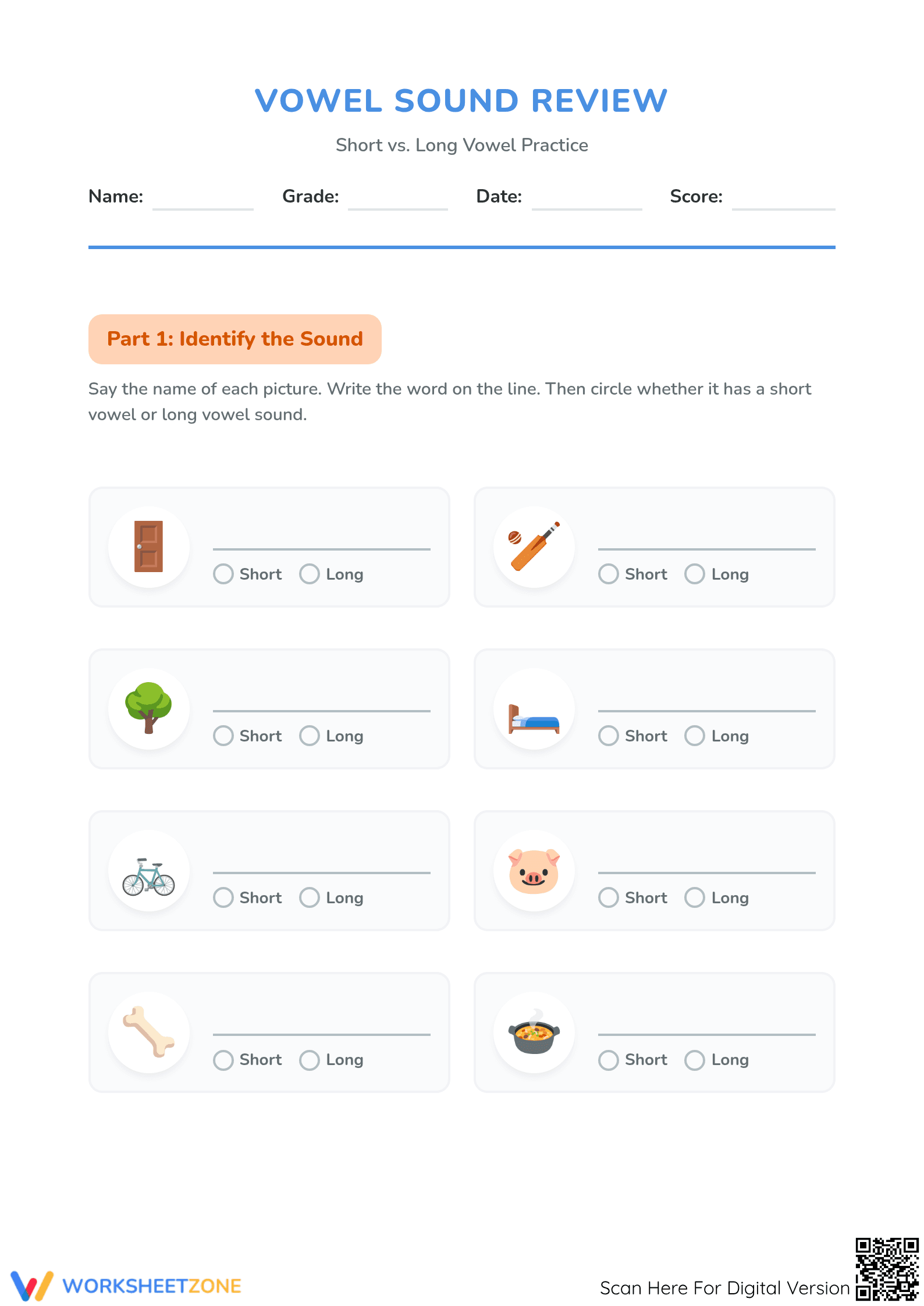
This Grade 1 phonics worksheet provides students with 23 structured tasks to master the distinction between long and short vowel sounds. By identifying, writing, and sorting words based on their auditory patterns, learners build the foundational decoding skills necessary for reading fluency. It is a comprehensive tool for early literacy development.
At a Glance
- Grade: 1 · Subject: ELA Phonics
- Standard:
CCSS.ELA-LITERACY.RF.1.2.A— Distinguish long from short vowel sounds in spoken single-syllable words- Skill Focus: Vowel Sound Discrimination
- Format: 2 pages · 23 problems · Answer key included · PDF
- Best For: Independent practice or phonics centers
- Time: 15–20 minutes
The two-page PDF features ten visual prompts where students must name the object, write the word, and circle the correct vowel type. It follows with a categorization table for sorting those ten words into "Short Vowels" and "Long Vowels" columns. Finally, a bonus section provides three sentences for identifying long vowel sounds in context. A complete answer key is provided.
This resource is designed for immediate classroom implementation with a total teacher prep time of under 2 minutes. Simply print the two pages and distribute them to students. The clear, icon-supported instructions allow for independent completion, making it an ideal choice for morning work, literacy rotations, or emergency sub plans.
The primary focus is `CCSS.ELA-LITERACY.RF.1.2.A`, which requires students to distinguish long from short vowel sounds in spoken single-syllable words. It also supports RF.1.3.C by helping students recognize common vowel team conventions. Both standard codes can be copied directly into lesson plans, IEP goals, or district curriculum mapping tools.
Use this worksheet during the "You Do" phase of a gradual release lesson after introducing vowel pairs. It serves as an excellent formative assessment; observe if students struggle more with the auditory identification or the spelling of the words. Expected completion time is 15 to 20 minutes depending on writing speed.
This resource is tailored for first-grade students but serves as a valuable intervention for second graders needing phonics reinforcement. It pairs naturally with an anchor chart displaying vowel sound examples or a direct instruction lesson on "silent e" and "vowel teams."
According to the RAND AIRS 2024 report, systematic phonics instruction that includes explicit practice in phonemic awareness and sound-spelling correspondences is critical for early reading success. This worksheet aligns with these findings by requiring students to isolate and categorize vowel sounds (CCSS.ELA-LITERACY.RF.1.2.A) through multiple modalities, including visual recognition and written sorting. Research from Fisher & Frey (2014) emphasizes that such structured practice helps bridge the gap between phonemic awareness and orthographic mapping. By engaging with 23 distinct tasks, students reinforce their ability to decode single-syllable words, a foundational skill that predicts long-term literacy outcomes. This resource provides the high-frequency repetition necessary for mastery while offering a clear evidence base for progress monitoring in primary classrooms.


