What Energy Pyramid Worksheets Ask Students to Do
Energy pyramid worksheets give middle school students a structured way to see something they can't observe directly: how energy moves and shrinks as it travels up an ecosystem. Instead of only reading a paragraph about food chains, students label trophic levels, shade the widening base, and run the numbers that show why a hawk needs so much grass beneath it. For grades 6-8, that mix of visual and calculation is exactly what makes the concept stick.
A strong worksheet set moves students from identification to reasoning. Early tasks ask them to name producers, primary consumers, and secondary consumers. Later tasks hand them raw energy values in kilocalories and ask them to predict what actually reaches the top. When you plan an ecosystems unit, these worksheets become the bridge between vocabulary and the modeling work your standards expect students to produce, and they give you tangible evidence to keep in a portfolio.
The 10 Percent Rule at the Heart of the Model
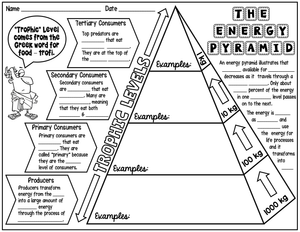
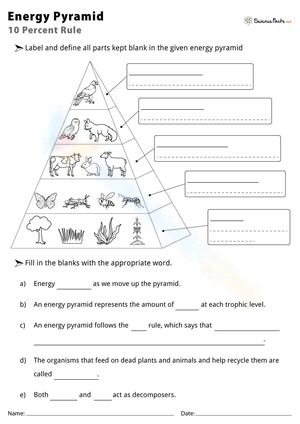
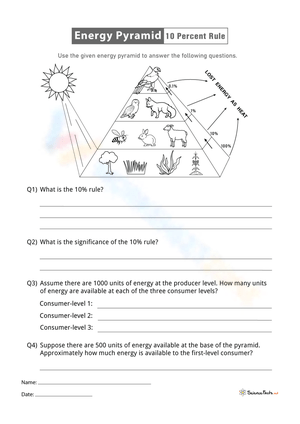
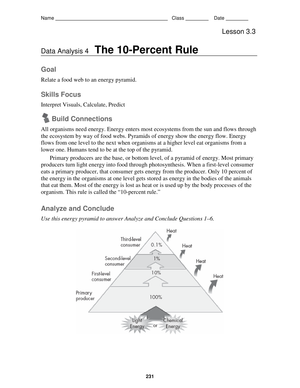
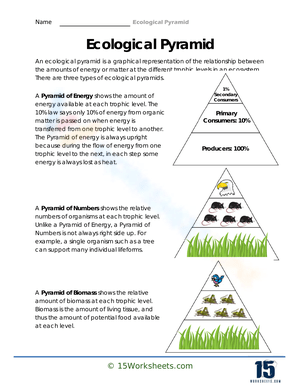
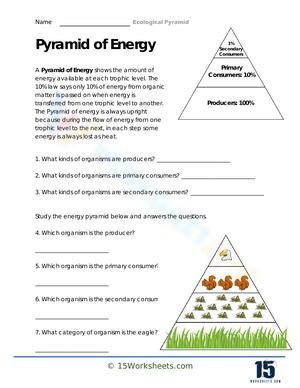
The single idea that organizes every energy pyramid is the 10 percent rule. On average, only about 10 percent of the energy stored at one trophic level is passed on to the next. The other roughly 90 percent is spent on movement, growth, and reproduction, or lost as heat. Worksheets that make students calculate that drop-off do more for proportional reasoning than any lecture can.
Here's the detail that trips up even strong students: the 10 percent rule is the reason pyramids rarely stack more than four or five levels high. If producers capture 10,000 units of energy, primary consumers get about 1,000, secondary consumers about 100, and tertiary consumers roughly 10. By a fifth level there simply isn't enough energy left to support a stable population. When students run that collapse themselves, they stop memorizing "energy is lost" and start explaining why apex predators are rare and why they roam such large territories.
Trophic Levels: From Producers to Apex Predators
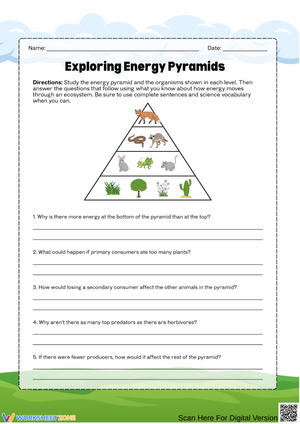
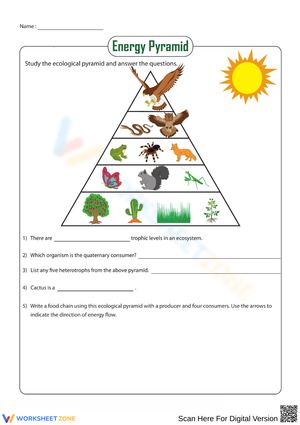
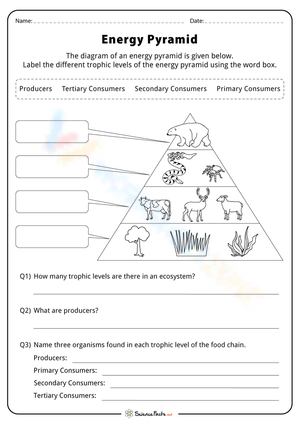
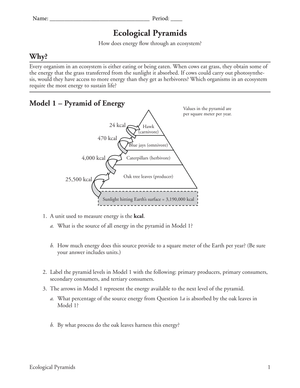
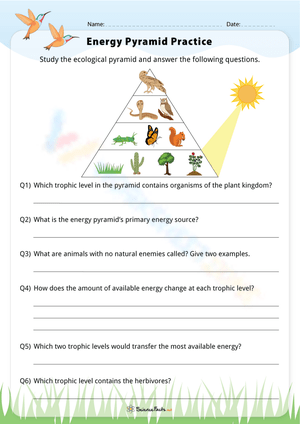
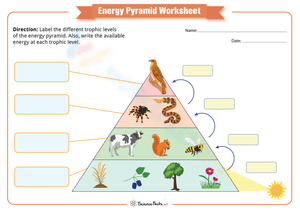
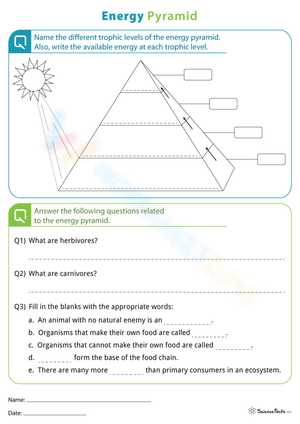
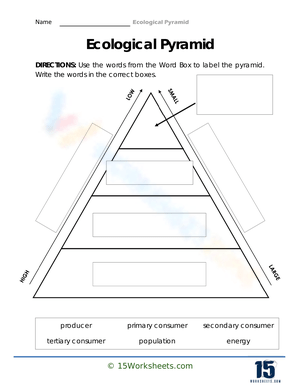
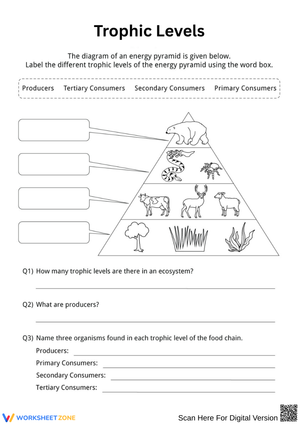
Every energy pyramid is built from the same layers, and worksheets should reinforce that order. Producers form the widest base because they capture the most usable energy directly from sunlight. Above them sit primary consumers, then secondary consumers, and sometimes tertiary consumers at the narrow apex. The shrinking width isn't decoration; it represents the shrinking amount of energy available at each step up the pyramid.
According to National Geographic Education, energy flow through an ecosystem follows the 10 percent rule: roughly 10 percent of the energy at each trophic level transfers to the level above, while about 90 percent is used for life processes or lost as heat. That steep decline is why pyramids narrow so sharply toward the top.
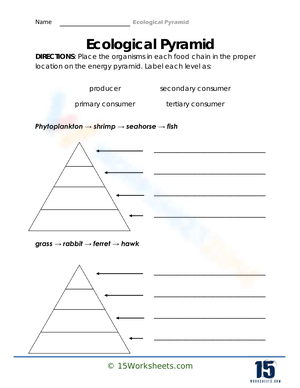
Worksheets that ask students to draw or complete the pyramid help them internalize that a healthy ecosystem needs a broad base of plants and algae to support just a handful of top predators.
Aligning Energy Pyramid Worksheets with NGSS MS-LS2-3
NGSS standard MS-LS2-3 asks students to develop a model that describes the cycling of matter and the flow of energy among the living and nonliving parts of an ecosystem. An energy pyramid is one of the clearest models students can build to meet that expectation, and worksheets scaffold the skill step by step.
To make the alignment explicit, look for worksheets that ask students to construct or revise a model, not just label a finished one. When a student decides where an organism belongs, justifies it with feeding relationships, and shows the energy transfer between levels, they're doing the modeling MS-LS2-3 describes. Pair a labeling worksheet with a short written-explanation prompt and you have clear evidence for the standard.
This also gives you a ready answer when an administrator asks how a printable worksheet connects to three-dimensional standards. The core idea is energy flow, the practice is developing and using models, and the connecting concept is energy and matter moving through a system.
Using These Worksheets In Ecosystem Lessons
Energy pyramid worksheets work best when you differentiate by task type rather than by topic. Students who are struggling can start with labeling and identification sheets that reinforce vocabulary and the producer-to-consumer order. Students ready for more can take on data-analysis sheets that hand them energy values and ask them to calculate transfers, compare two ecosystems, or explain why a level is missing.
A few practical ways to put the worksheets to work:
- Station rotations: Set up one station for labeling, one for 10 percent calculations, and one for a short model-building prompt, then rotate small groups through all three.
- Formative check: Assign a single-page pyramid worksheet the day before your ecosystems test to surface misconceptions while there's still time to reteach.
- Intervention: Use a scaffolded version with the base already filled in for students who need a lighter entry point during small-group time.
- Warm-up: Open class with one calculation problem projected from a worksheet to spiral the 10 percent rule across the week.
Because the same worksheet can be scaled up or down, a single set can cover your whole roster without you building three separate assignments from scratch.
Pairing Energy Pyramids with Food Webs
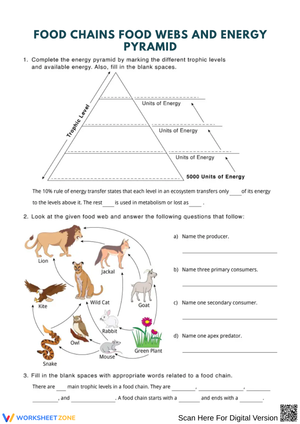
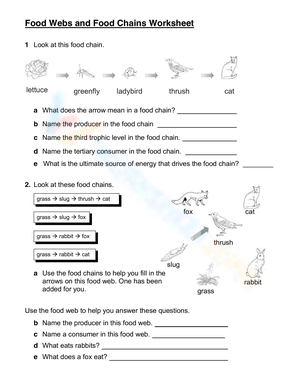
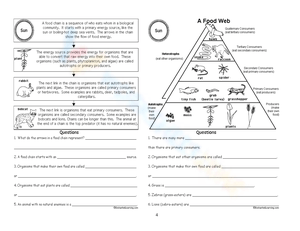
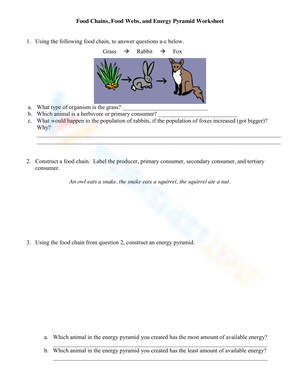
An energy pyramid answers "how much," while a food web answers "who eats whom." Students understand ecosystems best when they see both. Teach food chains and food webs first so students can trace feeding relationships, then bring in the energy pyramid to quantify what those arrows actually cost. Worksheets that share the same sample organisms across all three models help students connect the representations instead of treating them as separate topics.
Used this way, energy pyramid worksheets double as formative assessment. If a student can build the web but can't explain why the top level is so thin, you've found a gap in their understanding of energy loss, not just a labeling slip. That distinction tells you exactly what to reteach before the unit ends, and it keeps your intervention groups focused on the real problem.
Frequently Asked Questions
1. What grade level are energy pyramid worksheets appropriate for?
They fit best in grades 6-8 life science, where students study ecosystems, energy flow, and food webs. Labeling versions can support upper-elementary review, while calculation-heavy versions stretch advanced middle schoolers and early high school students who need a challenge.
2. How do energy pyramid worksheets align with NGSS ecosystem standards?
They directly support MS-LS2-3, which asks students to develop a model of matter cycling and energy flow in an ecosystem. Building and explaining a pyramid gives you concrete evidence of that modeling skill.
3. What is the 10 percent rule and how is it used in worksheet problems?
The 10 percent rule states that only about 10 percent of the energy at one trophic level passes to the next. Worksheet problems give students an energy value at the base and ask them to calculate what remains at each higher level.
4. How can teachers use energy pyramid worksheets for review or intervention?
Assign a short pyramid worksheet as a formative check before a test, or use a scaffolded version with the base pre-filled during small-group intervention to rebuild the producer-to-consumer sequence.
5. What is the difference between an energy pyramid and a food web worksheet?
A food web worksheet shows feeding relationships and who eats whom, while an energy pyramid worksheet quantifies how much energy moves between trophic levels. Using both gives students a more complete picture of an ecosystem.












 Interactive Worksheet Maker
 Quiz Maker
 Word Search Maker
 Crossword Puzzle Maker
 Word Scramble Generator
 Sentence Scramble Generator
 Handwriting Worksheet Generator
 Name Tracing Generator
 Fill In The Blank Generator