Where Ecological Relationships Worksheets Fit in a Middle School Ecosystems Unit
If you teach life science, ecological relationships usually land in the middle of an ecosystems unit, right after students can trace energy through a food chain. This is the point where the class shifts from "who eats whom" to the bigger driving question behind the whole unit: how and why do organisms interact with their environment, and what are the effects of those interactions? Worksheets built around this topic give students repeated, low-stakes practice classifying interactions before they have to explain them in an essay or on a summative test.
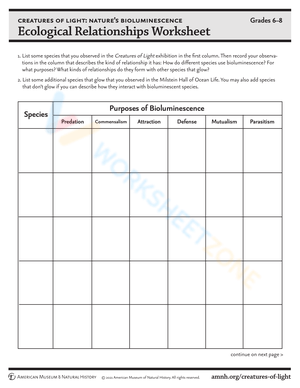
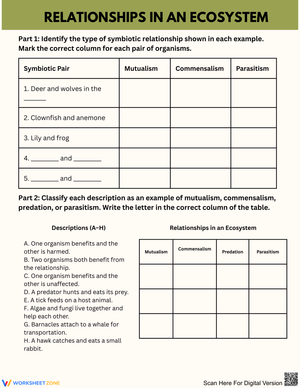
The ecological relationships worksheets on Worksheetzone are built for exactly that classroom moment. They ask students to identify predation, competition, and the three symbiotic relationships, then apply those labels to real organisms and food web scenarios rather than memorizing definitions in isolation. That application step is what makes the practice stick, and it is what your standards actually ask for.
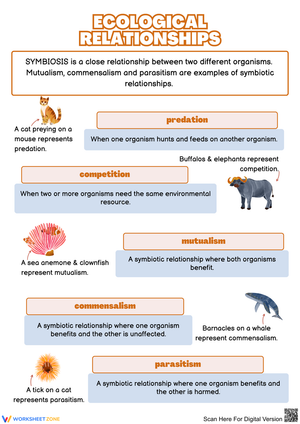
The Five Core Relationship Types Students Must Classify
Most standards-aligned worksheets center on five interaction types, and students need to tell them apart quickly and defend the choice they make:
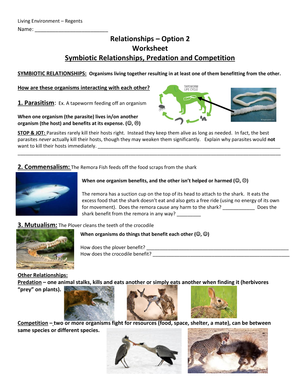
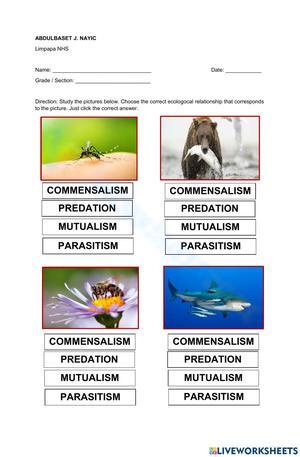
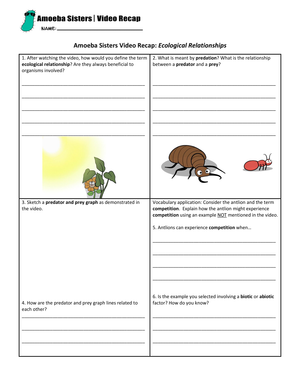
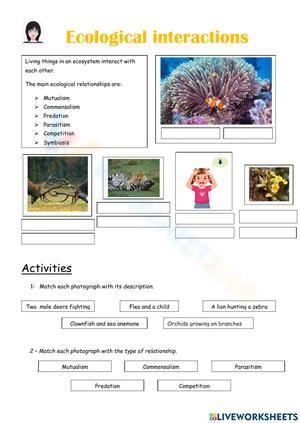
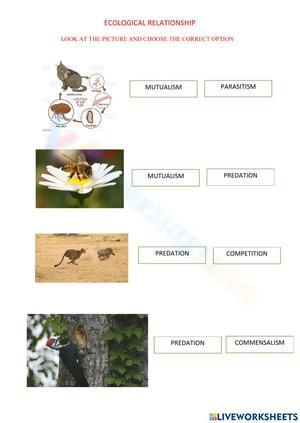
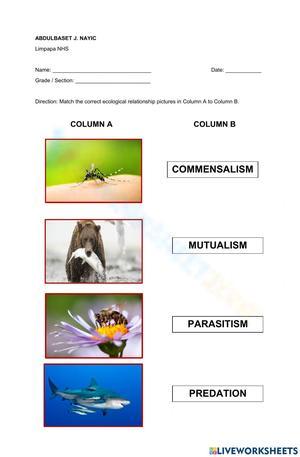
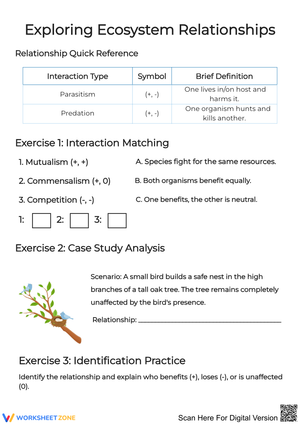
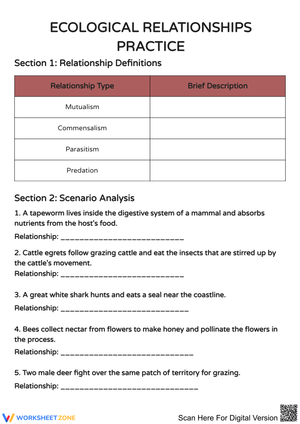
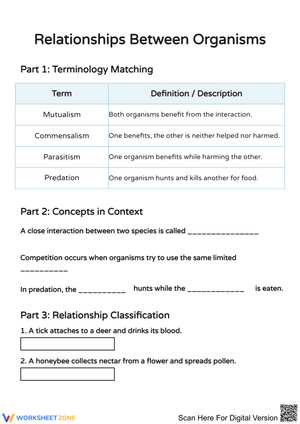
- Predation — one organism hunts and eats another, like a hawk and a field mouse.
- Competition — two organisms fight over the same limited resource, such as two plant species reaching for the same patch of sunlight.
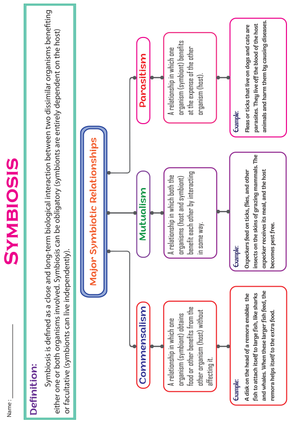
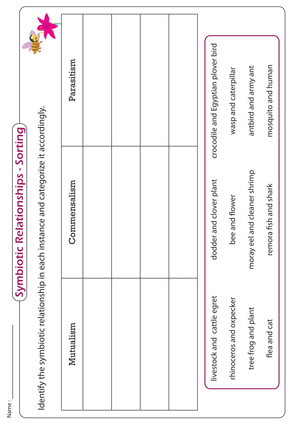
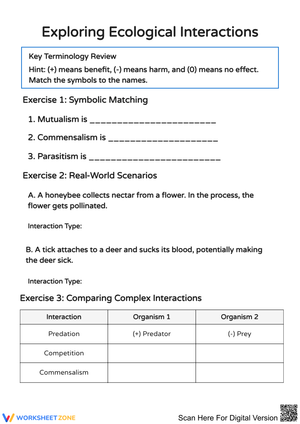
- Mutualism — both organisms benefit, like a bee gathering nectar while pollinating a flower.
- Commensalism — one benefits and the other is unaffected, such as a bird nesting in a tree.
- Parasitism — one benefits while harming the other, like a tick feeding on a deer.
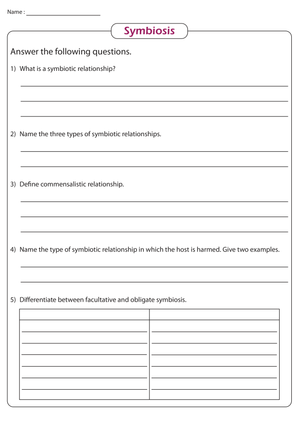
The last three are the symbiotic relationships, and they are where students stumble most. A worksheet that forces a clear plus, zero, or minus judgment for each organism gives students a concrete rule to apply instead of a vocabulary word to guess at. Once they internalize that rule, the definitions take care of themselves.
Real examples help these categories land. Predation and competition tend to click fast because students have seen them in nature documentaries. Mutualism, commensalism, and parasitism are the trio worth extra time, since the difference between them is one organism's outcome, not the headline behavior everyone notices first.
Start With Food Webs Before Classification Worksheets
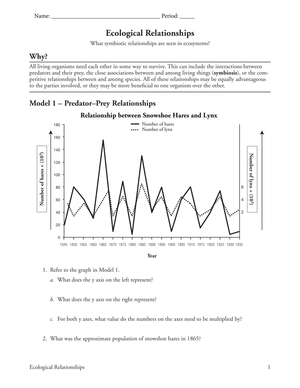
Students classify relationships far more accurately when they can already picture the flow of energy through a system. Food chain and food web diagrams give them that mental map: producers, consumers, and decomposers connected by arrows that show where energy actually goes. Once a student can read a web, a relationship worksheet stops feeling abstract, because every predator-prey pair is already sitting on the page, waiting to be named.
It helps to have students annotate the web before they classify. Ask them to mark each arrow as an energy transfer, then circle any two organisms that share a food source. Those circled pairs are your competition examples, already found, and the arrows are your predation examples. The worksheet then becomes a labeling job built on evidence students collected themselves.
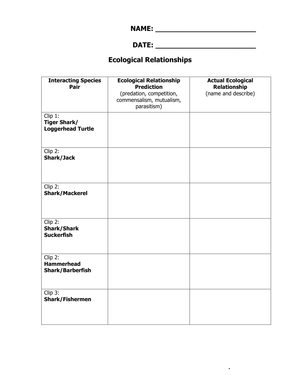
Here is the pattern I see most often in student work: kids who can label a food web perfectly still misclassify commensalism as mutualism, because they only check the organism they find interesting and quietly ignore the second one. Building a two-column "who benefits, who is affected" check directly into the worksheet cuts that error sharply, because it forces a decision about both organisms before any label is allowed. That one structural change turns a guessing exercise into a reasoning task, and it is the single highest-leverage tweak you can make to a classification sheet.
How the Worksheets Align to NGSS Ecosystem Standards
NGSS performance expectation MS-LS2-2 asks middle schoolers to construct an explanation that predicts patterns of interactions among organisms across multiple ecosystems, naming competitive, predatory, and mutualistic relationships specifically. Worksheets that make students justify a classification, not merely circle it, map directly onto that expectation and hand you evidence you can actually grade.
The surrounding standards matter too. MS-LS2-1 has students analyze data on how resource availability affects populations, which is the "why" sitting underneath competition. MS-LS2-3 has them build models of matter cycling and energy flow, which is exactly what a food web worksheet rehearses. For high school, the NGSS interdependent relationships in ecosystems topic extends the same ideas into carrying capacity and competitive exclusion, so the vocabulary you build in seventh grade pays off years later.
Using These Worksheets In Real Classes
These worksheets work best as one station in a rotation rather than a whole-period task. Here is a sequence that fits a single 45-minute class period:
- Warm-up (5 minutes): project one food web and have students name one predator-prey pair.
- Direct instruction (10 minutes): introduce the plus, zero, minus rule for the three symbiotic types.
- Guided worksheet (15 minutes): students classify eight to ten interactions in pairs, defending each with the benefit rule.
- Share-out (10 minutes): groups compare two answers they disagreed on and settle them.
Because the worksheet is printable, you can rerun the same task as a small-group intervention the next day for students who need another pass, without prepping new materials. If you have a lab or simulation on hand, drop the worksheet in as the exit reflection so students name the relationships they just observed.
Frequently Asked Questions
1. What grade level covers ecological relationships?
In most US science sequences this topic lands in middle school life science, typically grades 6-8, under the NGSS MS-LS2 ecosystems standards. High school biology revisits it with more depth around carrying capacity and interdependence.
2. What relationship types do students identify on these worksheets?
The five core types are predation, competition, mutualism, commensalism, and parasitism. The last three are the symbiotic relationships, and they cause the most confusion because they hinge on whether the second organism is helped, harmed, or unaffected.
3. How do these worksheets align with NGSS?
They support MS-LS2-2, which asks students to predict patterns of interaction among organisms, and they connect to MS-LS2-1 on resource competition and MS-LS2-3 on energy flow through food webs.
4. Can I use these for review instead of assessment?
Yes. Use a scaffolded version with sentence frames for guided review, then hand out a clean version with no supports as a graded formative check once students are ready. You can also read the answers aloud as a class debrief so students self-correct before the graded version goes out.
5. What helps students tell mutualism from commensalism?
A plus, zero, minus table. Have students score each organism separately: two pluses means mutualism, a plus and a zero means commensalism, and a plus and a minus means parasitism. Scoring both organisms before labeling prevents the most common mistake.












 Interactive Worksheet Maker
 Quiz Maker
 Word Search Maker
 Crossword Puzzle Maker
 Word Scramble Generator
 Sentence Scramble Generator
 Handwriting Worksheet Generator
 Name Tracing Generator
 Fill In The Blank Generator