




























Views
Downloads

Seed Sorting Mat Printable | Grade K Science

Paste this activity's link or code into your existing LMS (Google Classroom, Canvas, Teams, Schoology, Moodle, etc.).
Students can open and work on the activity right away, with no student login required.
You'll still be able to track student progress and results from your teacher account.
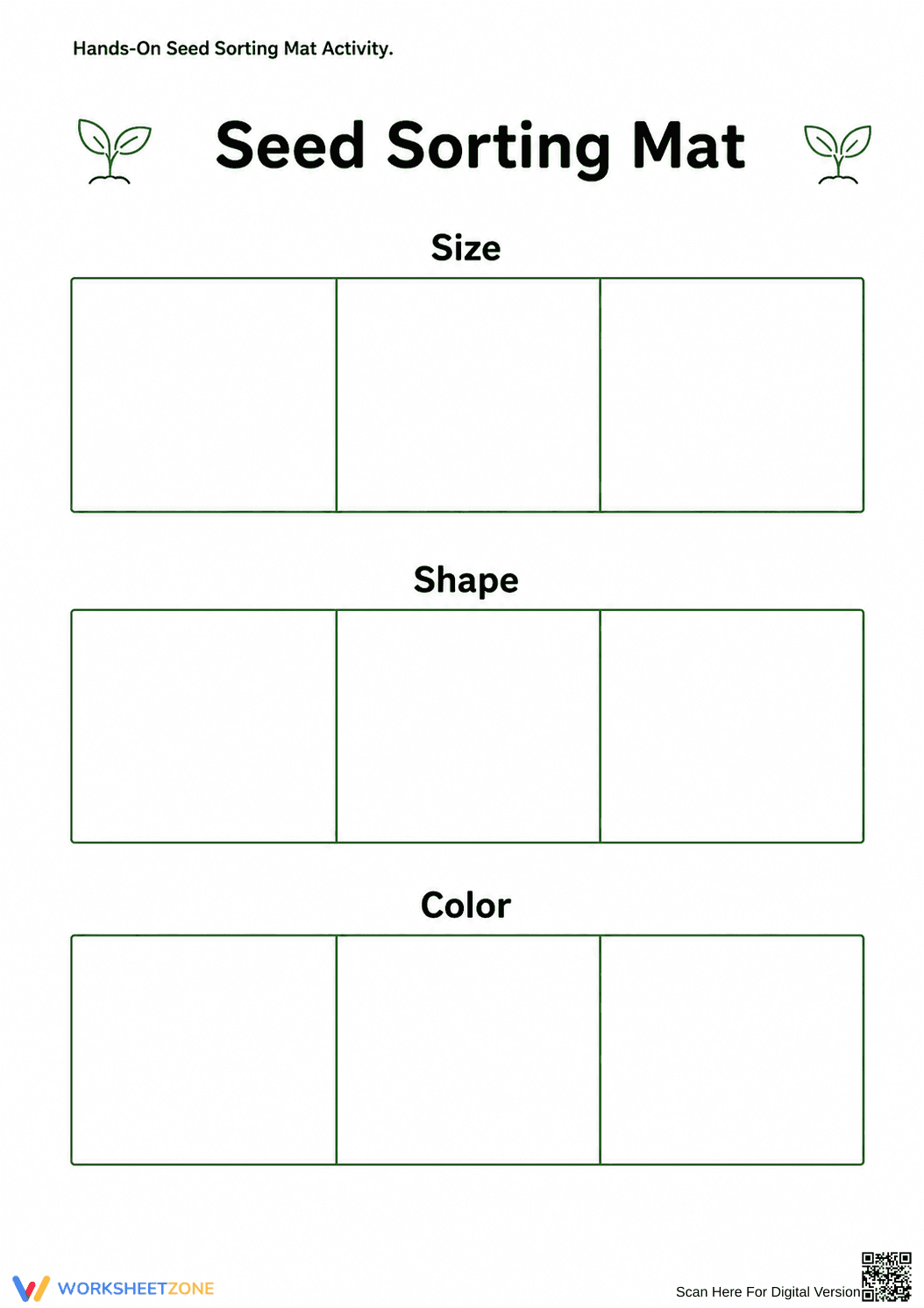
This hands-on seed sorting mat introduces early learners to foundational scientific observation and classification. Students use the visual mat to categorize physical objects by their observable traits, building critical thinking and fine motor skills as they physically place seeds into designated areas based on size, shape, and color.
At a Glance
- Grade: K · Subject: Science
- Standard:
CCSS.MATH.CONTENT.K.MD.B.3— Classify objects into given categories- Skill Focus: Sorting by observable properties
- Format: 1 page · 3 sorting categories · No answer key · PDF
- Best For: Hands-on science centers
- Time: 15–20 minutes
This single-page printable features a clean, highly visual layout designed specifically for early childhood education. It includes three distinct sorting rows labeled Size, Shape, and Color. Each row contains three large, blank boxes, providing ample physical space for young students to place actual seeds or printed seed manipulatives during their investigation.
- Guided practice: Introduce the mat during whole-group instruction, demonstrating how to sort a single seed type by its size, shape, or color into the correct box.
- Supported practice: Provide small groups with a mixed handful of seeds, allowing them to collaborate and discuss which category each seed belongs in while the teacher circulates.
- Independent practice: Assign the mat as an independent science center where students classify a new assortment of seeds entirely on their own.
This gradual-release approach ensures students confidently master the I Do, We Do, You Do progression of scientific observation.
Aligned to primary standard CCSS.MATH.CONTENT.K.MD.B.3: Classify objects into given categories; count the numbers of objects in each category and sort the categories by count. This cross-curricular activity bridges early math and science skills by focusing on observable physical properties. Both standard codes can be copied directly into lesson plans, IEP goals, or district curriculum mapping tools.
Use this sorting mat during a spring plant life cycle unit before planting actual seeds, helping students recognize the vast diversity in plant life. Alternatively, set it up as a continuous provision science center where the seed varieties rotate weekly. As a formative assessment observation tip, watch to see if students can articulate why they placed a specific seed in a particular box, ensuring they understand the target attribute rather than just guessing. Expected completion time is 15 to 20 minutes.
This resource is primarily for Kindergarten and Pre-K students developing basic classification skills. For differentiation, limit the sorting to just one row (e.g., only color) for students needing more support, or challenge advanced learners by asking them to sort seeds that share two attributes simultaneously. It pairs perfectly with a read-aloud book about how plants grow or a direct instruction lesson on living versus non-living things.
Integrating hands-on manipulatives with structured classification tasks significantly enhances early cognitive development in young learners. By aligning directly with CCSS.MATH.CONTENT.K.MD.B.3 to classify objects into given categories, this activity supports foundational scientific inquiry and mathematical reasoning simultaneously. According to Fisher & Frey (2014), providing students with physical objects to manipulate while learning new vocabulary and concepts increases retention and deepens their understanding of abstract categories. When kindergarteners physically pick up a seed, feel its texture, and decide where it belongs on the mat, they are engaging multiple senses to solidify their learning. This seed sorting mat translates that educational research into a highly practical classroom tool. It allows young students to physically interact with the material world, fostering curiosity while building the critical observation and analytical skills necessary for future STEM success across all grade levels.


