Building Vocabulary Through Root Words
Start by discussing why morphology matters in elementary and middle school English language arts. Explain how a single root acts as a foundation for countless other terms. When students understand the core meaning of a word part, they unlock the ability to decode unfamiliar vocabulary across all subjects, from science to social studies. Mention that utilizing a root words printable worksheets offers a structured way to introduce these concepts. Instead of memorizing long lists of isolated vocabulary terms, children learn to identify patterns. The ability to break down a long word into its prefix, root, and suffix is a powerful strategy. For example, knowing that "bio" means life and "ology" means the study of instantly clarifies the definition of biology, biography, and biosphere. This systematic approach to language arts builds confidence and reading comprehension. Talk about how standardized tests often include complex vocabulary that students have never seen before, making morphological awareness an essential skill. By practicing with targeted materials, learners develop a habit of looking for familiar chunks within new words, which significantly reduces the cognitive load during independent reading. Vocabulary building accelerates across grades 3 through 8 as texts become more academic, so having a strong foundation is vital for academic success.
The Difference Between Base and Root Words
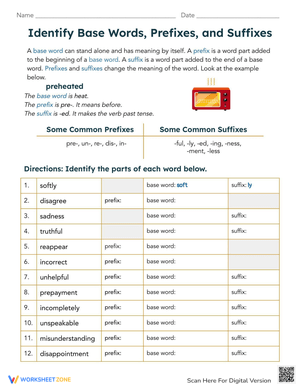
Many teachers use these terms interchangeably, but distinguishing between them helps when planning targeted morphological instruction. A base word is a standalone English word that can function independently without any affixes. For instance, in the word "unbreakable," the base is "break." It carries meaning all on its own. You can add prefixes or suffixes to change its tense or part of speech, but it remains a complete word. On the other hand, a root word is the foundational morpheme, often derived from Greek or Latin, that typically cannot stand alone in English. It requires a prefix or suffix to form a complete, recognizable word. The Latin root "struct," meaning to build, cannot function independently in a sentence. It must become "construct," "structure," or "instruction." This technical distinction is important for teachers to highlight because it changes how students approach spelling and decoding. When assigning a root words printable worksheets activity, being precise about whether students are identifying a base or a bound root prevents confusion. It also helps students recognize that English is a deeply historical language, built upon the linguistic foundations of other cultures, clarifying why some word chunks look familiar but do not make sense alone.
Common Greek and Latin Roots to Teach
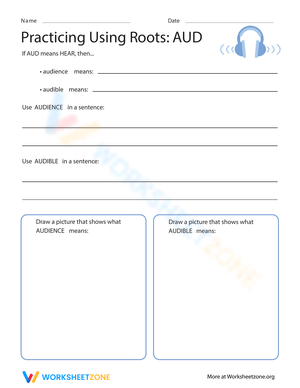
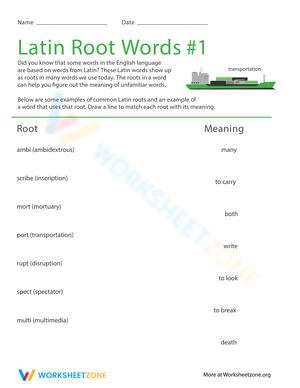
When selecting words for your weekly lessons, starting with the most highly frequent roots ensures students get immediate value from their vocabulary practice. Greek roots often relate to science and mathematics. For example, teaching "graph" (to write) helps decode autograph, paragraph, and graphic. Teaching "phon" (sound) unlocks telephone, phonics, and symphony. Latin roots frequently form the basis of our everyday academic language. Introducing "port" (to carry) leads to transport, import, and portable, while "aud" (to hear) connects to audio, audience, and auditorium.
According to the guide A Guide to Understanding Root Words for Kids - FirstCry Parenting, learning foundational Greek and Latin roots provides children with a reliable strategy to decode complex vocabulary, noting that a single root can help unlock the meaning of 20 or more related terms in everyday reading.
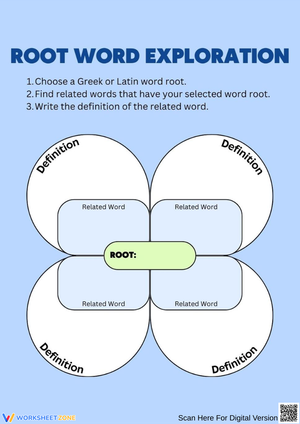
Creating a progression where students first learn the root, then generate a web of words containing it, is highly effective. Giving students a graphic organizer to brainstorm derivatives helps them see how one root generates a whole family of words. Worksheets that group roots by their linguistic origin or by thematic meaning provide a tangible way for students to connect the root to its derivatives.
Activities for Reinforcing Morphology Skills
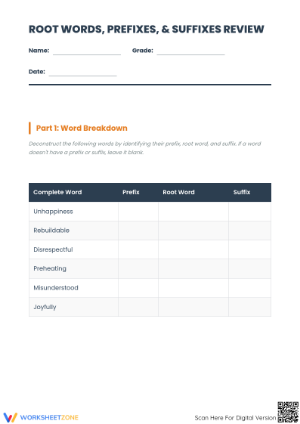
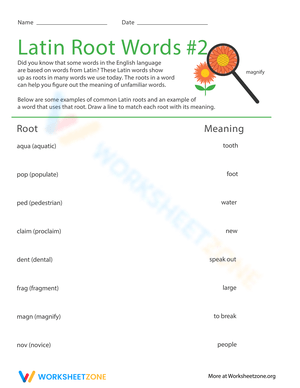
How do we make practice engaging and meaningful? Students need repetitive, varied exposure to internalize these word parts. When you distribute a root words printable worksheets, the goal is active manipulation, not just copying definitions. Quality printable materials should include a variety of exercise formats. Matching root words to their definitions is a solid starting point for initial exposure. From there, move into word-building equations where students combine a prefix, root, and suffix to form a new word.
Fill-in-the-blank sentences using a word bank challenge students to apply their knowledge in context, proving that morphology is a reading comprehension tool rather than just a spelling exercise. Another excellent activity involves analyzing a short reading passage and highlighting all the words that share a common root. You can also gamify the learning process by giving students a root like "spect" and a list of affixes, asking them to create as many valid English words as possible within a time limit. Integrating these activities into literacy centers or morning work routines ensures consistent practice without taking over the entire instructional block, keeping students engaged and motivated to discover new word connections.
Classroom Implementation
When designing a scope and sequence for morphology, introduce roots that share similar spellings but have different meanings on completely separate weeks to prevent cognitive interference. For instance, teaching the Latin root "ped" (foot) alongside the Greek root "ped" (child) simultaneously often results in long-term confusion for elementary learners.
To effectively fit this into the weekly schedule, consider a structured routine. On Monday, introduce the new root and its meaning. On Tuesday, focus on word building and creating word families. By Wednesday, shift to contextual reading exercises. Use Thursday for fill-in-the-blank activities, and Friday for a brief assessment. Discuss using a root words printable worksheets as a formative assessment tool rather than just independent busywork. Reviewing the completed pages with the class helps identify which students understand the connection between the root and the word's overall meaning.
Create a "root of the week" bulletin board where students can add words they find in their independent reading books. This bridges the gap between isolated worksheet practice and authentic reading experiences. Encourage students to become word detectives, constantly on the lookout for familiar roots hidden inside challenging vocabulary. Emphasize that consistent, small doses of morphology instruction yield better results than cramming a long list of roots right before a standardized test.
Assessing Student Mastery of Word Parts
Assessment is a critical component of vocabulary instruction. Beyond traditional multiple-choice quizzes, how do teachers know students are truly internalizing the concepts? The most effective strategy is to use authentic writing tasks. Ask students to write a short paragraph using at least five words derived from the week's target roots. This demonstrates application rather than just basic recognition.
When evaluating a root words printable worksheets for assessment purposes, look for tasks that require higher-order thinking. For example, ask students to explain how the root contributes to the overall meaning of a specific word, such as explaining why a "telescope" is used to see things far away based on the roots "tele" and "scope." Use cloze passages where the missing words must be derived from a specific root. Keep track of which roots have been mastered and which need review by incorporating a cumulative assessment at the end of every quarter. The resource The Wordsmyth Root Word Dictionary is an excellent tool for teachers to curate lists of words for these assessments, ensuring the vocabulary is grade-appropriate. Assessing morphology should ultimately measure a student's ability to tackle unknown words independently.
Frequently Asked Questions
1. What is a root word and how does it differ from a base word?
A root word is the foundational morpheme that holds the core meaning of a word, often originating from Greek or Latin, and typically requires an affix to form a complete word in English (like "aud" in audio). A base word is a complete English word that can stand alone without any prefixes or suffixes (like "happy" in unhappiness). While both serve as the core of complex words, base words are independent, whereas roots are generally bound.
2. Why is learning Greek and Latin roots important for vocabulary?
A significant portion of the English language, especially academic and scientific vocabulary, is derived from Greek and Latin. When students learn these foundational word parts, they gain a strategic tool to decode unfamiliar words across all subjects. Instead of memorizing thousands of individual definitions, they learn a smaller set of roots that unlock the meanings of countless related words, significantly boosting reading comprehension.
3. What are some common examples of root words and the words derived from them?
Common Greek roots include "bio" (meaning life), which gives us biology, biography, and biosphere; and "tele" (meaning far), which forms television, telephone, and telescope. Common Latin roots include "port" (meaning to carry), found in transport, portable, and export; and "dict" (meaning to say), which appears in dictate, dictionary, and predict.
4. How can I use these worksheets effectively to teach my students?
To maximize effectiveness, use a root words printable worksheets as part of a comprehensive morphology routine rather than an isolated task. Introduce a new root explicitly, have students brainstorm related words, and then use the printable for guided practice. Incorporate activities like word building, matching, and contextual fill-in-the-blanks. Always review the answers together to discuss how the root's meaning influences the whole word.
5. At what grade level should students start learning about root words?
While basic compound words and simple affixes are introduced in primary grades, explicit instruction in Greek and Latin roots typically begins in third grade and intensifies through middle school (grades 3-8). As students encounter more complex, domain-specific texts in science and social studies, their morphological awareness must expand to handle the increased vocabulary demands.












 Interactive Worksheet Maker
 Quiz Maker
 Word Search Maker
 Crossword Puzzle Maker
 Word Scramble Generator
 Sentence Scramble Generator
 Handwriting Worksheet Generator
 Name Tracing Generator
 Fill In The Blank Generator