


























0
Views
0
Downloads

0.0
0
Save
0 Likes
Share
Retell It! Story Retelling Worksheet
0 Views
0 Downloads
Paste this activity's link or code into your existing LMS (Google Classroom, Canvas, Teams, Schoology, Moodle, etc.).
Students can open and work on the activity right away, with no student login required.
You'll still be able to track student progress and results from your teacher account.
Information
Description
What It Is:
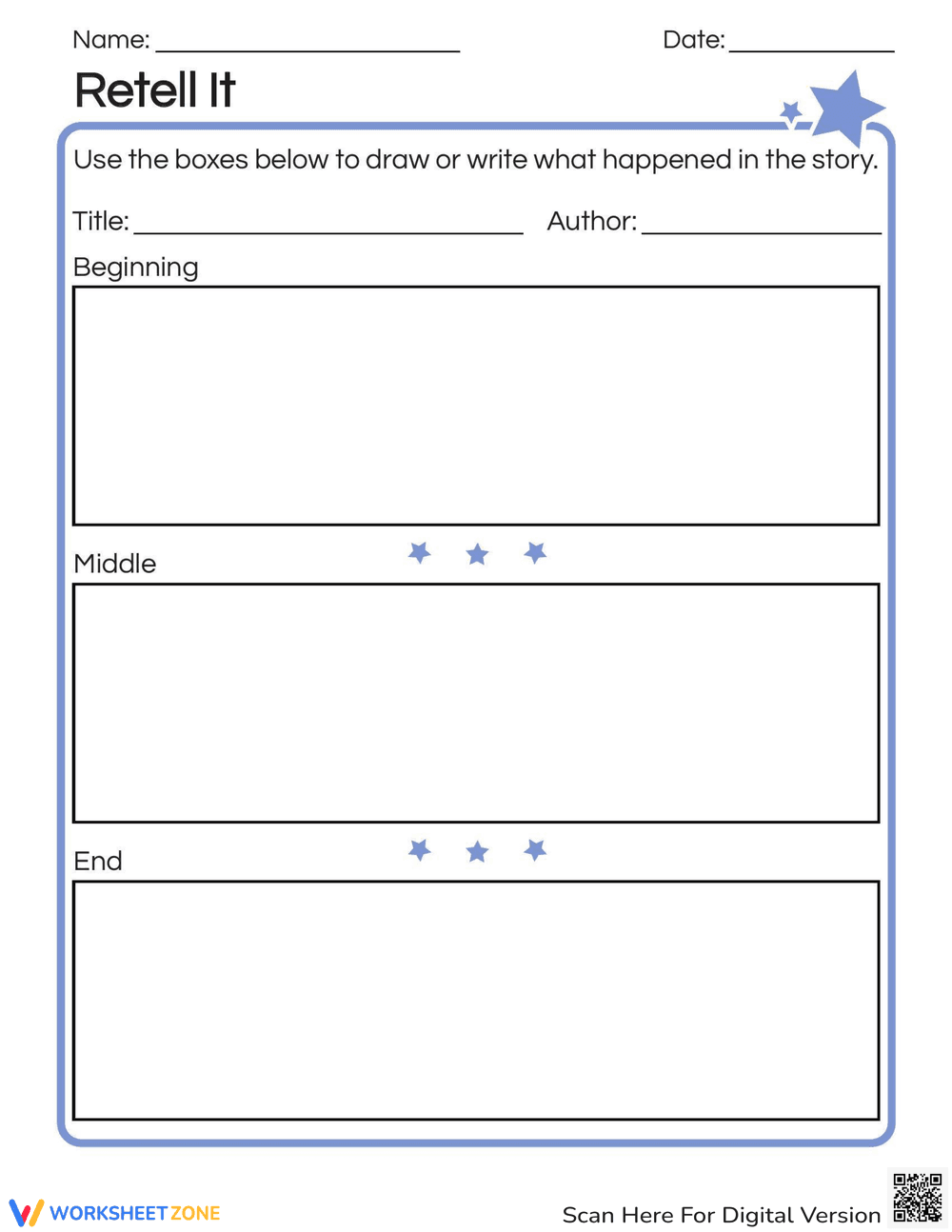
This is a story retell worksheet. It prompts students to write or draw what happened in the beginning, middle, and end of a story. There are spaces for the student's name, date, story title, and author. The worksheet contains three large rectangular boxes labeled 'Beginning,' 'Middle,' and 'End' where students can illustrate or write their summaries.
Grade Level Suitability:
This worksheet is suitable for grades 1-3. The task of retelling a story using beginning, middle, and end is a foundational skill taught in these grades. The option to draw allows younger students to participate, while older students can focus on writing more detailed summaries.
Why Use It:
This worksheet helps students improve their reading comprehension and summarization skills. It encourages them to identify the key events in a story and organize them in a logical sequence. It also promotes creative thinking and visual representation of information.
How to Use It:
After reading a story aloud or silently, provide this worksheet to students. Instruct them to fill in the title and author. Then, guide them to think about what happened at the beginning, middle, and end of the story. They can either draw a picture or write a sentence or two in each box to represent the key events.
Target Users:
This worksheet is ideal for elementary school students, particularly those in grades 1-3. It can be used in the classroom or as a homework assignment. It's also beneficial for students who need extra support with reading comprehension and story sequencing.
This is a story retell worksheet. It prompts students to write or draw what happened in the beginning, middle, and end of a story. There are spaces for the student's name, date, story title, and author. The worksheet contains three large rectangular boxes labeled 'Beginning,' 'Middle,' and 'End' where students can illustrate or write their summaries.
Grade Level Suitability:
This worksheet is suitable for grades 1-3. The task of retelling a story using beginning, middle, and end is a foundational skill taught in these grades. The option to draw allows younger students to participate, while older students can focus on writing more detailed summaries.
Why Use It:
This worksheet helps students improve their reading comprehension and summarization skills. It encourages them to identify the key events in a story and organize them in a logical sequence. It also promotes creative thinking and visual representation of information.
How to Use It:
After reading a story aloud or silently, provide this worksheet to students. Instruct them to fill in the title and author. Then, guide them to think about what happened at the beginning, middle, and end of the story. They can either draw a picture or write a sentence or two in each box to represent the key events.
Target Users:
This worksheet is ideal for elementary school students, particularly those in grades 1-3. It can be used in the classroom or as a homework assignment. It's also beneficial for students who need extra support with reading comprehension and story sequencing.


