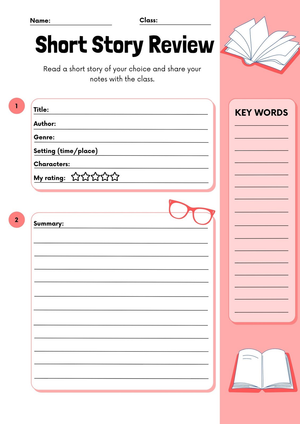
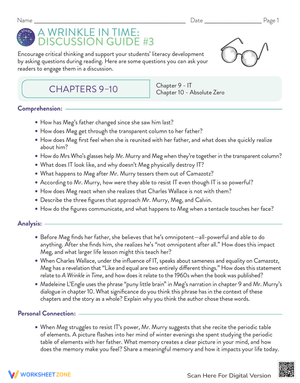
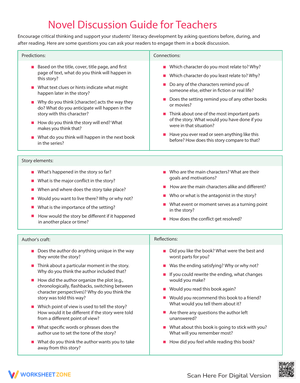
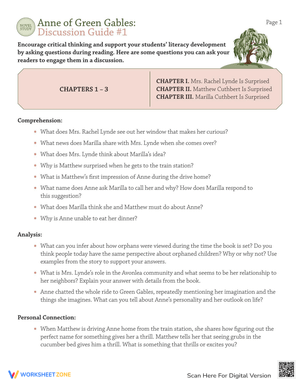
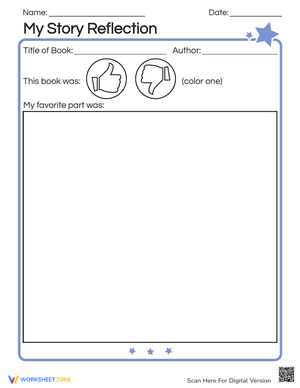
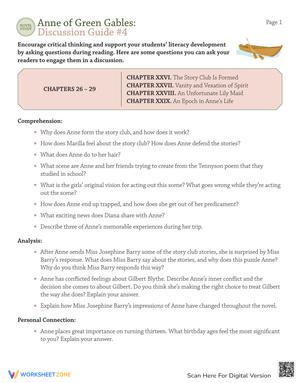
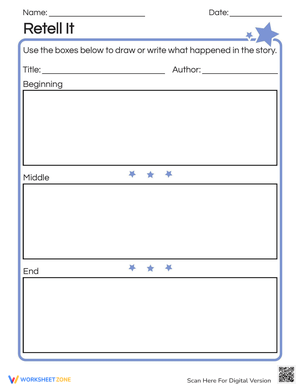
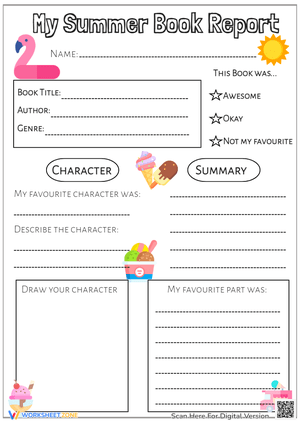
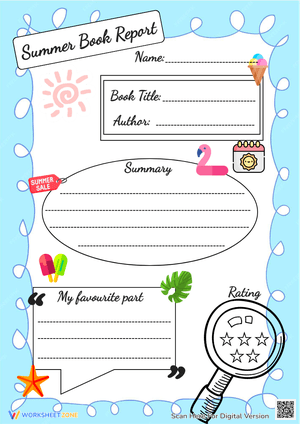
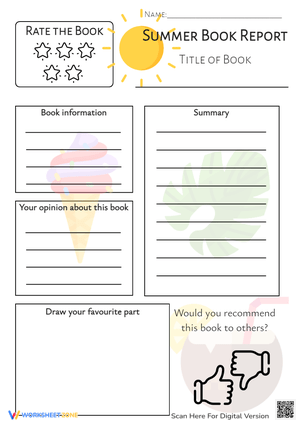
These summarizing fiction texts worksheets resources give students a structured way to move beyond sequential retelling — where every event gets equal weight — toward genuine synthesis, where they identify only the elements that carry the story's meaning. The set spans elementary through early middle school and includes both graphic organizers built around the Somebody-Wanted-But-So-Then framework and more open-ended structures that push students toward analytical summary writing.
Skills the Set Builds
Across the worksheets, students practice identifying a protagonist's central motivation — not just what the character does, but why — distinguishing the primary conflict from the minor complications surrounding it, and tracing the cause-and-effect logic that connects a story's turning points. Several worksheets ask students to annotate a short passage before summarizing, marking events as either essential or non-essential. That annotation step is where the real decision-making happens, and it is often the step that gets skipped when summary instruction stays at the fill-in-the-blank level. Forcing students to commit to a judgment about each event before they write anything changes the quality of what they produce.
The final task on most worksheets is a written paragraph that pulls together whatever the organizer has built. That paragraph is the accountability piece: a student who filled in the graphic organizer by copying sentences from the text will not be able to write a coherent summary paragraph without doing the synthesis work the organizer was meant to prompt.
Where Retelling Ends and Summarizing Begins — Student Errors Worth Watching
The most persistent error in student summaries is scene-by-scene narration with no filtering for importance. A student writing a summary of Charlotte's Web who produces "Wilbur was a pig and Charlotte was a spider and she wrote words in her web and then she died" has retold the plot without capturing what the story is about. That gap is not a reading failure — it is a thinking failure, and it shows up in the majority of students encountering formal summarization for the first time at grades 2 and 3.
A subtler problem surfaces in grades 4 through 6: students who can identify the main conflict still conflate it with the climax. They describe the moment of highest drama as "the problem" rather than tracing the tension that built toward it. The prompt "The real problem in this story is that..." will immediately reveal this confusion. Students who understand conflict answer in terms of character motivation and circumstance. Students who don't answer by describing the most exciting scene. This distinction is worth spending explicit time on before students work independently, because the worksheets will not fix that confusion if it never gets named aloud.
How to Work These Worksheets Into Your Lesson Sequence
The most effective placement is after a chapter, not after a full book. Summarizing a complete novel from memory is a recall exercise; summarizing a chapter while the text is still on the desk is a comprehension exercise. The SWBST organizers work best when students fill them in immediately after reading, before class discussion begins — that way, each student commits to their own interpretation rather than borrowing from whoever speaks first.
For whole-class instruction, projecting a shared text and working through one worksheet together — modeling which events make the cut and why — gives students a concrete example of the decision before they attempt it independently. This fits the gradual release pattern without requiring separate materials at each stage. Small-group guided reading is another strong context: the worksheet captures the group's thinking in real time, giving you something concrete to review when planning the next session. Exit tickets — three-sentence summaries written in the final four minutes of class — tell you immediately who is generalizing the skill and who is still listing. These summarizing fiction texts worksheets downloads integrate cleanly into any of those structures without requiring a separate unit or a change in your materials rotation.
Making the Set Work Across Your Class's Range of Readers
Students with limited working memory do better on worksheets that break the task into fully separated steps: one prompt for character, one for motivation, one for conflict, one for resolution — answered in sequence before attempting any connected writing. Removing the need to hold all four components in mind simultaneously does not simplify the thinking; it removes only the cognitive traffic jam that prevents some students from getting started at all. For English language learners, a word bank of transition phrases placed directly on the worksheet — initially, as a result, ultimately — reduces the writing load without reducing the analytical demand. The SWBST structure works particularly well for ELL students because the narrow sentence slots require only one idea per line, which keeps the task focused rather than open-ended in ways that can stall students who are still developing sentence-level fluency.
Advanced students do not benefit from longer summaries. The more useful extension is a more analytical one: ask them to summarize the story and then explain how the resolution connects to the story's theme, or to compare what the protagonist stated as their goal with what the character actually needed. These summarizing fiction texts worksheets resources include open-ended prompts that support exactly that kind of extension, so no separate materials are needed for students who are ready to move beyond basic synthesis.
Standard Alignment
These worksheets align to CCSS.ELA-LITERACY.RL.3.2, RL.4.2, RL.5.2, and RL.6.2, each of which requires students to recount or summarize a text and determine the central message, lesson, or theme. At grade 3, the standard asks for recounting of key details that support the central message — which maps directly to the Beginning-Middle-End organizers in the set. By grade 5, the expectation shifts to summarizing and explaining how key details support the text, which is precisely what the SWBST and conflict-resolution worksheets address. The grade 6 version adds a distinction between the student's own perspective and the narrator's or character's perspective — a distinction the more analytical extension prompts begin to develop. Teachers in states using TEKS or other non-Common Core frameworks will find these skills align directly to the narrative comprehension standards in the reading/literary strand at the same grade bands, typically under the strand that addresses theme, central idea, and textual evidence.
Frequently Asked Questions
How do I stop students from writing retellings when I ask for summaries?
Limiting the space on the worksheet is the simplest constraint that actually changes student behavior. When students have eight lines, they try to fit the whole story. When they have three, they are forced to decide what matters. The SWBST format reinforces this by requiring students to name the conflict in a single clause — compression that is impossible to fake by listing. Modeling the removal of interesting-but-non-essential events explicitly, using a text the class already knows, gives students a concrete image of the decision they are supposed to make when working alone.
At what grade level do these worksheets fit best?
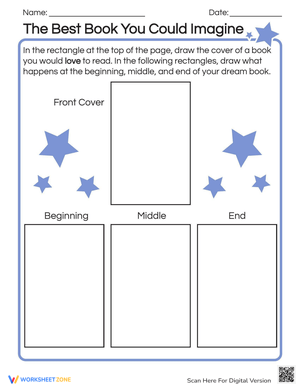
The simpler graphic organizers — Beginning, Middle, End with single-sentence prompts — fit grades 2 and 3, when students are still building the cognitive habit of selecting rather than listing. The SWBST and conflict-mapping worksheets fit grades 4 through 6, where text complexity increases and analytical writing expectations rise. Most fourth-grade teachers find the SWBST format a strong entry point for students who haven't encountered a formal summary structure, including students with strong reading fluency who have never been asked to synthesize rather than recount.
Can these worksheets be used with any fiction text, or only specific titles?
Each worksheet is text-agnostic — the prompts work with whatever narrative the student is reading, whether that's an independent reading book, a guided reading selection, or a class read-aloud. Teachers who use these summarizing fiction texts worksheets resources during literature circles report that students in different groups can complete the same worksheet while reading different books, which simplifies planning during independent work time. The SWBST organizers have been used successfully with picture books, short stories, and individual novel chapters.












 Interactive Worksheet Maker
 Quiz Maker
 Word Search Maker
 Crossword Puzzle Maker
 Word Scramble Generator
 Sentence Scramble Generator
 Handwriting Worksheet Generator
 Name Tracing Generator
 Fill In The Blank Generator