

































Ready Species Interactions Worksheet | Grades 6-12 Science

Paste this activity's link or code into your existing LMS (Google Classroom, Canvas, Teams, Schoology, Moodle, etc.).
Students can open and work on the activity right away, with no student login required.
You'll still be able to track student progress and results from your teacher account.
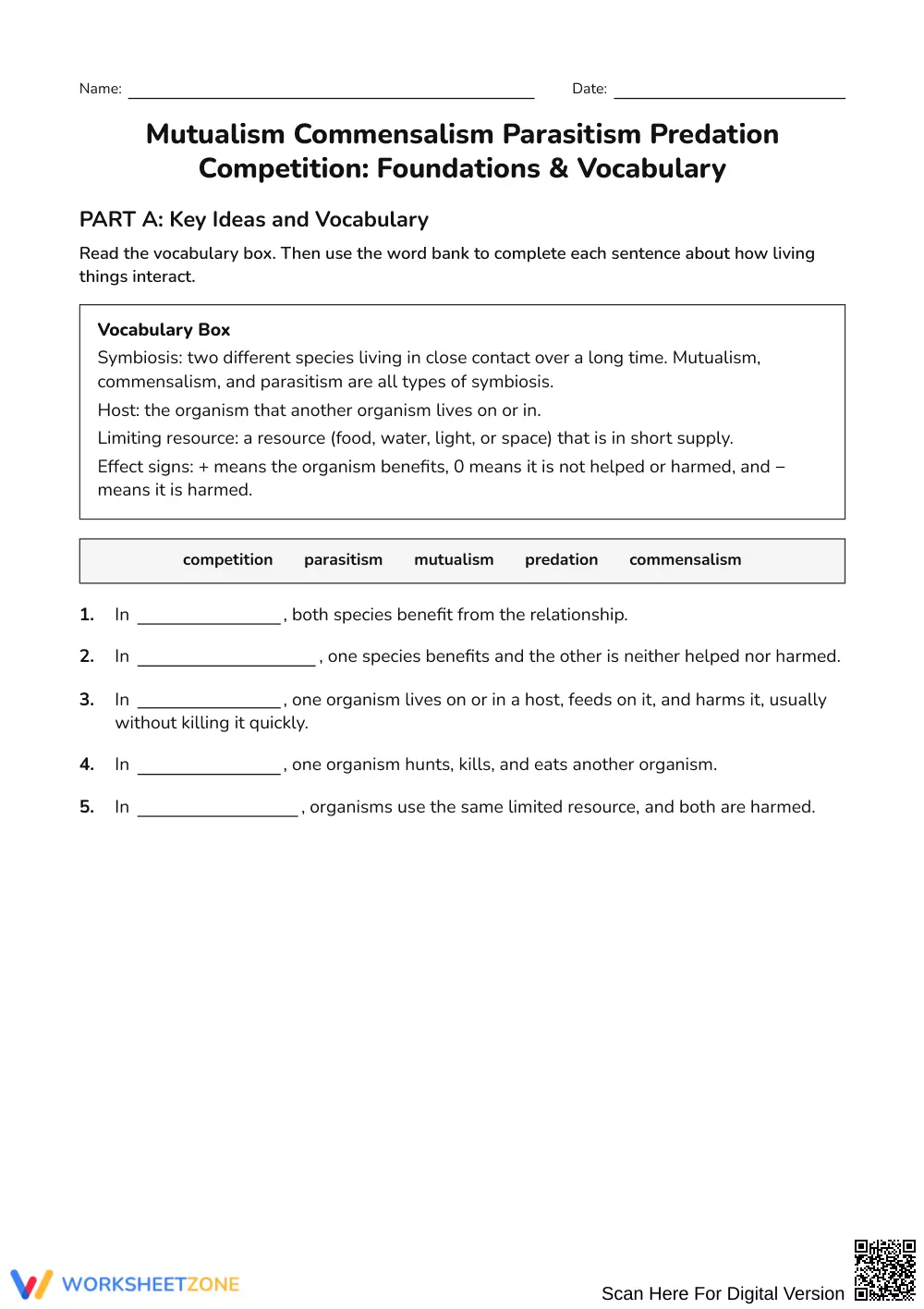
This comprehensive science worksheet reinforces foundational ecological vocabulary by guiding students through mutualism, commensalism, parasitism, predation, and competition. Students examine structured definitions, categorize real-world organisms, evaluate effect notation, analyze experimental growth data, and construct written explanations. The resource ensures learners confidently distinguish subtle differences between organism interactions across four organized, student-friendly pages.
At a Glance
- Grade: Grades 6–12 · Subject: Science
- Standard: Ecosystem Interactions — Analyze and interpret data on symbiotic interactions and resource competition
- Skill Focus: Ecological interactions and symbiosis vocabulary
- Format: 4 pages · 31 problems · Answer key included · PDF
- Best For: Reinforcing core ecological vocabulary and concepts
- Time: 40–50 minutes
What's Inside
This 4-page worksheet delivers 31 scaffolded tasks covering organism interactions. Students begin with a reference box containing key definitions and mathematical effect signs (+, 0, −). The resource includes matching exercises, effect-matrix completion, misconception analysis, experimental growth data tables, and constructed-response prompts. A complete 4-page answer key provides full model responses for streamlined grading.
Skill Progression
- Guided practice (Parts A–B): Students review vocabulary definitions in an explicit reference box and complete 5 fill-in sentences with a word bank, followed by 5 paired matching scenarios.
- Supported practice (Parts C–D): Learners complete a 5-row effect table using +, 0, and − notation and analyze 2 misconception prompts comparing predation, parasitism, and intraspecific competition.
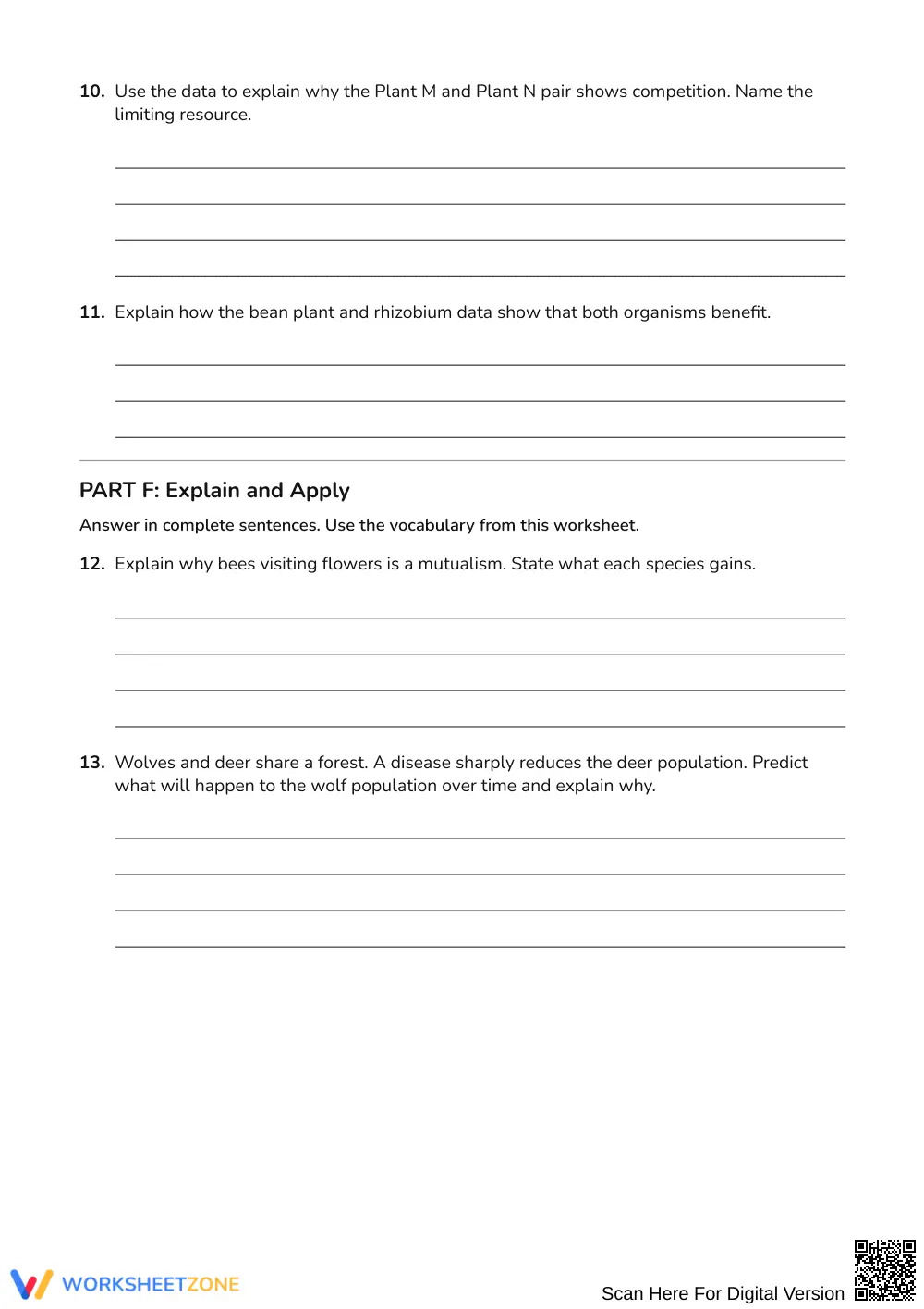
- Independent practice (Parts E–F): Students interpret growth percentages across 3 experimental pairs, solve 3 data analysis questions, and craft 2 extended scientific explanations.
This sequence follows the gradual-release model, moving students from guided recall to independent scientific reasoning.
Standards Alignment
This worksheet aligns with secondary life science standards focusing on interdependent relationships in ecosystems. Students examine how organisms interact within shared environments, distinguish competitive behaviors for limited resources, and analyze mutualistic pairings. This content easily integrates into standard life science curriculum maps, biology units, and secondary IEP instructional goals.
How to Use It
Deploy this worksheet after direct instruction on ecosystem dynamics as a collaborative mid-unit checkpoint or post-lesson independent synthesis. During student work, monitor Part C and Part D to identify whether students confuse parasitism with predation based on effect signs alone. Students typically complete the 31 items within 40 to 50 minutes of instructional time.
Who It's For
This resource serves general science, life science, and introductory biology students in grades 6 through 12. Built-in scaffolds such as word banks and reference boxes support multilingual learners and developing readers. For optimal instruction, pair this worksheet with an interactive food web diagram or a symbiotic relationships video case study.
According to Fisher & Frey (2014), academic literacy increases significantly when instructional materials employ structured vocabulary supports, guided rehearsal, and progressive cognitive release. This science worksheet directly targets ecological interaction terminology—including mutualism, commensalism, parasitism, predation, and competition—by embedding definitions, symbolic effect notation, and multi-tiered practice. Learners progress through 31 items that advance from simple term matching to interpreting quantitative growth data and formulating written predictions. The gradual-release structure provides initial linguistic scaffolding for emerging science learners while culminating in rigorous, analytical synthesis tasks. By explicitly addressing common conceptual misconceptions between predation and parasitism, the activity deepens conceptual clarity rather than relying on surface memorization. Educators can utilize these 4 pages of focused practice to verify that secondary science students establish durable mastery of foundational ecological concepts prior to engaging in advanced ecosystem modeling and population dynamics.


