




























Ready Ecological Pyramids Worksheet | Grades 6-12 Science
Paste this activity's link or code into your existing LMS (Google Classroom, Canvas, Teams, Schoology, Moodle, etc.).
Students can open and work on the activity right away, with no student login required.
You'll still be able to track student progress and results from your teacher account.
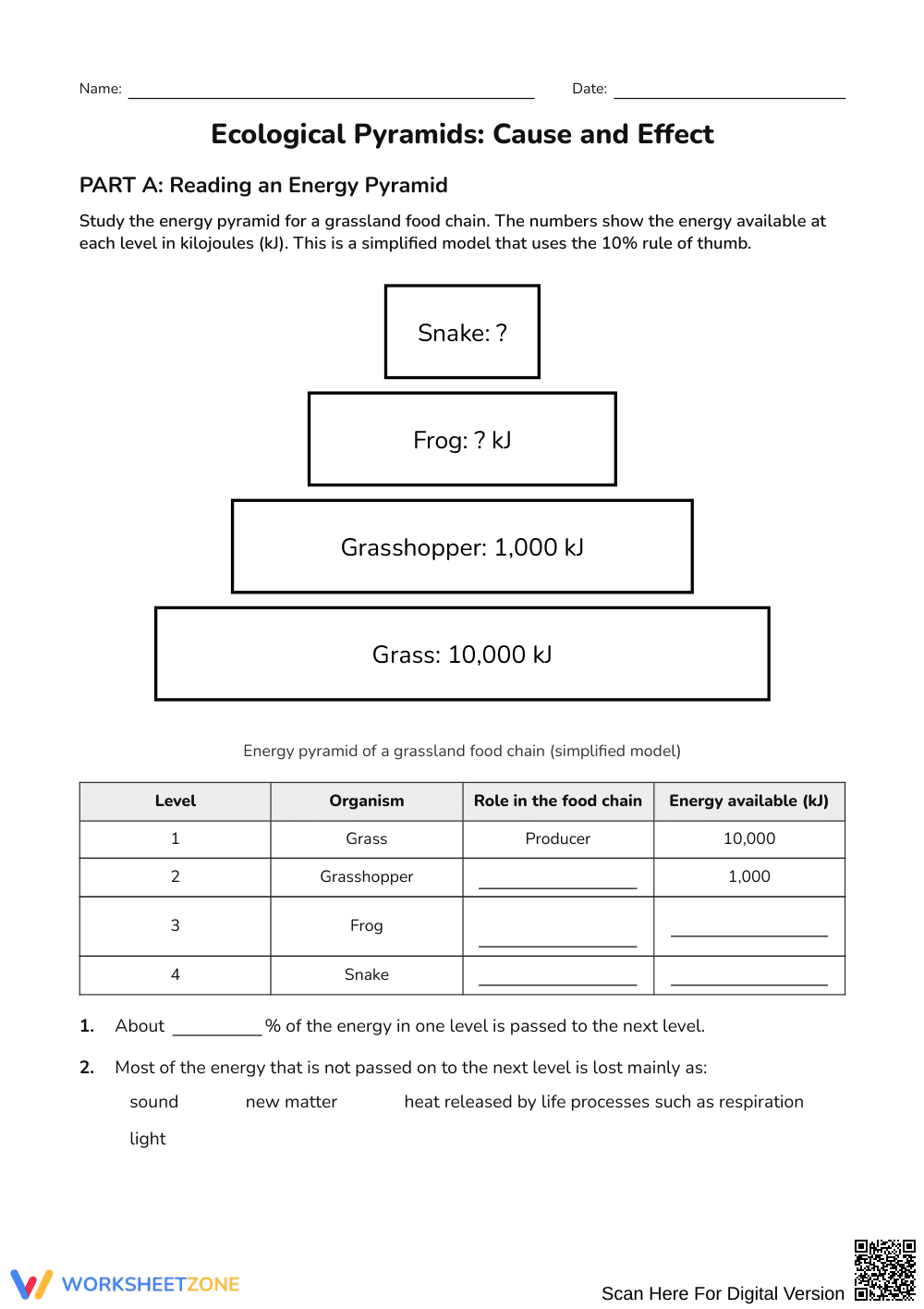
Mastering trophic dynamics requires students to evaluate how energy diminishes across feeding levels. This four-page science worksheet delivers targeted practice analyzing energy, biomass, and numbers pyramids. Through structured cause-and-effect scenarios, students calculate energy transfers using the 10% rule and predict specific ecological outcomes when environmental conditions shift.
At a Glance
- Grade: Grades 6–12 · Subject: Science · Course: Life Science / Biology
- Standard: Model energy flow, biomass distribution, and trophic dynamics across ecological systems
- Skill Focus: Predicting ecological pyramid cause-and-effect changes using the 10% rule
- Format: 4 student pages · 23 problems · 4-page answer key included · Printable PDF
- Best For: Mid-unit formative assessment, classwork practice, or structured review
- Time: 40–50 minutes
What's Inside
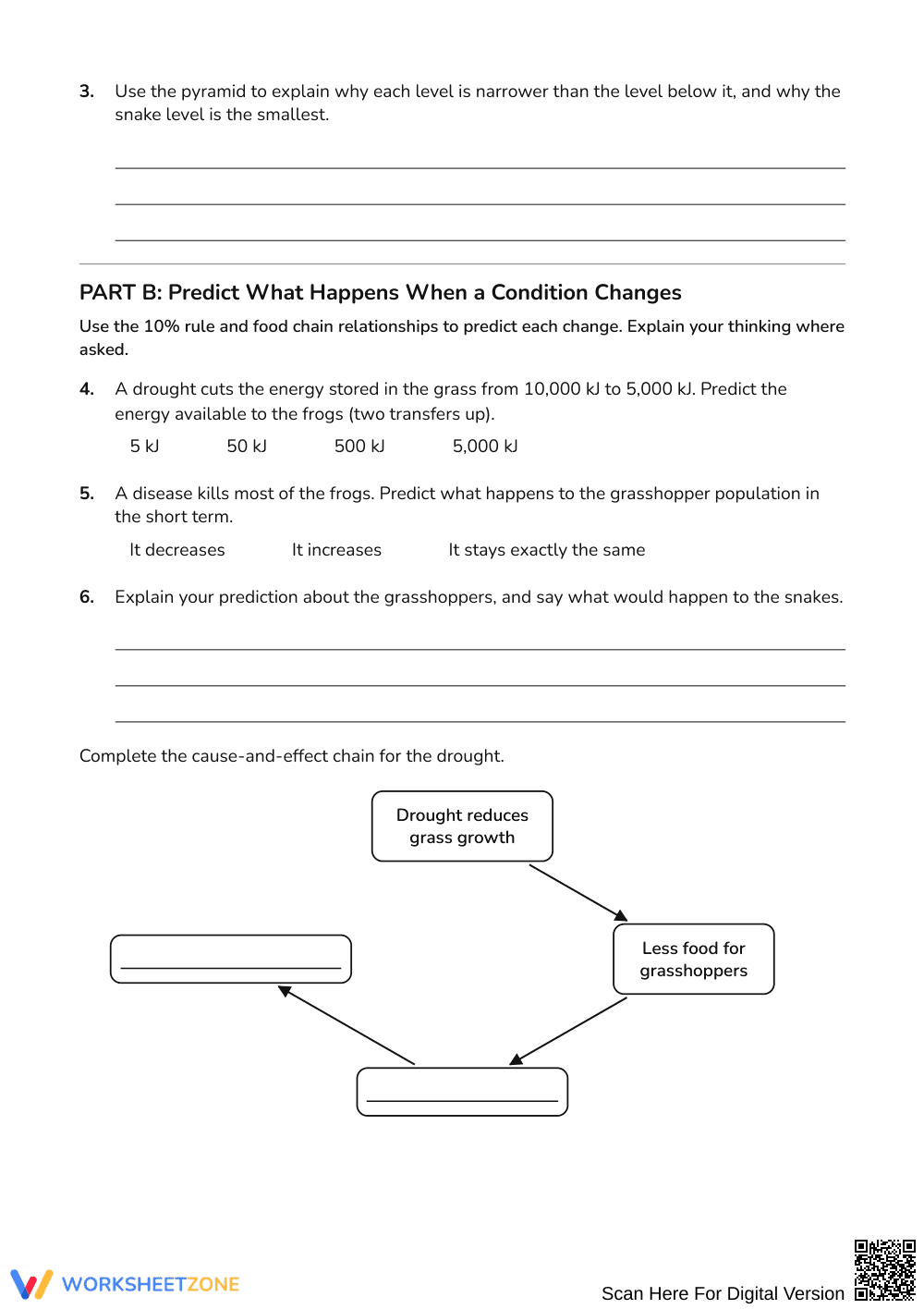
This four-page worksheet contains 23 tasks divided across four coherent parts. Students interpret a grassland energy model, trace disturbance impacts such as drought and disease, contrast upright numbers pyramids with inverted biomass pyramids, and calculate multi-trophic energy transfers. A complete four-page answer key outlines all mathematical calculations and conceptual explanations.
Skill Progression
- Guided Practice (Part A, 4 tasks): Students review the 10% rule, interpreting a grassland energy table and identifying mechanisms of respiratory heat loss.
- Supported Practice (Parts B & C, 14 tasks): Learners apply cause-and-effect chains to model population shifts from drought and evaluate inverted marine biomass data.
- Independent Practice (Part D, 5 tasks): Students calculate multi-step energy transfers and evaluate human dietary efficiency from an ecological perspective.
This sequence implements gradual release, moving from foundational diagram reading to independent synthesis.
Standards Alignment
This worksheet aligns with middle and high school life science standards addressing ecosystem energy flow and trophic dynamics. Students model exponential energy decline across tiers and explain biological constraints on food chain length. Teachers can incorporate these concepts directly into curriculum mapping guides, unit overviews, and lesson plans.
How to Use It
Deploy this worksheet following direct instruction on trophic pyramids and the 10% rule. It serves well as a mid-unit formative assessment or collaborative practice task. During class, monitor Part D to check whether students correctly apply sequential 10% calculations rather than subtraction. Expected completion time is 40 to 50 minutes.
Who It's For
This resource serves middle school life science and introductory biology students. The structured tables support visual learners, while sequential prompts scaffold cause-and-effect writing for developing writers. Pair this worksheet with a food web diagram or hands-on trophic energy demonstration.
According to Fisher & Frey (2014), student mastery of complex scientific concepts relies on purposeful gradual release structures that transition learners from guided analysis to independent evaluation. This 23-task science worksheet targets ecological pyramids across Grades 6 through 12, prompting students to calculate trophic transfers using the 10% rule and predict population responses to environmental disruptions. By connecting graphical models directly to cause-and-effect reasoning, the tasks build student capacity to explain energy dissipation and biomass variation across marine and terrestrial ecosystems. Contrasting inverted biomass snapshots with upright energy pyramids directly addresses widespread student misconceptions regarding energy conservation in ecological food webs. The complete four-page answer key provides step-by-step mathematical reasoning and clear conceptual explanations, making this rigorous resource an ideal asset for ongoing formative evaluation, targeted remediation, and standards-based biology instruction.


