


























Views
Plays

Making Inferences Printable Worksheet | Grade 6 ELA
Paste this activity's link or code into your existing LMS (Google Classroom, Canvas, Teams, Schoology, Moodle, etc.).
Students can open and work on the activity right away, with no student login required.
You'll still be able to track student progress and results from your teacher account.
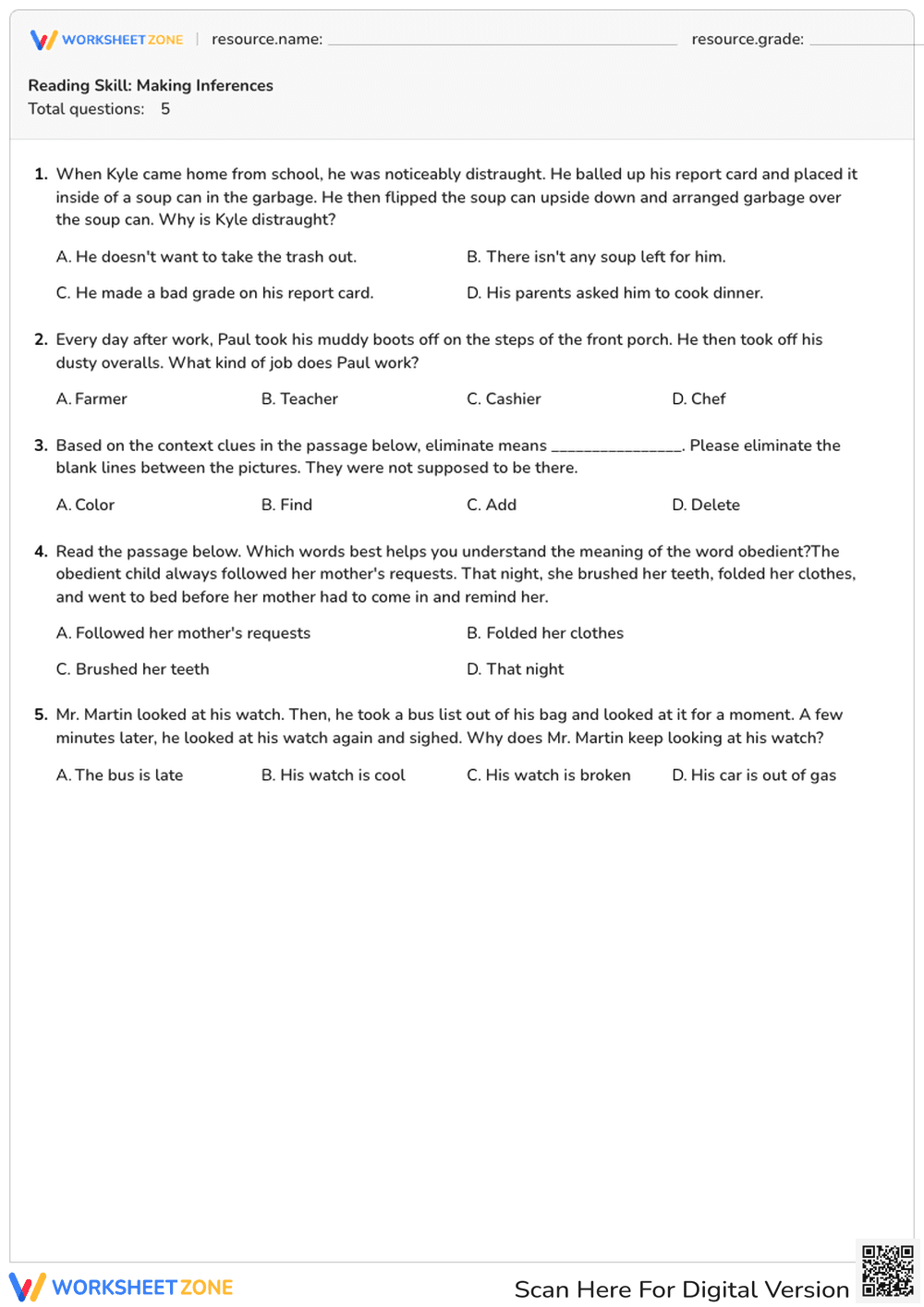
This reading worksheet helps students practice making inferences and using context clues. By analyzing short passages, learners build the critical thinking skills necessary to draw logical conclusions. This targeted practice strengthens reading proficiency and prepares students for complex literary analysis.
At a Glance
- Grade: 6 · Subject: ELA
- Standard:
CCSS.ELA-LITERACY.RL.6.1— Cite textual evidence to support inferences drawn from the text.- Skill Focus: Making Inferences
- Format: 1 page · 5 problems · Answer key included · PDF
- Best For: Formative assessment or independent practice
- Time: 10–15 minutes
Inside this single-page resource, educators will find five multiple-choice questions. Each task presents a brief scenario requiring students to infer information not explicitly stated. Scenarios cover everyday situations, like identifying a character's mood or deducing an occupation, plus vocabulary context clues. A complete answer key ensures quick grading.
This resource offers a streamlined, zero-prep workflow:
- Print (1 min): Download the PDF and print a class set.
- Distribute (1 min): Hand out the single-page quiz as a bell-ringer or exit ticket.
- Review (3 mins): Use the answer key to grade submissions rapidly.
With teacher preparation under two minutes, this worksheet is an excellent addition to any emergency sub plan.
This worksheet is tightly aligned to CCSS.ELA-LITERACY.RL.6.1, requiring students to cite textual evidence to support inferences drawn from the text. Both standard codes can be copied directly into lesson plans, IEP goals, or district curriculum mapping tools.
Assign this worksheet after direct instruction on inferencing to gauge comprehension, or use it as a bell-ringer to activate prior knowledge. As an observation tip, monitor which question types students struggle with to guide small-group interventions. Students should complete the five questions within 10 to 15 minutes.
Designed for sixth-grade ELA students, this resource also serves as a review tool for seventh graders. To support differentiation, teachers can read passages aloud for students with accommodations or require advanced learners to underline text evidence. It pairs perfectly with an anchor chart on context clues.
Mastering the ability to read between the lines is a fundamental component of adolescent literacy. According to a RAND AIRS 2024 report on reading comprehension, explicit practice with targeted inference tasks significantly improves a student's capacity to process complex texts. When learners engage with materials aligned to CCSS.ELA-LITERACY.RL.6.1, they develop the cognitive habits required to cite textual evidence to support inferences drawn from the text. Connecting background knowledge with text clues bridges the gap between basic decoding and advanced analysis. By providing structured scenarios that isolate this process, educators build student confidence. Consistent exposure ensures students are equipped to tackle rigorous reading demands across all content areas.


