




























Views
Downloads

Printable Properties of Water Worksheet | Grade 9 Science

Paste this activity's link or code into your existing LMS (Google Classroom, Canvas, Teams, Schoology, Moodle, etc.).
Students can open and work on the activity right away, with no student login required.
You'll still be able to track student progress and results from your teacher account.
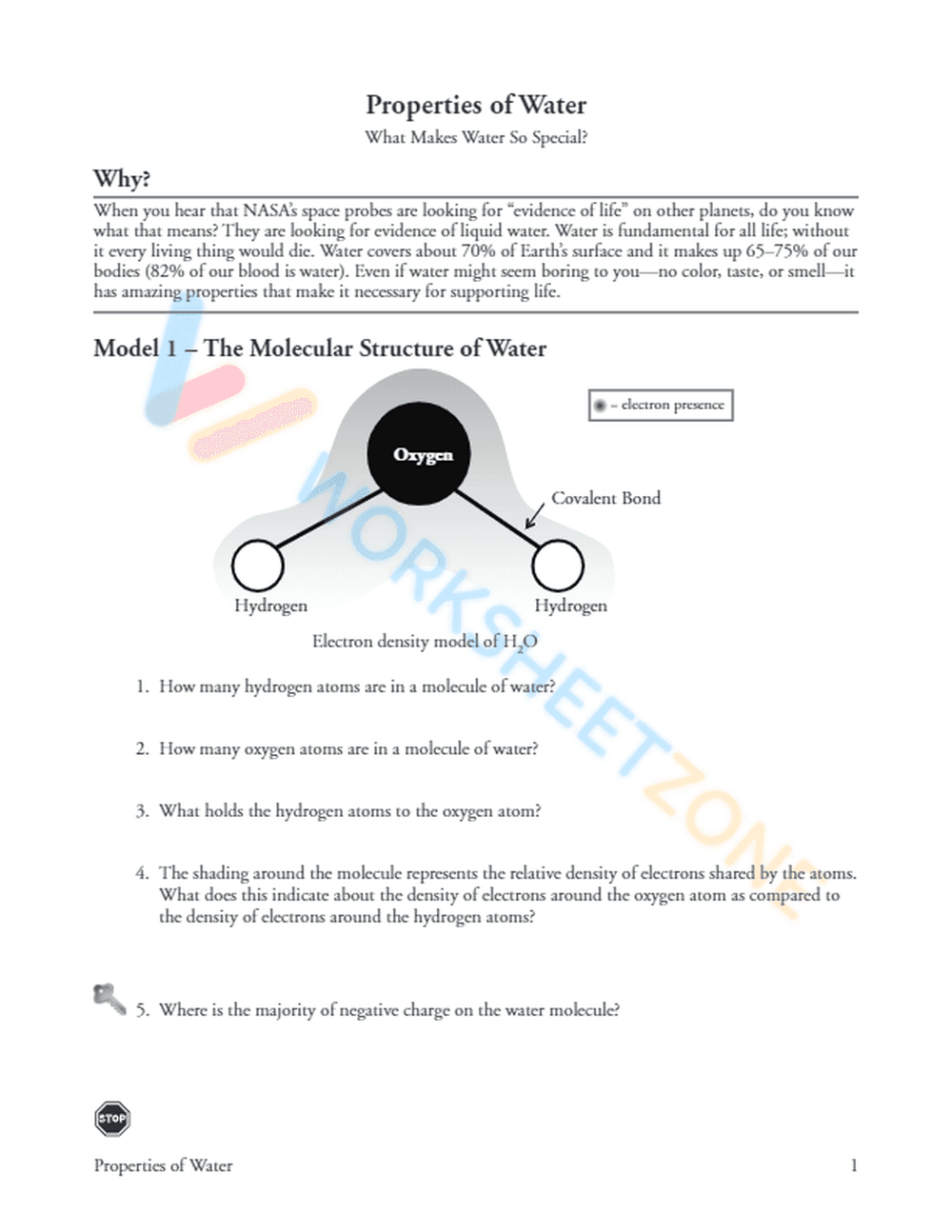
This comprehensive properties of water worksheet guides high school science students through the molecular structure of H2O. By analyzing diagrams and reading short passages, learners will understand covalent bonds, electron density, and hydrogen bonding, ultimately explaining why water is essential for supporting life on Earth.
At a Glance
- Grade: 9-12 · Subject: Science
- Standard:
HS-PS1-3— Infer the strength of electrical forces between particles- Skill Focus: Molecular structure and polarity
- Format: 4 pages · 17 problems · PDF
- Best For: Guided group work or independent study
- Time: 30–45 minutes
Inside this four-page resource, educators will find a carefully sequenced set of 17 analytical questions. The activity features detailed molecular models, including electron density diagrams and water molecule clusters, to help students visualize abstract concepts. A dedicated reading section on polar molecules bridges the gap between visual models and scientific terminology, while extension questions challenge students to apply their knowledge to DNA and nonpolar substances.
- Guided practice: The first 5 questions introduce the basic molecular structure of water, asking students to identify atoms and covalent bonds using clear visual models.
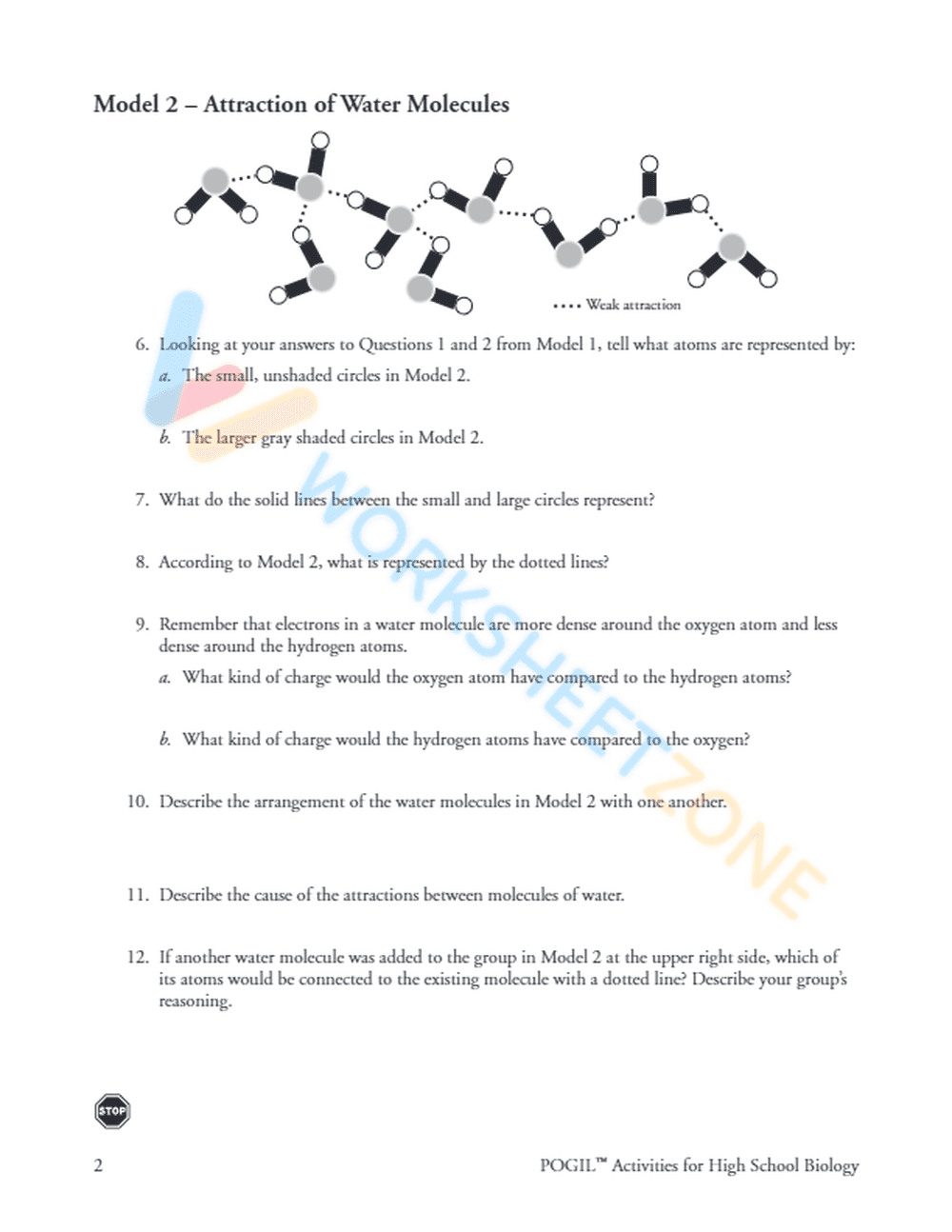
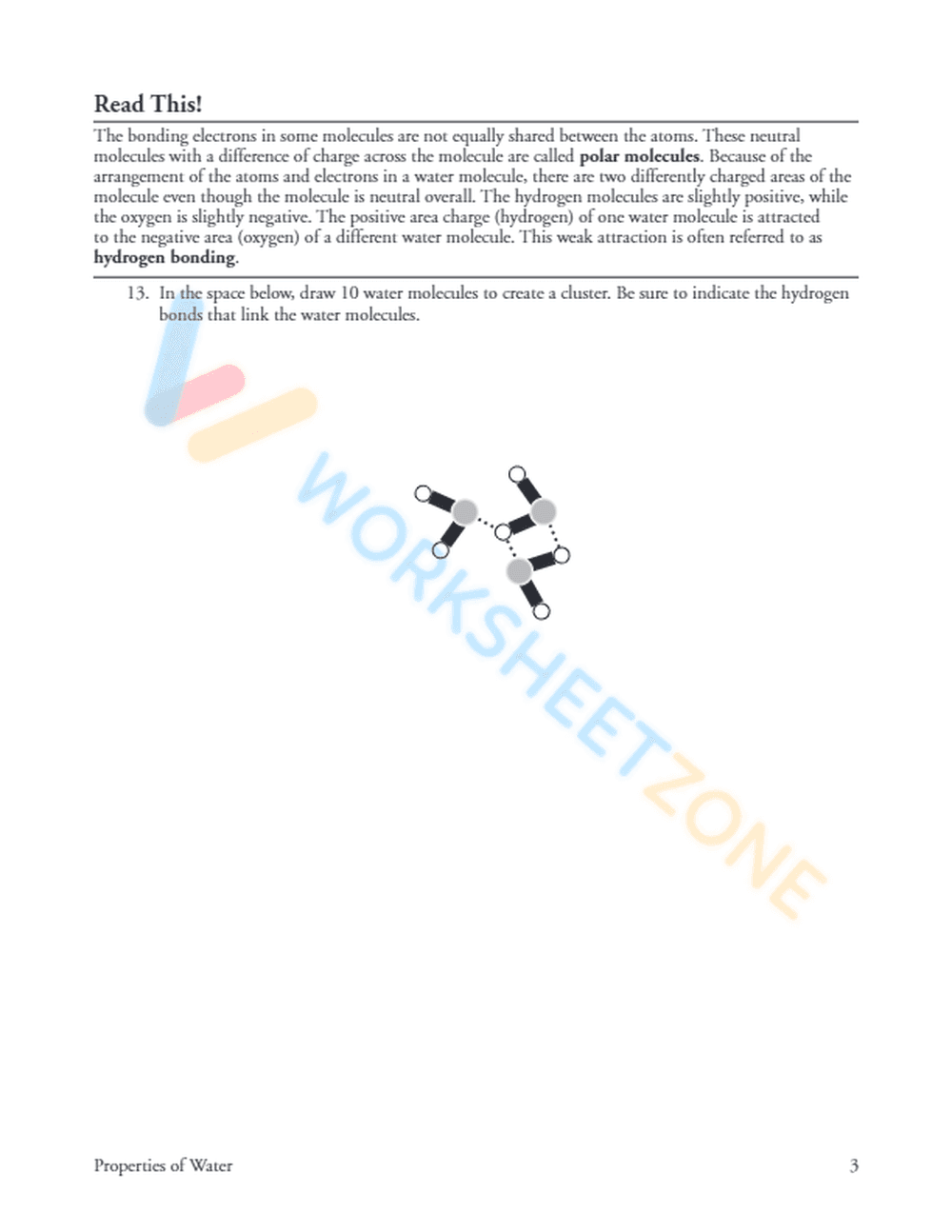
- Supported practice: Questions 6 through 13 explore the attraction between water molecules, introducing hydrogen bonding and polarity with step-by-step analytical prompts.
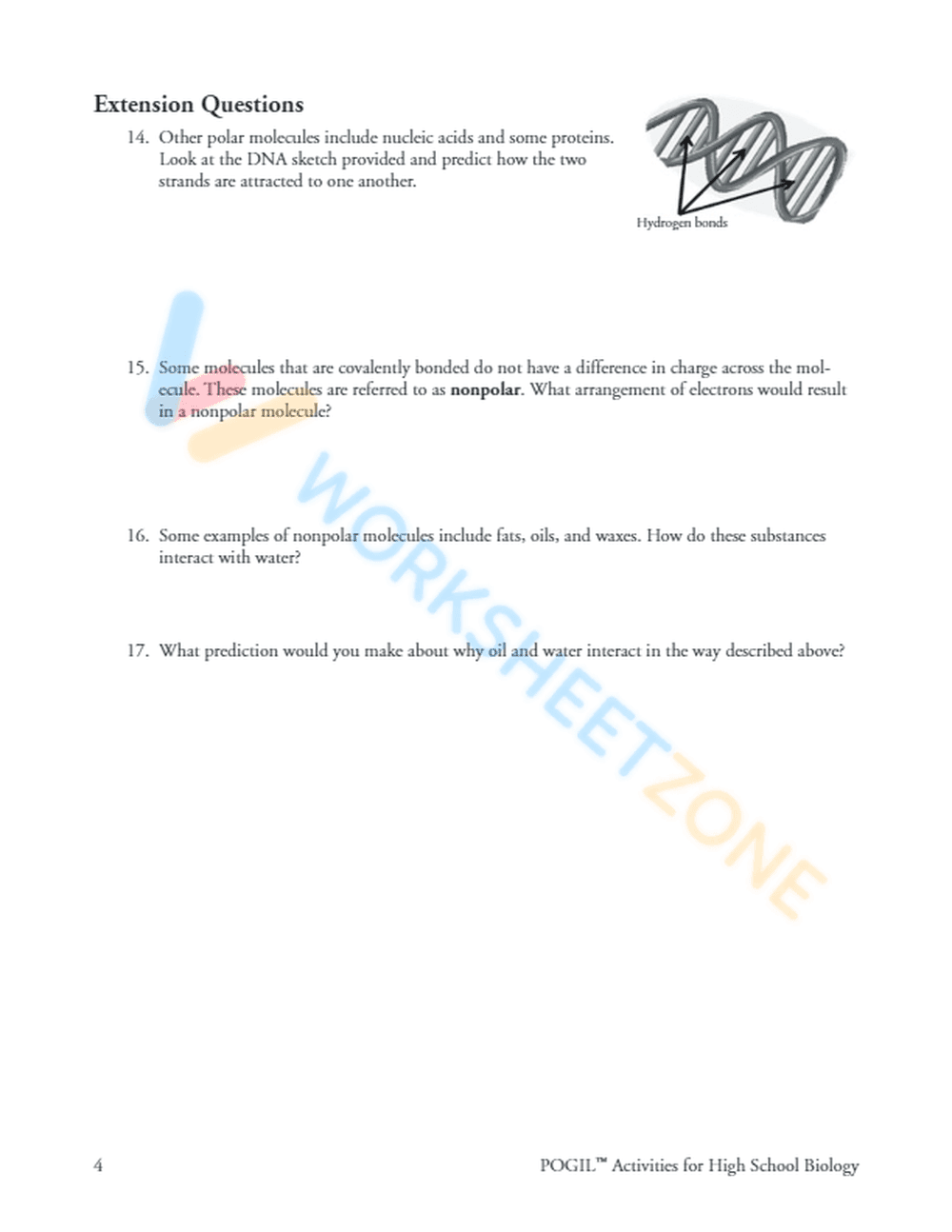
- Independent practice: The final 4 extension questions require students to predict interactions between polar and nonpolar molecules, such as oils and waxes.
This gradual-release approach ensures students build confidence as they move from simple observations to complex scientific reasoning.
Aligned to HS-PS1-3, this resource supports students as they infer the strength of electrical forces between particles based on molecular structure. It also touches upon foundational biology concepts regarding how molecular interactions support life processes. Both standard codes can be copied directly into lesson plans, IEP goals, or district curriculum mapping tools.
This worksheet is highly effective when used during direct instruction as a collaborative inquiry activity. Place students in small groups to discuss the models and build consensus on the answers before reviewing as a class. As a formative assessment tip, circulate the room during the hydrogen bonding drawing task (Question 13) to quickly gauge which students grasp the concept of polarity. Expect the full packet to take 30 to 45 minutes to complete.
Designed primarily for high school biology and chemistry students, this resource provides essential scaffolding for learners struggling with abstract molecular concepts. The visual models make it accessible for visual learners and English Language Learners. It pairs perfectly with an introductory lesson on biochemistry or a hands-on lab demonstrating water's unique properties like surface tension and cohesion.
Mastering the concepts outlined in HS-PS1-3 requires students to infer the strength of electrical forces between particles, which is a foundational skill for understanding complex biological and chemical systems. According to a recent ScienceDirect TpT Analysis, inquiry-based modeling activities significantly improve student retention of abstract micro-scale phenomena when compared directly to traditional lecture methods. By guiding learners to construct their own understanding of polarity and hydrogen bonding through structured visual analysis, this properties of water worksheet aligns perfectly with evidence-based practices for modern science education. When students actively engage with these detailed molecular models, they develop the critical thinking skills necessary to predict how different substances will interact in real-world biological environments. This targeted practice ensures learners build the robust conceptual framework required for advanced high school science coursework and beyond.


