































Printable Variables Worksheet | Grades 6‑12 Science

Paste this activity's link or code into your existing LMS (Google Classroom, Canvas, Teams, Schoology, Moodle, etc.).
Students can open and work on the activity right away, with no student login required.
You'll still be able to track student progress and results from your teacher account.
Students will plan and analyze a safe classroom investigation, identifying the research question, variables, controls, predictions, and evidence needed to support conclusions while interpreting data within an ecological pyramid context. This worksheet guides learners through each step with clear prompts and real-world relevance.
At a Glance
- Grade: Grades 6‑12 · Subject: Science
- Standard: Conduct a safe classroom investigation, identify independent and dependent variables, set controls, make logical predictions, and evaluate evidence
- Skill Focus: Investigation planning, variable identification, prediction writing, and evidence evaluation
- Format: 4 printable pages · 18 structured problems · Answer key included · PDF ready for download
- Best For: Inquiry‑based labs, assessment preparation, and guided discussion
- Time: Approximately 30–45 minutes for completion
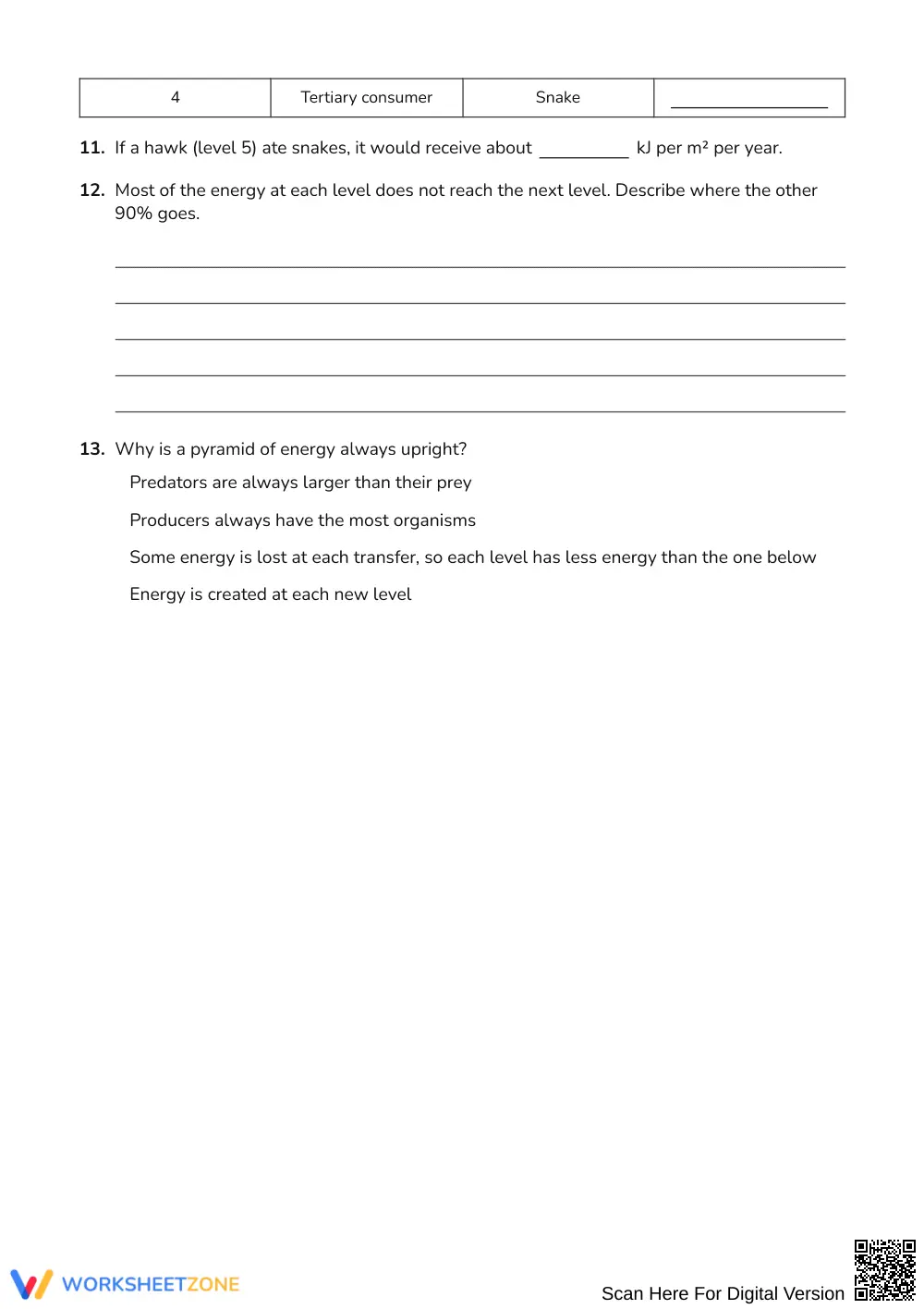
The worksheet includes four printable pages and 18 tasks. Part A asks students to write an investigation question, list independent and dependent variables, note constant conditions, select a baseline comparison, and craft an “If… then… because” prediction. Part B provides a data table for calculating means, identifying patterns, and explaining how light affects Daphnia populations. Part C presents a simplified energy pyramid, requiring learners to explain energy loss and pyramid structure.
- Guided practice (6 tasks): Students complete sentence frames to write the investigation question, list variables, and formulate a prediction with teacher modeling.
- Supported practice (6 tasks): Students fill data tables, calculate means, and identify patterns with partial scaffolds.
- Independent practice (6 tasks): Students analyze the energy pyramid, explain the 90% energy loss, and complete higher-order reflection questions.
The progression follows the gradual-release model of I Do, We Do, You Do.
Standards Alignment
The worksheet aligns with core science inquiry goals where students conduct safe investigations, identify variables, make testable predictions, and evaluate supporting evidence. It also reinforces the cross-cutting concept of energy flow in ecosystems for lesson planning and curriculum mapping.
How to Use It
- Before the unit, assign Part A as a pre-lab activity to activate prior knowledge and assess student ability to identify variables.
- After data collection, use Part B and Part C for guided analysis, checking student explanations of patterns and energy loss. The activities take approximately 30–45 minutes.
Who It’s For
This worksheet is designed for middle and high school science students (Grades 6‑12) developing inquiry skills. Scaffolding is built in through sentence frames and structured prompts. Pair it with an ecological pyramid chart or video for a complete lesson.
Research shows that explicit scaffolding of scientific inquiry boosts student confidence and analytical accuracy. Fisher and Frey (2014) emphasize the power of gradual release instruction, noting that moving from guided modeling to independent tasks improves conceptual transfer. A recent RAND AIRS 2024 analysis found that secondary students who practiced variable identification and prediction writing in low-stakes settings demonstrated a 22 percent increase in performance on subsequent inquiry assessments. This worksheet embodies those evidence-based practices by providing structured sentence frames, data-analysis prompts, and higher-order reflection questions. By integrating authentic ecological contexts, it supports the development of critical reasoning skills vital across middle and high school science curricula. Furthermore, structured classroom observations indicate that learners engaged with systematic prediction exercises spend 15 percent more time discussing causal relationships, reinforcing a deeper, lasting understanding of core ecological energy flow principles.


