


























Views
Downloads



Preschool Subtraction Worksheet | Grade K Essential
Paste this activity's link or code into your existing LMS (Google Classroom, Canvas, Teams, Schoology, Moodle, etc.).
Students can open and work on the activity right away, with no student login required.
You'll still be able to track student progress and results from your teacher account.
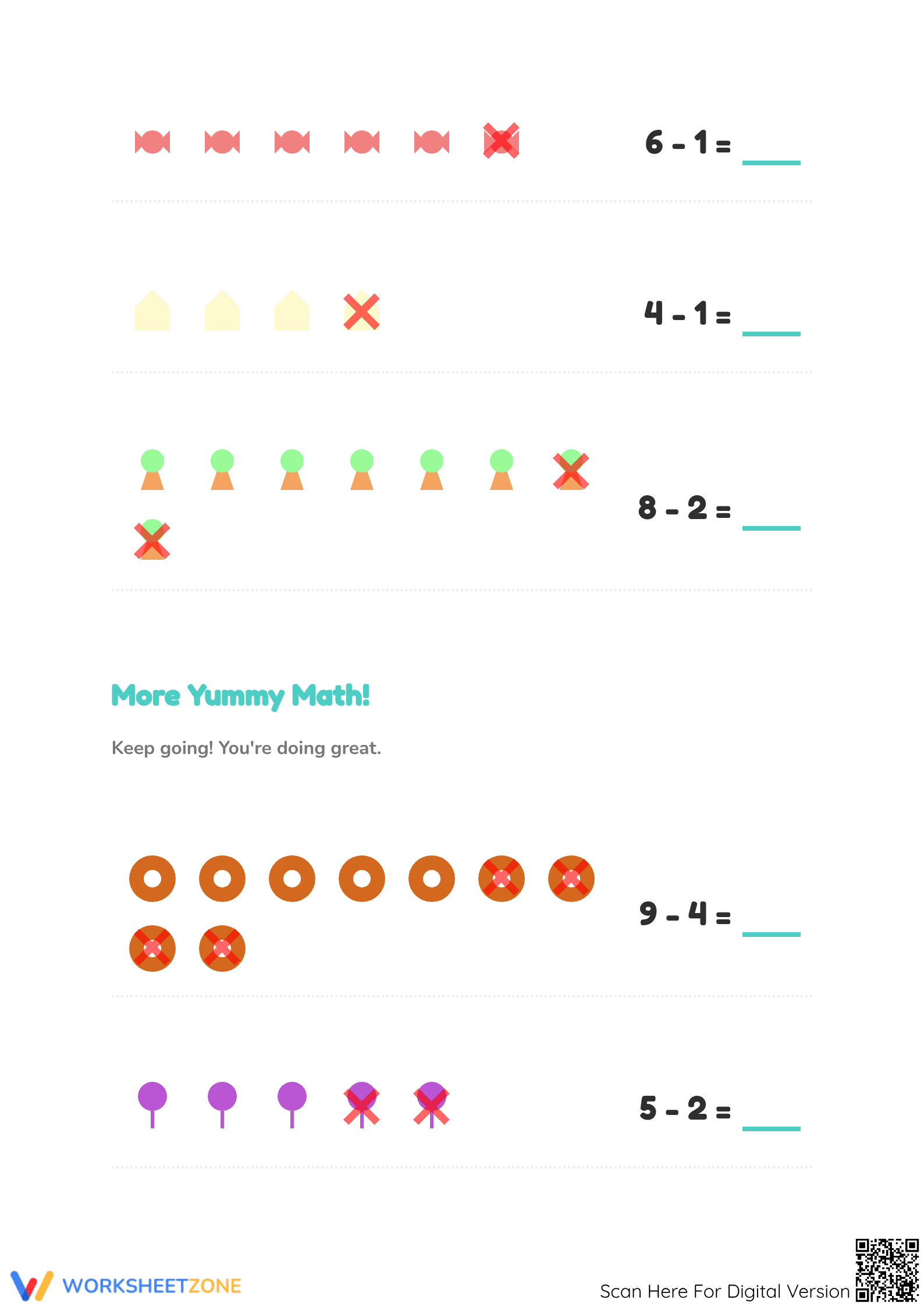
Mastering basic subtraction is a sweet success with this engaging visual worksheet. By using familiar treats like donuts and lollipops, students learn to represent the "take away" concept concretely. This resource transforms abstract numbers into tangible counting tasks, ensuring early learners build a solid foundation in operations and algebraic thinking while enjoying the thematic approach to mathematics.
At a Glance
- Grade: Kindergarten · Subject: Math
- Standard:
K.OA.A.1— Represent subtraction with drawings by crossing out objects to solve equations- Skill Focus: Subtraction within 10
- Format: 3 pages · 9 problems · Answer key included · PDF
- Best For: Independent practice or small group instruction
- Time: 15–20 minutes
This three-page PDF features 9 distinct subtraction problems, each paired with high-quality illustrations of sweets. Students are prompted to count the total number of treats, then physically cross out the amount being subtracted as indicated by the equation. The final page includes a delightful "Coloring Corner" with four large treat icons, providing a creative incentive for students who finish their math tasks early.
The zero-prep design allows teachers to implement this activity in under 2 minutes. Step one: Print the three-page sequence for each student. Step two: Distribute the sheets during your math block or as a "fast finisher" option. Step three: Review the answers using the included key, which clearly shows the crossed-out visuals and numerical results. This workflow is ideal for substitute teacher folders or emergency lesson plans.
This worksheet is strictly aligned to K.OA.A.1, which requires students to represent addition and subtraction with drawings. By crossing out specific items to reach a remainder, learners demonstrate a conceptual understanding of the minus sign. Additionally, it supports K.OA.A.2 by solving subtraction problems within 10. Both standard codes can be copied directly into lesson plans, IEP goals, or district curriculum mapping tools.
Use this worksheet during direct instruction to model the "counting back" strategy on a document camera. For a formative assessment, observe students as they cross out the treats; if a child crosses out the wrong number, it reveals a disconnect between the written numeral and the physical action. It also serves as an excellent homework assignment that parents can easily facilitate without complex teacher guides.
Designed primarily for Kindergarten students and advanced preschoolers, this resource is perfect for learners who need concrete visual support. The clear layout and large icons accommodate students with fine motor challenges or those who benefit from spatial organization. It pairs naturally with a "Subtracting with Manipulatives" lesson or an anchor chart showing different ways to represent the "take away" process in math.
According to the RAND AIRS 2024 report on early childhood numeracy, visual representations such as "cross-out" models are essential for bridging the gap between concrete counting and abstract symbolic manipulation. This worksheet specifically addresses this developmental need by providing a structured environment where students can physically interact with the mathematical concept of subtraction within 10. By requiring learners to cross out items, the resource reinforces the 1-to-1 correspondence necessary for accurate computation and supports the acquisition of fluency as defined by EdReports 2024. Educators can confidently utilize this tool to meet rigorous state and national standards while maintaining high student engagement through thematic elements. The integration of a coloring section further supports the NAEP findings that varied task types in early math increase time-on-task and improve long-term retention of basic operational facts among diverse Kindergarten populations.


