


























Views
Downloads
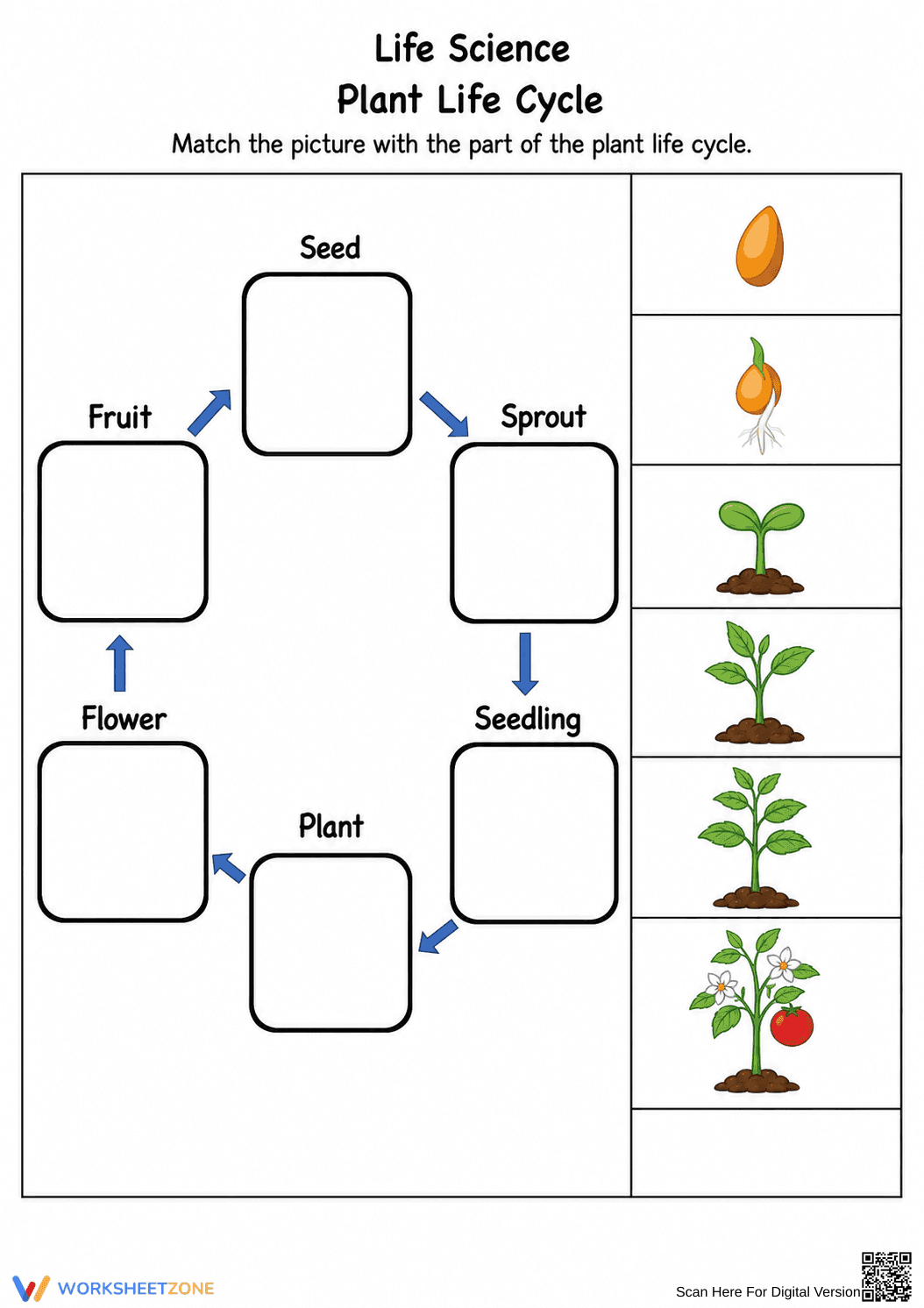

Grade 3 Plant Life Cycle — Printable No-Prep Worksheet
Paste this activity's link or code into your existing LMS (Google Classroom, Canvas, Teams, Schoology, Moodle, etc.).
Students can open and work on the activity right away, with no student login required.
You'll still be able to track student progress and results from your teacher account.
This Grade 3 plant life cycle worksheet helps students visualize the biological progression of flowering plants. By matching visual representations to specific terminology, learners develop a concrete understanding of how organisms grow and change over time. It provides a clear, structured way to master the sequence from germination to fruit production.
At a Glance
- Grade: 3 · Subject: Science
- Standard:
3-LS1-1— Develop models to describe that organisms have unique and diverse life cycles- Skill Focus: Life cycle sequencing
- Format: 1 page · 6 problems · Answer key included · PDF
- Best For: Independent practice or quick formative assessment
- Time: 10–15 minutes
This single-page PDF features a circular flow diagram representing the six key stages of a plant's life. Students are presented with six high-quality illustrations—including seeds, sprouts, and mature plants—which they must correctly pair with the corresponding labels. The layout includes a clear answer key for rapid grading and immediate student feedback.
Zero-Prep Workflow
- Print: Generate the single-page PDF for your entire class in under 30 seconds.
- Distribute: Hand out the sheets as a morning warm-up or a quick exit ticket (1 minute).
- Review: Use the provided answer key to verify the circular sequence as a whole class (2 minutes).
Total teacher preparation time is under two minutes, making it an ideal sub-plan resource or a last-minute addition to a life science unit.
Standards Alignment
The primary focus is `3-LS1-1`, which requires students to develop models to describe that organisms have unique and diverse life cycles but all have in common birth, growth, reproduction, and death. This activity serves as a foundational model for plant growth. Both standard codes can be copied directly into lesson plans, IEP goals, or district curriculum mapping tools.
How to Use It
Use this worksheet during the "Explain" phase of a 5E lesson model to reinforce vocabulary after a seed-planting observation. It also functions effectively as a formative assessment tool; observe if students can distinguish between the "sprout" and "seedling" stages. Completion typically takes 10 to 15 minutes depending on prior knowledge.
Who It's For
This resource is designed for third-grade science students, though it is accessible for second graders or as a review for older learners. It is particularly helpful for English Language Learners (ELLs) due to the heavy reliance on visual cues and matching. Pair this with a physical bean-growing project or a life cycle anchor chart.
According to the RAND AIRS 2024 report, visual sequencing tasks are critical for developing scientific literacy in elementary learners. This worksheet aligns with the 3-LS1-1 standard by requiring students to identify the common stages of growth and reproduction in flowering plants. By engaging with 6 distinct stages—seed, sprout, seedling, plant, flower, and fruit—students build a mental model of biological continuity. Research from Fisher & Frey (2014) suggests that such scaffolded matching activities support the gradual release of responsibility, moving students from guided observation to independent mastery of complex biological concepts. This resource provides the necessary structure for students to internalize the cyclical nature of life, ensuring they meet grade-level expectations for modeling life science phenomena while reducing cognitive load through clear, high-contrast imagery and direct terminology.


