


























Views
Downloads
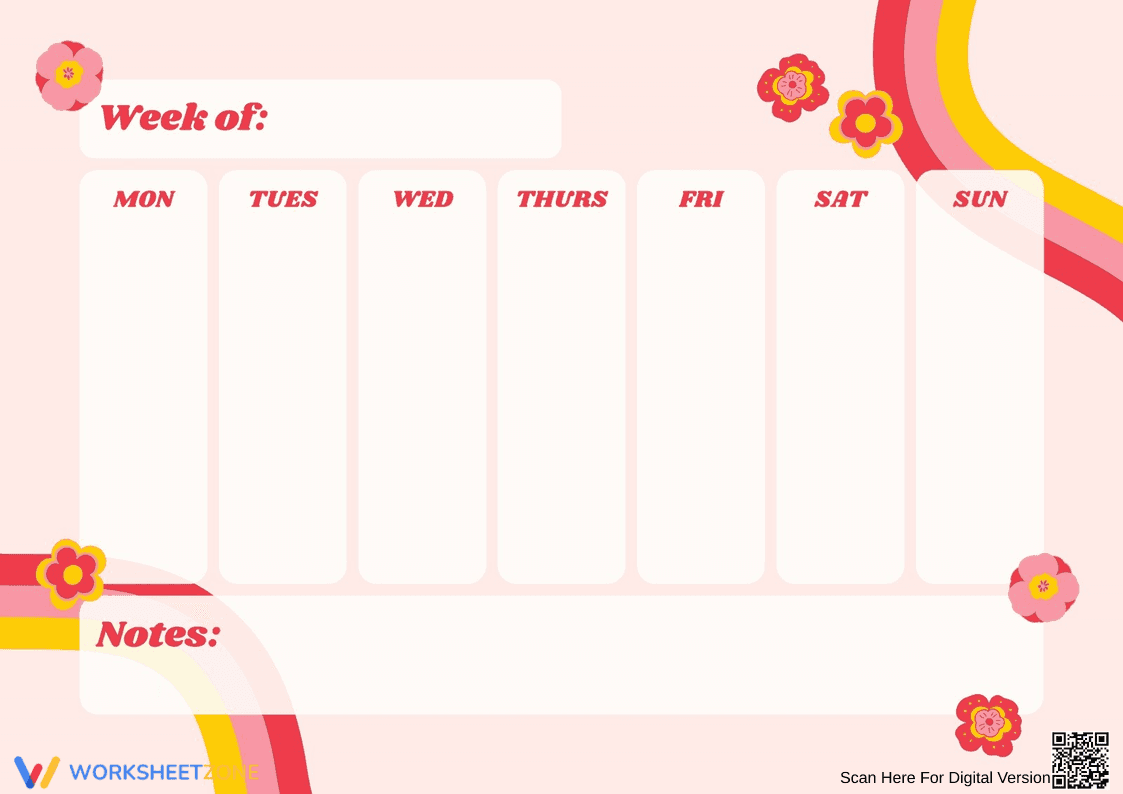

Weekly Planner Worksheet | Grade 3 Essential Printable
Paste this activity's link or code into your existing LMS (Google Classroom, Canvas, Teams, Schoology, Moodle, etc.).
Students can open and work on the activity right away, with no student login required.
You'll still be able to track student progress and results from your teacher account.
Organize Your Week with Style
This Grade 3 weekly planner worksheet provides a structured visual framework for students to manage their time and responsibilities. By using this resource, learners practice the essential skill of routine writing for organizational purposes, ensuring they stay on track with assignments and personal goals. The clear layout promotes independence and reduces scheduling anxiety.
At a Glance
- Grade: 3 · Subject: Life Skills
- Standard:
CCSS.ELA-LITERACY.W.3.10— Write routinely over extended time frames for specific organizational purposes- Skill Focus: Time management and organization
- Format: 1 page · 9 sections · Answer key not applicable · PDF
- Best For: Daily student agenda and morning routines
- Time: 5–10 minutes
What's Inside
The worksheet features a landscape orientation with seven dedicated columns for every day of the week, from Monday through Sunday. It includes a prominent "Week of" header for date tracking and a spacious "Notes" section at the bottom for reminders or reflections. The retro floral design provides an engaging aesthetic without distracting from the functional writing spaces provided on the single-page PDF.
Zero-Prep Workflow
- Print: Select the landscape PDF and print copies for your entire class in less than 1 minute.
- Distribute: Hand out the planners during Monday morning meeting to establish a consistent weekly routine.
- Review: Spend 2 minutes modeling how to record one primary learning objective in the daily column to guide student focus.
Standards Alignment
This resource aligns with `CCSS.ELA-LITERACY.W.3.10`, which requires students to write routinely over extended time frames for a range of discipline-specific tasks, purposes, and audiences. By maintaining a weekly log, students apply writing skills to real-world organization. This standard code can be copied directly into lesson plans, IEP goals, or district curriculum mapping tools.
How to Use It
Integrate this planner during the first ten minutes of the school day as a formative assessment of student readiness. Observe how students prioritize their tasks to identify those who may need additional executive function support. It is also highly effective as a homework tracker, where students record evening assignments before dismissal to ensure clear communication between school and home.
Who It's For
This worksheet is designed for Grade 3 students but is adaptable for any elementary learner needing organizational support. It is particularly beneficial for students with ADHD or those who struggle with transitions. Pair this resource with a classroom anchor chart on time management or a direct instruction lesson on setting SMART goals for the week.
Fisher & Frey (2014) emphasize that the gradual release of responsibility is most effective when students use structural scaffolds to manage their own learning processes. This weekly planner provides that necessary framework, enabling Grade 3 students to meet the routine writing expectations of CCSS.ELA-LITERACY.W.3.10. By externalizing their daily schedules and notes, learners develop the executive function required for academic independence. Research suggests that visual organizers with distinct spatial boundaries reduce cognitive load and help students prioritize tasks effectively. This resource offers a consistent, predictable format for tracking assignments, which is essential for developing self-regulation skills in early elementary education. The inclusion of a notes area further supports metacognitive reflection. Implementing this printable as a daily tool ensures that organizational habits are reinforced, creating a structured environment that accommodates diverse learners while fostering the skills needed for long-term success in more complex academic settings.


