


























Views
Downloads

Essential New Year’s History & Traditions — Grade 4 ELA
Paste this activity's link or code into your existing LMS (Google Classroom, Canvas, Teams, Schoology, Moodle, etc.).
Students can open and work on the activity right away, with no student login required.
You'll still be able to track student progress and results from your teacher account.
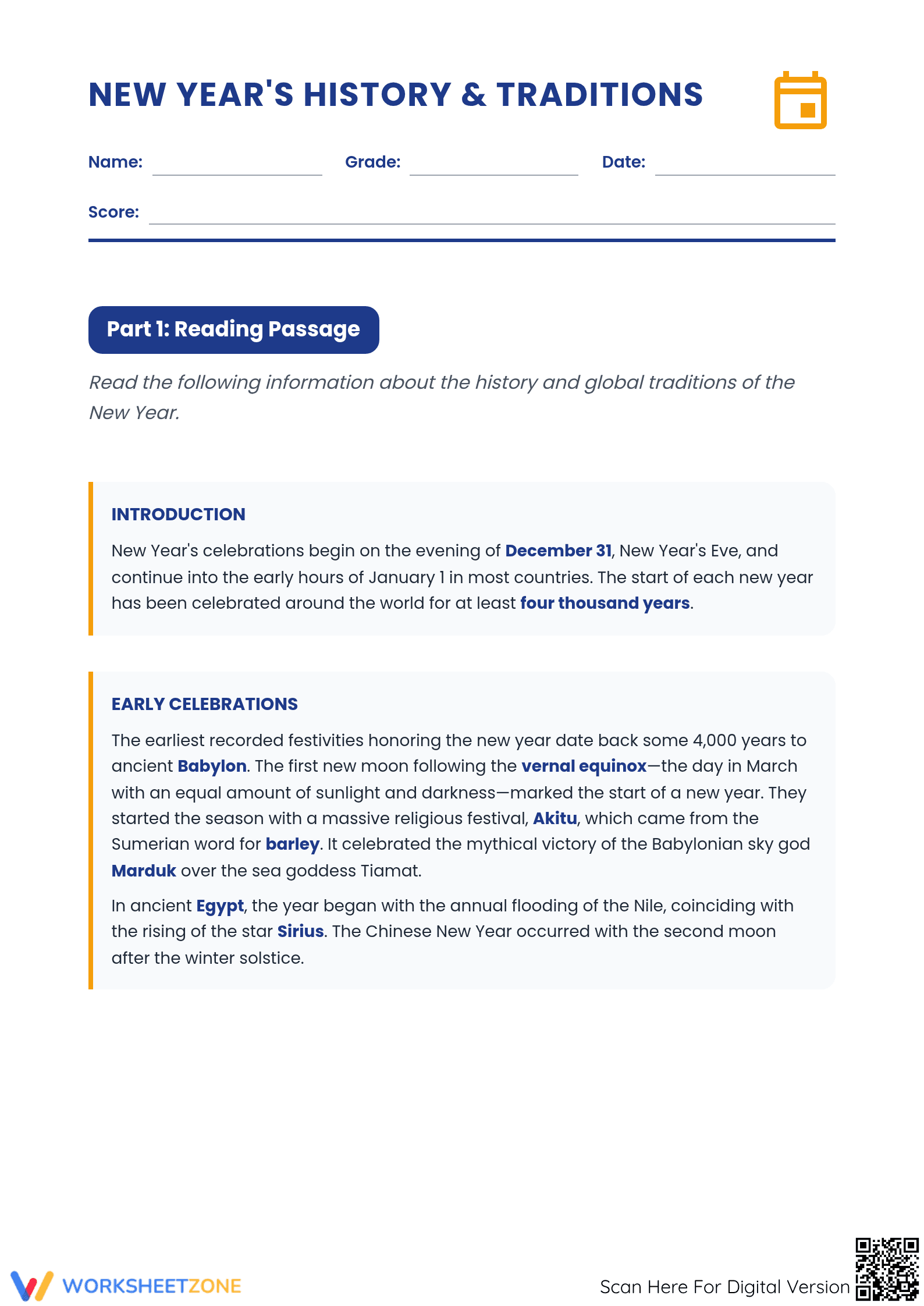
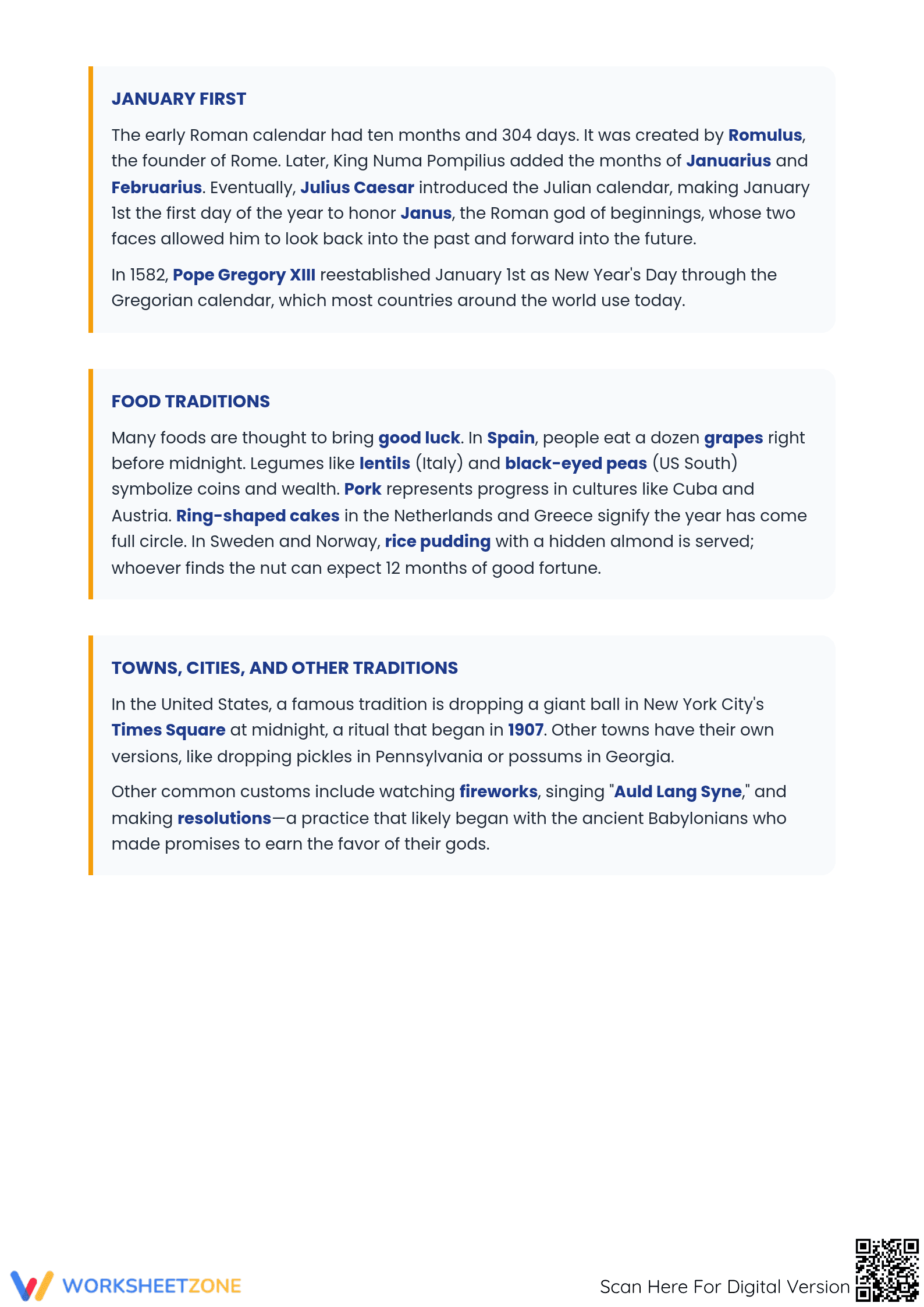
This comprehensive reading comprehension packet explores the deep historical roots and diverse global traditions of the New Year. Students engage with a detailed multi-page text to extract key facts about ancient Babylon, Roman calendar shifts, and modern cultural customs. By connecting historical evidence to modern practices, learners build critical informational reading skills and cultural awareness.
At a Glance
- Grade: 4 · Subject: English Language Arts
- Standard:
CCSS.ELA-LITERACY.RI.4.1— Refer to details and examples in a text when explaining what the text says- Skill Focus: Informational Reading Comprehension
- Format: 5 pages · 19 problems · Answer key included · PDF
- Best For: Holiday-themed informational text analysis and assessment
- Time: 45–60 minutes
What's Inside
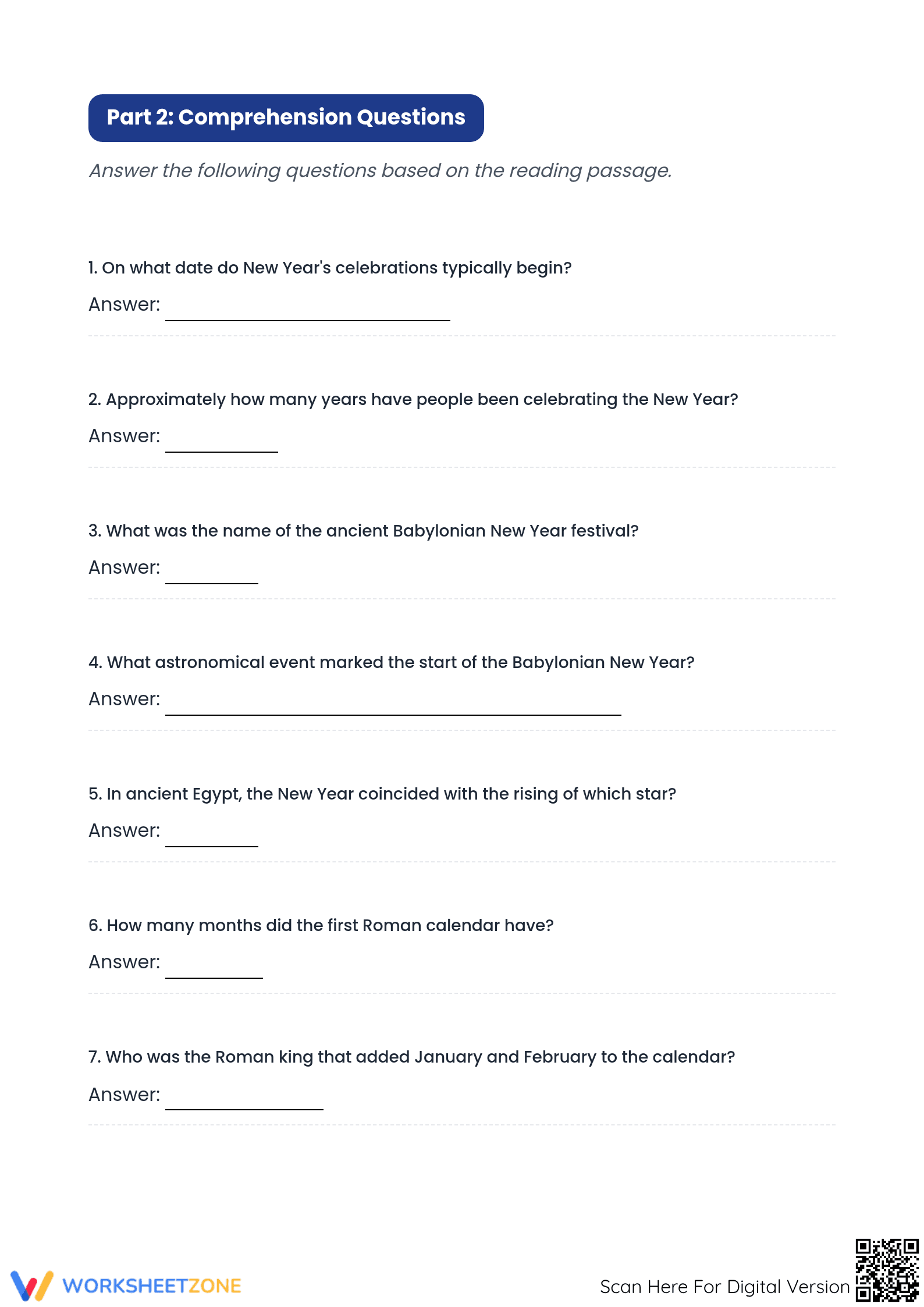
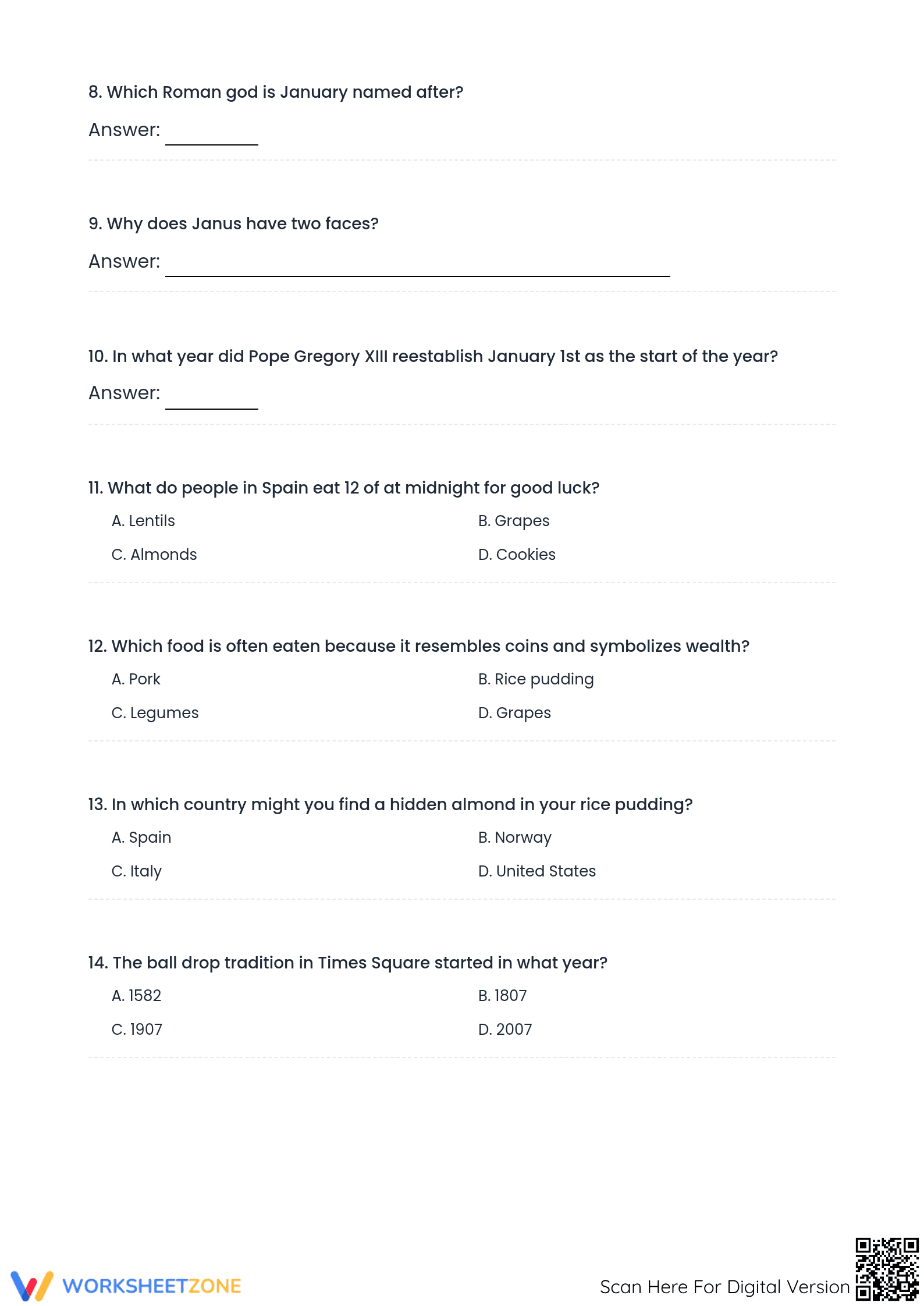
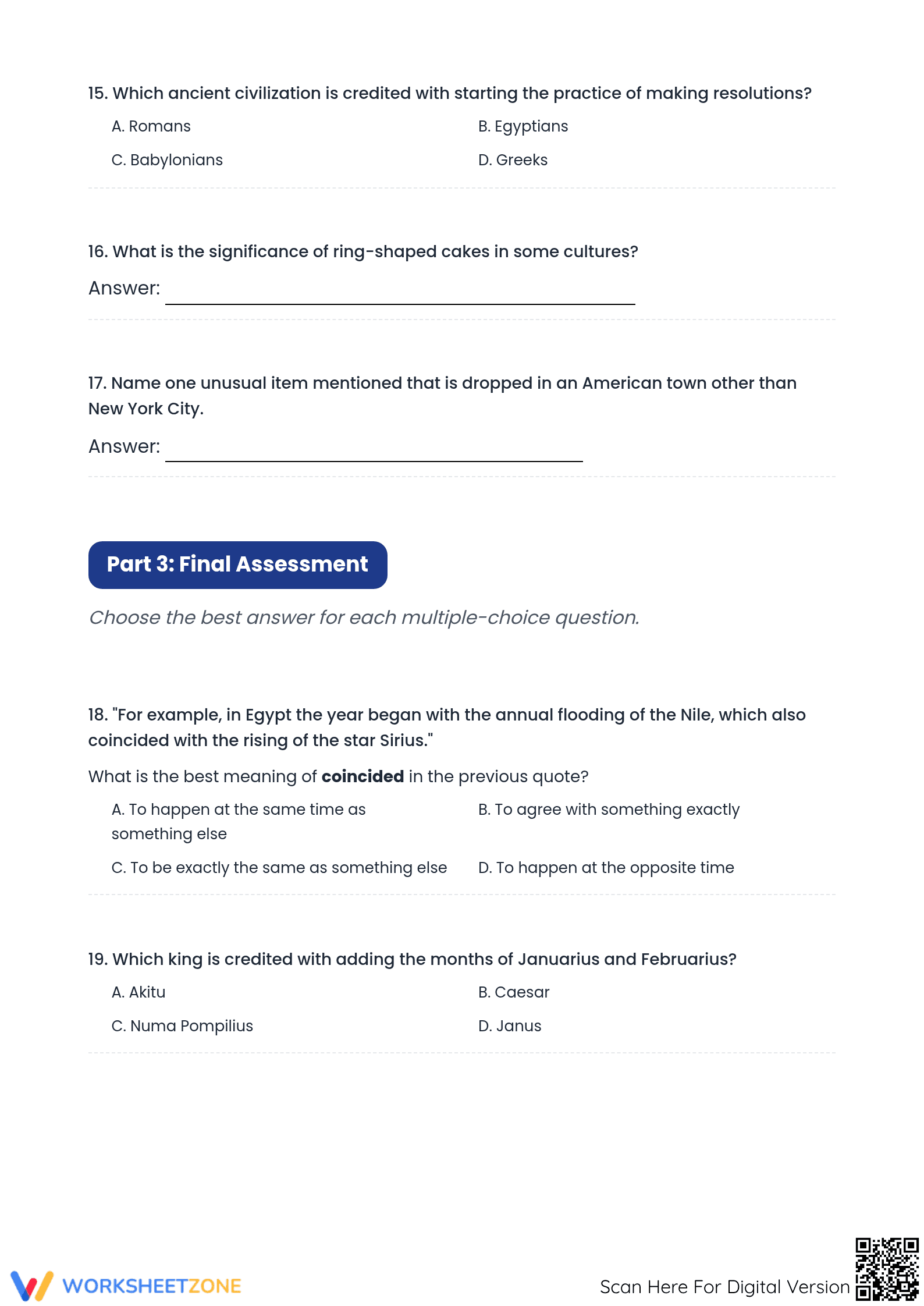
This 5-page printable resource includes a two-page detailed reading passage divided into manageable sections like "Early Celebrations" and "Food Traditions." Following the text, students encounter 17 comprehension questions, including short-answer and multiple-choice formats, plus a final two-question assessment focused on vocabulary in context. A complete answer key is provided for efficient grading and immediate student feedback.
Skill Progression
- Guided Practice: 10 short-answer questions require students to locate explicit facts, such as specific dates and figures like Julius Caesar.
- Supported Practice: Questions 11-17 use multiple-choice formats to categorize global traditions and identify symbols of wealth across cultures.
- Independent Practice: Final tasks require students to determine vocabulary meaning in context and synthesize historical information.
This resource utilizes a gradual release model to move students from locating explicit evidence to inferring meaning and applying vocabulary skills.
Standards Alignment
This resource is primary aligned to CCSS.ELA-LITERACY.RI.4.1, which requires students to refer to details and examples in a text when explaining what the text says explicitly. It also supports CCSS.ELA-LITERACY.RI.4.4 through context-clue tasks that ask students to define domain-specific terms like "coincided." Both standard codes can be copied directly into lesson plans, IEP goals, or district curriculum mapping tools.
How to Use It
This worksheet is ideal for use during a dedicated social studies or ELA block in late December or early January. Use it as a summative assessment after a whole-class discussion on seasonal holidays to gauge individual comprehension levels. For a formative assessment tip, observe students as they complete the short-answer section to see if they are returning to the text for evidence or relying on memory. Completion typically takes 50 minutes.
Who It's For
This resource is designed for Grade 4 students, though it is highly appropriate for Grade 3-6 learners depending on their reading proficiency. It serves as an excellent enrichment tool for advanced third graders or a scaffolded review for sixth graders. It pairs naturally with a comparative cultural passage or a world map activity to visualize the traditions mentioned in the text.
Research from Fisher & Frey (2014) emphasizes that complex informational texts, like this history-focused passage, are essential for developing disciplinary literacy and background knowledge in middle-grade learners. By requiring students to interact with 19 structured tasks aligned to CCSS.ELA-LITERACY.RI.4.1, this resource ensures students practice high-utility skills such as citing textual evidence and identifying main ideas. The integration of historical facts with modern cultural practices provides the necessary context for students to transition from learning to read to reading to learn. Consistent exposure to these multi-page informational sets has been shown to improve NAEP reading scores by strengthening stamina and close-reading habits. Educators can utilize this worksheet as a benchmark for student growth in analyzing non-fiction structures, ensuring that learners are prepared for the rigorous demands of upper-elementary standardized assessments and future academic inquiries.


