


























Views
Downloads




"Casey at the Bat" Narrative Poem | Essential Grade 4
Paste this activity's link or code into your existing LMS (Google Classroom, Canvas, Teams, Schoology, Moodle, etc.).
Students can open and work on the activity right away, with no student login required.
You'll still be able to track student progress and results from your teacher account.
This Grade 4 reading comprehension worksheet uses the classic narrative poem "Casey at the Bat" to help students master evidence-based analysis. By engaging with Ernest Thayer’s rhythmic text, learners identify key plot points and character motivations to improve their literary interpretation skills. It provides a complete framework for analyzing narrative structure and poetic devices.
At a Glance
- Grade: 4 · Subject: English Language Arts
- Standard:
RL.4.1— Refer to details and examples in a text when explaining what the text says- Skill Focus: Narrative Poetry Analysis
- Format: 4 pages · 6 problems · Answer key included · PDF
- Best For: Whole-class reading and formative assessment
- Time: 25–35 minutes
What's Inside
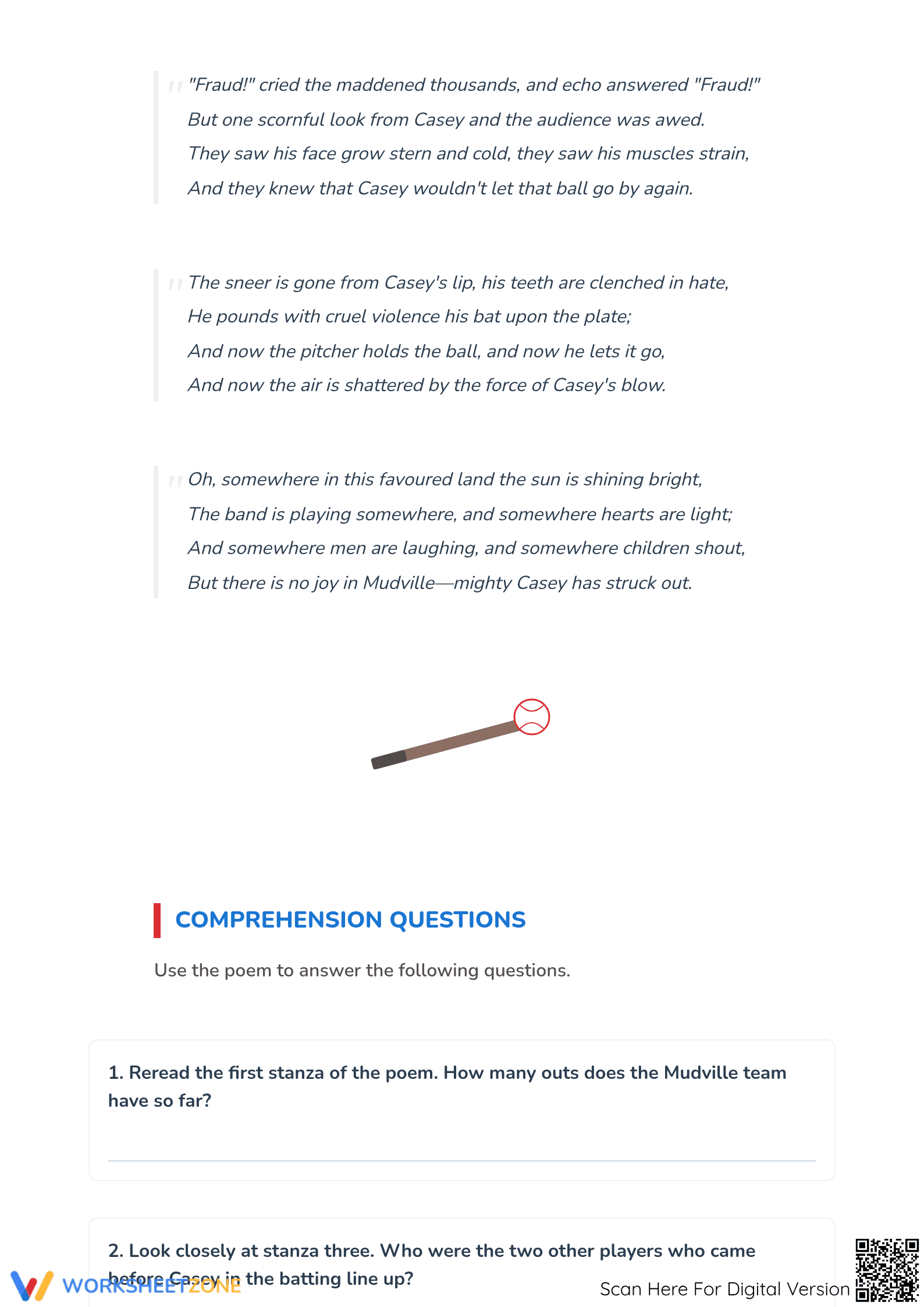
This comprehensive 4-page PDF includes the full unabridged text of "Casey at the Bat" by Ernest Lawrence Thayer, spread across three readable pages. The final page features 6 targeted comprehension questions that require students to revisit specific stanzas. A detailed answer key is provided to streamline grading and provide immediate feedback on student inferences and literal understanding.
Skill Progression
- Guided Practice: Students begin by rereading the opening stanza to identify the immediate setting and conflict, establishing a baseline for literal comprehension.
- Supported Practice: Middle-tier questions ask students to interpret specific vocabulary like "hoodoo" and "cake" within the context of the poem’s baseball theme.
- Independent Practice: The final tasks require students to track the sequence of the climactic three pitches, requiring them to synthesize the poem's conclusion independently.
This gradual-release approach ensures students move from basic recall to deeper structural analysis using the I Do, We Do, You Do model.
Standards Alignment
The primary focus of this resource is RL.4.1, which requires students to "Refer to details and examples in a text when explaining what the text says explicitly and when drawing inferences from the text." Additionally, it supports RL.3.5 by exploring how stanzas build on one another. Both standard codes can be copied directly into lesson plans, IEP goals, or district curriculum mapping tools.
How to Use It
Use this worksheet during the "during reading" phase of a poetry unit to practice active annotation. Teachers can model the first two questions as a think-aloud, then have students complete the remaining four in pairs. As a formative assessment, observe if students are physically looking back at the text to find the specific stanzas mentioned in the prompts. Completion typically takes 30 minutes.
Who It's For
This resource is designed for Grade 4 students but is highly effective for Grade 3 enrichment or Grade 5 review. It serves English Language Learners well due to the clear stanza references. Pair this worksheet with an audio recording of the poem or a baseball-themed anchor chart to provide multi-sensory support for diverse learners.
The use of narrative poetry like "Casey at the Bat" is a proven method for increasing student engagement with complex text structures. According to Fisher & Frey (2014), close reading of rhythmic, narrative-driven texts allows students to develop a stronger grasp of character development and chronological sequence. This worksheet specifically targets RL.4.1 by forcing students to return to the text for evidence, a core requirement for meeting college and career readiness benchmarks. By breaking the 13 stanzas into manageable reading chunks followed by 6 evidence-based questions, the resource reduces cognitive load while maintaining high academic rigor. Research from the NAEP suggests that students who regularly practice with diverse genres, including poetry, show higher proficiency in overall reading comprehension. This printable PDF provides the necessary scaffolding to move students from surface-level reading to deep, evidence-based literary analysis within a standard 35-minute instructional block.


