


























Views
Downloads

Printable Monohybrid Crosses Worksheet | Grade 9 Biology
Paste this activity's link or code into your existing LMS (Google Classroom, Canvas, Teams, Schoology, Moodle, etc.).
Students can open and work on the activity right away, with no student login required.
You'll still be able to track student progress and results from your teacher account.
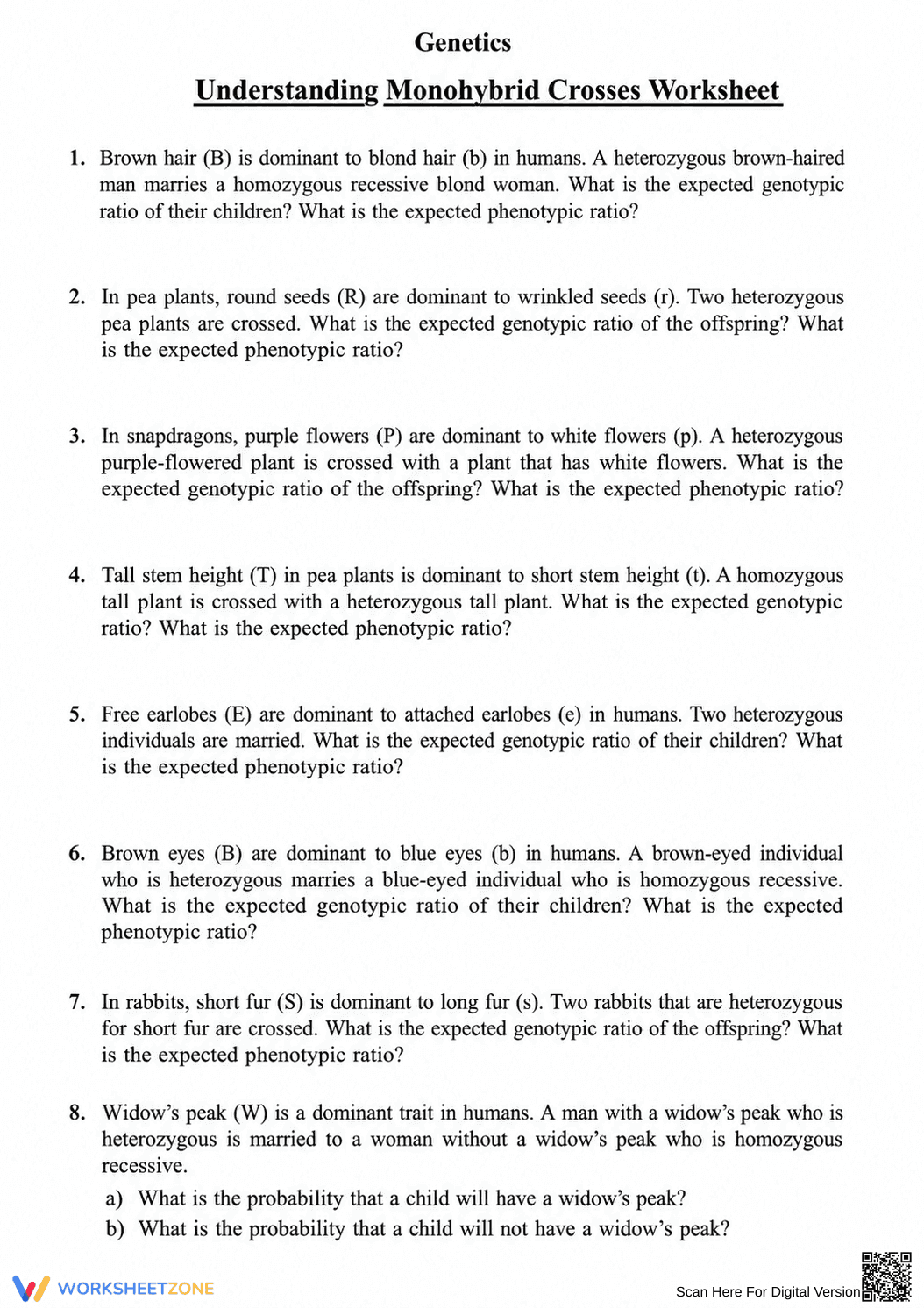
This high school biology worksheet provides focused practice on Mendelian genetics and monohybrid crosses. Students read real-world scenarios, identify alleles, and calculate expected genotypic and phenotypic ratios. This resource helps learners confidently apply probability to predict trait inheritance.
At a Glance
- Grade: 9 · Subject: Biology
- Standard:
HS-LS3-3— Apply probability to predict the distribution of expressed traits- Skill Focus: Monohybrid crosses and phenotypic ratios
- Format: 1 page · 8 problems · Answer key included · PDF
- Best For: Independent practice and review
- Time: 20–30 minutes
What's Inside
Inside this single-page resource, educators will find eight detailed word problems covering humans, pea plants, snapdragons, and rabbits. Each task requires students to evaluate parental genotypes to determine likely offspring outcomes. The straightforward format allows students to easily set up Punnett squares in the margins or on separate paper.
Skill Progression
This assignment follows a logical progression to build student confidence in genetic probability:
- Guided practice: The initial problems feature simple dominant-recessive relationships, allowing students to establish baseline skills in setting up crosses.
- Supported practice: Mid-level questions introduce different organisms and require careful reading to distinguish between homozygous and heterozygous terminology.
- Independent practice: The final tasks challenge students to calculate specific percentage probabilities for multiple traits, ensuring deep conceptual understanding.
This gradual-release approach ensures students master the "I Do, We Do, You Do" methodology for genetic problem-solving.
Standards Alignment
This material aligns to the Next Generation Science Standards, specifically HS-LS3-3: Apply concepts of statistics and probability to explain the variation and distribution of expressed traits in a population. It supports foundational math skills through ratio calculations. Both standard codes can be copied directly into lesson plans, IEP goals, or district curriculum mapping tools.
How to Use It
Deploy this worksheet during the middle of a genetics unit, immediately following direct instruction on Punnett squares. It serves as an excellent independent homework assignment or a collaborative in-class activity where students can compare their calculated ratios. As a formative assessment tip, circulate the room while students work on problem four to verify they are correctly identifying the alleles for "homozygous tall" versus "heterozygous tall" before they calculate the final phenotypic ratios. Expected completion time is 20 to 30 minutes.
Who It's For
This resource is designed for high school biology students, particularly those in ninth or tenth grade encountering Mendelian genetics for the first time. To support learners who need differentiation, teachers might provide a pre-drawn Punnett square template or a vocabulary cheat sheet defining terms like "heterozygous" and "recessive." This worksheet pairs perfectly with an introductory anchor chart on Gregor Mendel's laws of inheritance.
Mastering the mechanics of genetic inheritance requires repeated, structured practice with realistic scenarios. This resource directly supports standard HS-LS3-3 by asking students to apply probability to predict the distribution of expressed traits. According to a recent ScienceDirect TpT Analysis, science worksheets that integrate mathematical reasoning with biological concepts significantly improve cross-disciplinary retention and overall student performance. By calculating genotypic and phenotypic ratios for various organisms, students move beyond rote memorization and begin to truly understand the statistical nature of heredity. The inclusion of diverse examples—ranging from human widow's peaks to snapdragon flower colors—ensures that learners can successfully transfer their analytical skills across different biological contexts. This targeted, rigorous practice builds the exact analytical framework students need for advanced coursework in molecular biology, anatomy, and population genetics.


