


























Views
Downloads


Analyzing Tone Worksheet | Grade 7 Essential ELA Guide
Paste this activity's link or code into your existing LMS (Google Classroom, Canvas, Teams, Schoology, Moodle, etc.).
Students can open and work on the activity right away, with no student login required.
You'll still be able to track student progress and results from your teacher account.
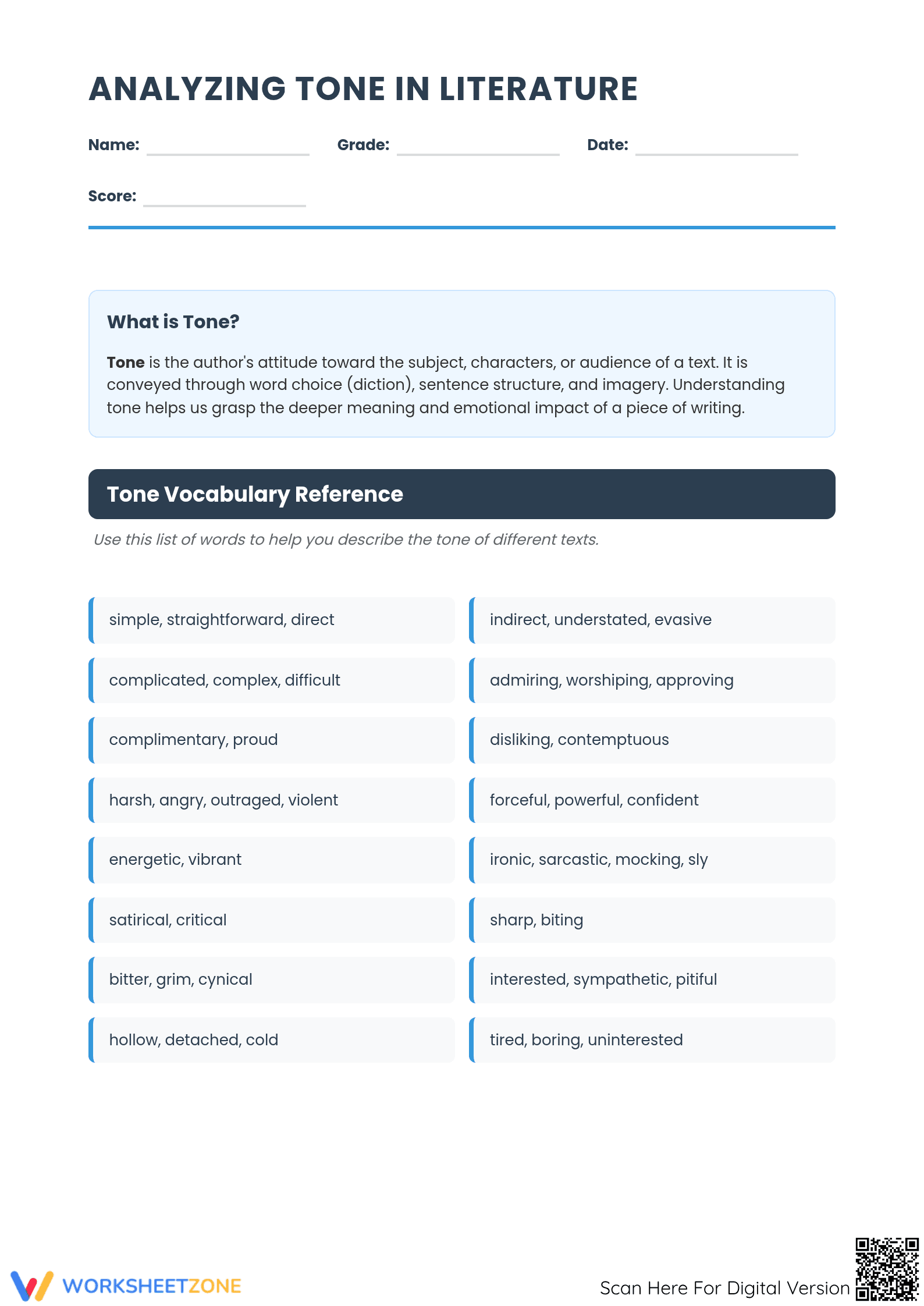
This Grade 7 ELA worksheet helps students master the complex skill of identifying an author's tone. By providing a comprehensive vocabulary bank and targeted practice, students learn to connect specific word choices to emotional impact. This resource ensures students can move beyond basic descriptions to precise literary analysis and evidence-based reasoning.
At a Glance
- Grade: 7 · Subject: ELA
- Standard:
CCSS.ELA-LITERACY.RL.7.4— Determine the impact of specific word choices on meaning and tone- Skill Focus: Tone Identification & Vocabulary
- Format: 3 pages · 4 problems · Answer key included · PDF
- Best For: Independent practice or sub plans
- Time: 20–30 minutes
What's Inside
The resource contains a detailed two-page "Tone Vocabulary Reference" featuring over 40 descriptive word groupings such as "bitter, grim, cynical" and "wistful, nostalgic, sentimental." This is followed by a practice page containing 4 distinct literary passages. Each passage requires students to apply their new vocabulary to identify the author's attitude. A full answer key is provided for quick grading and immediate student feedback.
Zero-Prep Workflow
- Print: Select the three-page PDF and print enough copies for your class (30 seconds).
- Distribute: Hand out the vocabulary reference and practice sheet as a combined packet (1 minute).
- Review: Use the included answer key to review the four practice passages as a whole group or for individual grading (5-10 minutes).
Total teacher preparation time is under 2 minutes, making this an ideal solution for busy mornings or unexpected absences.
Standards Alignment
This worksheet is directly aligned to `CCSS.ELA-LITERACY.RL.7.4`, which requires students to "Determine the meaning of words and phrases as they are used in a text, including figurative and connotative meanings; analyze the impact of a specific word choice on meaning and tone." It specifically targets the ability to categorize diction to determine the author's perspective. Both standard codes can be copied directly into lesson plans, IEP goals, or district curriculum mapping tools.
How to Use It
Use this as a formative assessment after a lesson on diction and imagery. Students can keep the vocabulary reference in their binders for use during future novel studies or creative writing assignments. Alternatively, assign it as a high-quality sub plan. During the activity, observe if students can justify their tone choice by highlighting specific "clue words" in the text. Expected completion time ranges from 20 to 30 minutes depending on reading speed.
Who It's For
This is ideal for Grade 7 students but works well for Grade 8 review or Grade 6 enrichment. The extensive word bank makes it an excellent scaffold for English Language Learners (ELL) who may struggle to find the right words to describe an author's attitude. It is a natural pairing for any short story unit or poetry analysis module where word choice is a central focus.
According to Fisher & Frey (2014), the development of a robust academic vocabulary is essential for students to engage in close reading and complex text analysis. This worksheet addresses that need by providing a structured bridge between raw text and sophisticated literary terminology. By using the CCSS.ELA-LITERACY.RL.7.4 standard as a framework, the resource ensures that students are not just guessing at emotions but are identifying tone through the lens of specific word choice and diction. Research indicates that providing students with categorized word banks significantly improves their ability to articulate abstract concepts in writing and discussion. This 3-page resource provides the necessary scaffolding to move students toward independent mastery of tone identification, a critical component of middle school literacy and high school readiness.


