


























Views
Downloads

Printable Penguin Life Cycle Worksheet | Grade 3 Science
Paste this activity's link or code into your existing LMS (Google Classroom, Canvas, Teams, Schoology, Moodle, etc.).
Students can open and work on the activity right away, with no student login required.
You'll still be able to track student progress and results from your teacher account.
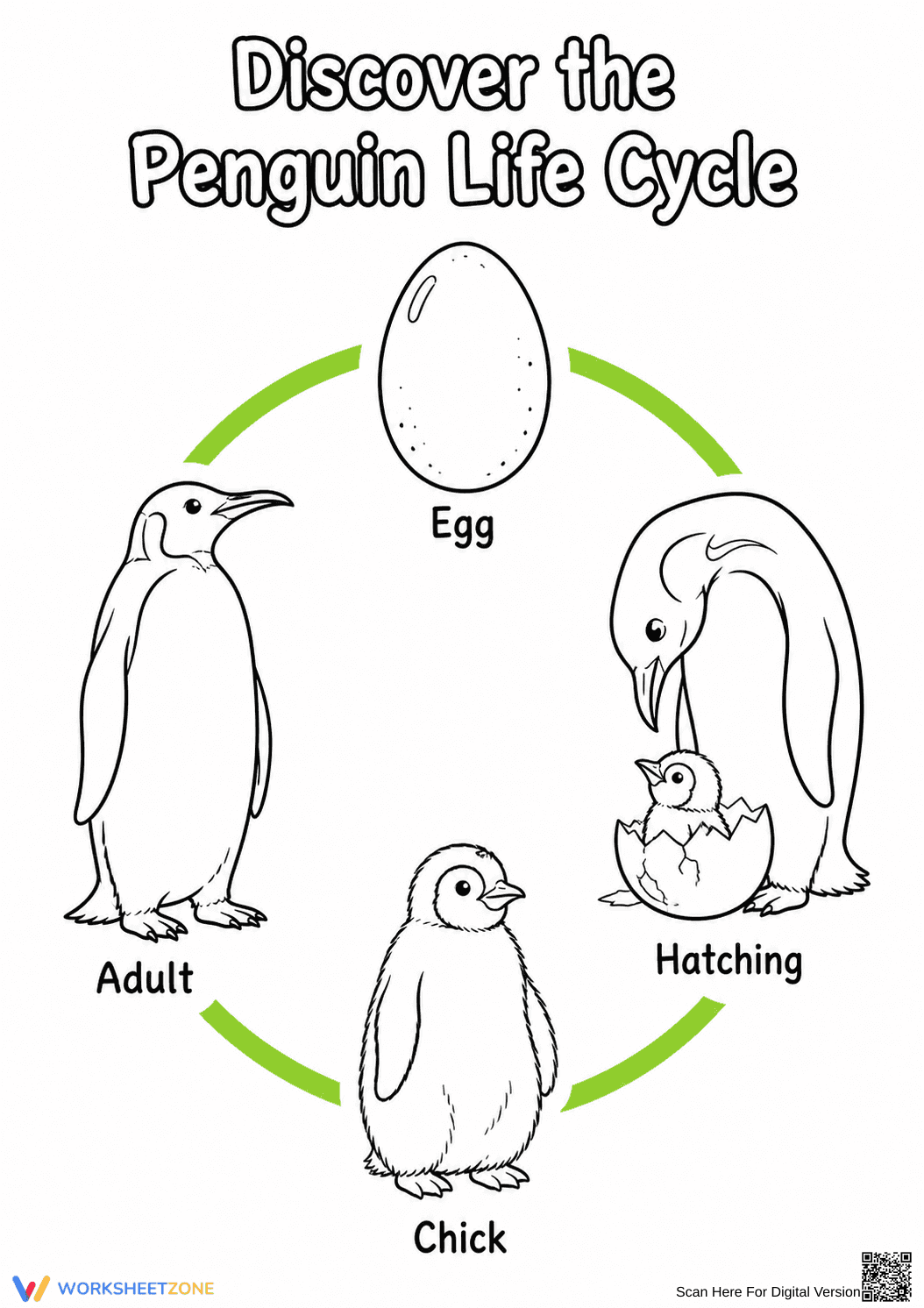
This visual science worksheet introduces students to the stages of a penguin's development. By examining a four-stage circular diagram, learners identify and sequence the progression from egg to adult. This resource provides an engaging way to reinforce foundational biology concepts regarding animal growth and reproduction.
At a Glance
- Grade: 3 · Subject: Science
- Standard:
3-LS1-1— Describe the stages of an organism's life cycle- Skill Focus: Sequencing animal life cycles
- Format: 1 page · 4 stages · No answer key needed · PDF
- Best For: Independent practice or science centers
- Time: 10–15 minutes
Inside this single-page resource, educators will find a black-and-white diagram detailing four phases of a penguin's life: egg, hatching, chick, and adult. Directional arrows emphasize the continuous cycle. Clear text labels make it accessible for early readers, while the line-art format allows students to color the illustrations, adding an interactive element to their observation.
Zero-Prep Workflow
This resource is designed for immediate classroom implementation.
- Print (1 minute): Simply download the PDF and print a class set. The black-and-white design is highly ink-friendly.
- Distribute (1 minute): Hand out the diagrams along with crayons or colored pencils. No complex instructions are required.
- Review (3 minutes): Briefly discuss the directional arrows and read the four labels aloud together to ensure comprehension.
With a total prep time of under two minutes, this worksheet is an excellent addition to any emergency sub plan or spontaneous science block.
Standards Alignment
This activity aligns with Next Generation Science Standard 3-LS1-1: Develop models to describe that organisms have diverse life cycles but all have in common birth, growth, reproduction, and death. By tracing the path from egg to adult penguin, students interact with a concrete model of these stages. Both standard codes can be copied directly into lesson plans, IEP goals, or district curriculum mapping tools.
How to Use It
This diagram serves as an introductory activity before a lesson on polar animals. Students can color the stages while the teacher reads an informational text aloud. Alternatively, use it as an independent wrap-up task after a science video. Expected completion time is 10 to 15 minutes. For a quick formative assessment, observe whether students can point to the correct stage when asked what comes after hatching.
Who It's For
Designed for third-grade science students, its visual nature makes it adaptable for second-grade learners or English Language Learners benefiting from picture-supported vocabulary. For students needing extra support, clear labels provide immediate context without overwhelming text. It pairs perfectly with a nonfiction reading passage about Antarctic wildlife or an anchor chart detailing bird traits.
Integrating visual models into elementary science instruction significantly enhances student comprehension of abstract biological processes. According to a ScienceDirect TpT Analysis, utilizing clear, sequential diagrams helps young learners internalize complex sequences, such as those found in nature. This specific resource targets 3-LS1-1, requiring students to describe the stages of an organism's life cycle. By interacting with the four distinct phases of a penguin's development—from egg to adult—students build a foundational understanding of growth and reproduction. The combination of visual tracking and fine motor engagement through coloring solidifies these concepts in working memory. Providing straightforward, visually appealing models ensures that foundational science standards are met effectively, giving educators a reliable tool for building early scientific literacy and observational skills in the elementary classroom.


