


























Views
Downloads

Letter S Tracing Worksheet | Essential Grade K Practice
Paste this activity's link or code into your existing LMS (Google Classroom, Canvas, Teams, Schoology, Moodle, etc.).
Students can open and work on the activity right away, with no student login required.
You'll still be able to track student progress and results from your teacher account.
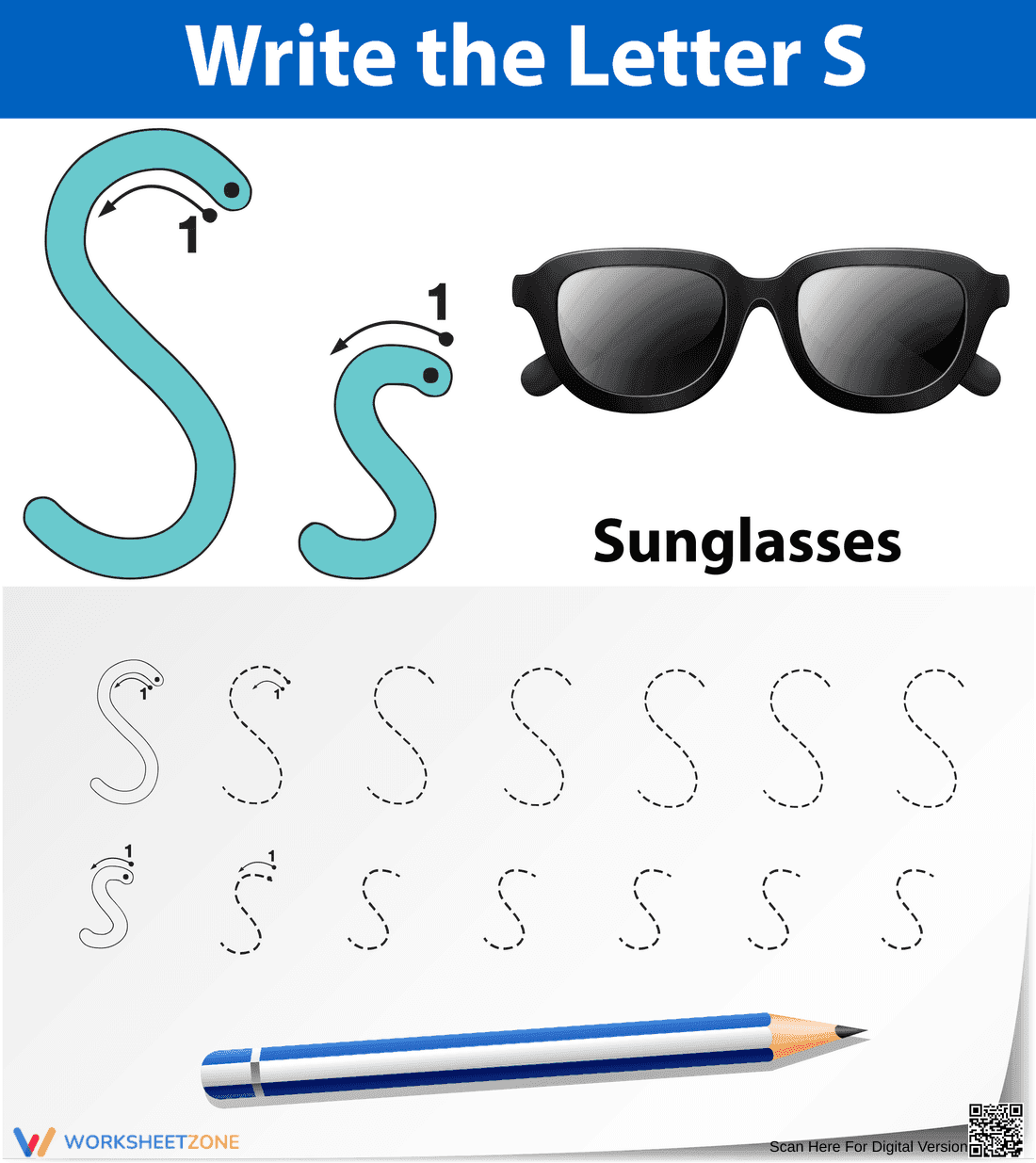
This Kindergarten Letter S tracing worksheet helps young learners master the formation of both uppercase and lowercase letters through structured repetition. By following the numbered stroke guides, students develop the muscle memory required for fluent handwriting while reinforcing the letter-sound connection with the engaging sunglasses theme. This resource ensures students understand exactly where to start their pencil to achieve proper letter shape.
At a Glance
- Grade: Kindergarten · Subject: Handwriting
- Standard:
CCSS.ELA-LITERACY.L.K.1.A— Print many upper- and lowercase letters accurately- Skill Focus: Letter S formation
- Format: 1 page · 14 tasks · Answer key included · PDF
- Best For: Morning work or literacy centers
- Time: 10–15 minutes
Inside this single-page PDF, you will find two large guided examples featuring directional arrows and numbered steps for the letter S. Below the instructional headers, students engage with 14 individual tracing opportunities—7 for uppercase 'S' and 7 for lowercase 's'—set on standard primary lines to ensure proper sizing and alignment. The sunglasses graphic provides a clear mnemonic for the /s/ sound.
This resource is designed for a zero-prep workflow. First, print the single-page PDF in under 30 seconds. Second, distribute the sheets to students with pencils or crayons. Third, review student stroke order as they work to provide immediate corrective feedback. Total teacher preparation time is under 2 minutes, making it an ideal sub plan, morning work activity, or quick transition task between literacy blocks.
This worksheet aligns with `CCSS.ELA-LITERACY.L.K.1.A`, which requires students to print many upper- and lowercase letters. It also supports fine motor development necessary for later writing standards. The inclusion of both cases allows for a comprehensive review of the letter's anatomy. Both standard codes can be copied directly into lesson plans, IEP goals, or district curriculum mapping tools.
Use this worksheet during the "You Do" phase of a gradual release lesson on the letter S. It serves as an excellent formative assessment tool; observe if students start at the top of the letter as indicated by the "1" marker. Completion typically takes 10 to 15 minutes depending on the student's fine motor proficiency. It can also be laminated for use in a dry-erase center for repeated practice.
This practice page is perfect for preschool, kindergarten, and first-grade students who need targeted handwriting intervention. It pairs naturally with an alphabet anchor chart or a phonics lesson focusing on the /s/ sound. The sunglasses theme provides a visual hook for summer-themed units or "S" week activities, helping students bridge the gap between phonemic awareness and grapheme production.
According to Fisher & Frey (2014), the gradual release of responsibility is most effective when students have clear, scaffolded models for independent practice. This worksheet provides that scaffolding through numbered stroke guides and faded tracing lines for the letter S. By focusing on CCSS.ELA-LITERACY.L.K.1.A, the resource ensures that students are meeting foundational literacy benchmarks required for Kindergarten. Research from the NAEP suggests that early mastery of letter formation is a strong predictor of later writing fluency and composition quality. This 1-page resource offers 14 specific opportunities for students to refine their motor control while associating the letter shape with the /s/ sound. It is a high-utility tool for any early childhood classroom looking to bridge the gap between letter recognition and production without adding to teacher prep time.


