


























Views
Downloads
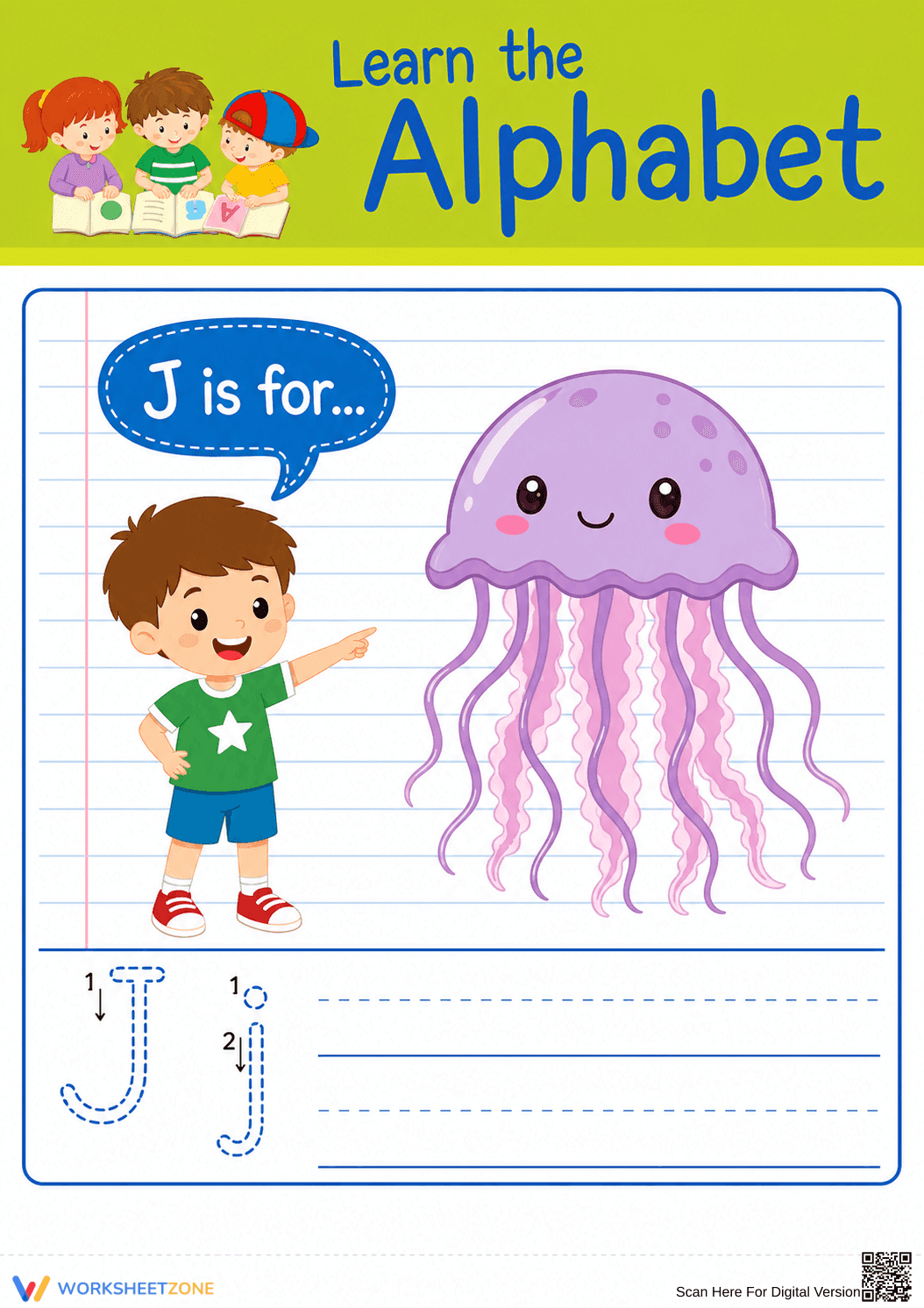

Printable Letter J Beginning Sound Worksheet | Grade K
Paste this activity's link or code into your existing LMS (Google Classroom, Canvas, Teams, Schoology, Moodle, etc.).
Students can open and work on the activity right away, with no student login required.
You'll still be able to track student progress and results from your teacher account.
This foundational phonics worksheet helps early learners master the beginning sound of the letter J. By connecting the visual cue of a jellyfish to the letter form, students build essential letter-sound correspondence skills. The tracing practice reinforces proper letter formation for both uppercase and lowercase letters.
At a Glance
- Grade: K · Subject: ELA
- Standard:
CCSS.ELA-LITERACY.RF.K.3.A— Demonstrate basic knowledge of letter-sound correspondences- Skill Focus: Letter J Beginning Sound
- Format: 1 page · 3 tasks · No answer key needed · PDF
- Best For: Morning work or literacy centers
- Time: 10–15 minutes
This single-page resource features a large, engaging illustration of a jellyfish to anchor the "J is for..." concept in a student's memory. Below the visual association, the worksheet provides guided tracing paths with directional arrows for both the uppercase 'J' and lowercase 'j'. Blank handwriting lines are included to encourage independent practice after the initial tracing steps are completed.
- Print (1 minute): Simply download the PDF and print a class set. The clear, high-contrast design ensures excellent reproduction on standard school printers.
- Distribute (1 minute): Hand out the sheets during morning routines or transition times. The intuitive layout requires minimal teacher explanation.
- Review (1 minute): Quickly check student handwriting and letter formation as they work independently.
Total teacher preparation time is under two minutes, making this an ideal resource for emergency sub plans or quick literacy center rotations.
Aligned to primary standard CCSS.ELA-LITERACY.RF.K.3.A: Demonstrate basic knowledge of one-to-one letter-sound correspondences by producing the primary sound or many of the most frequent sounds for each consonant. It also supports handwriting development by providing structured tracing guides. Both standard codes can be copied directly into lesson plans, IEP goals, or district curriculum mapping tools.
Use this worksheet as a targeted intervention tool during small group instruction before introducing more complex phonics patterns. Alternatively, assign it as independent morning work to reinforce the letter J after a whole-class read-aloud featuring J-words. While students trace, observe their pencil grip and stroke direction to provide immediate formative feedback on their fine motor skills. Expected completion time is 10 to 15 minutes.
This resource is designed for Kindergarten and early Grade 1 students developing foundational literacy skills. It is highly effective for visual learners who benefit from the strong picture-to-letter association. Pair this worksheet with an alphabet anchor chart or a tactile sand-tracing activity to provide a multi-sensory learning experience for students needing extra support.
Effective phonics instruction relies heavily on explicit letter-sound correspondence and guided handwriting practice. According to the RAND AIRS 2024 report on early literacy interventions, integrating visual mnemonics with motor skill practice significantly improves letter recognition and retention in early childhood education. This resource directly targets CCSS.ELA-LITERACY.RF.K.3.A by requiring students to demonstrate basic knowledge of letter-sound correspondences through the visual anchor of a jellyfish. By combining the auditory concept of the beginning sound with the physical act of tracing the letter J, educators can solidify foundational reading skills. The structured directional arrows ensure students build correct muscle memory, reducing letter reversals later in their academic journey. This targeted approach ensures that young learners establish the critical decoding skills necessary for future reading fluency and comprehension success.


