


























Views
Downloads

Women's History Month Card | Grade 1-3 Printable
Paste this activity's link or code into your existing LMS (Google Classroom, Canvas, Teams, Schoology, Moodle, etc.).
Students can open and work on the activity right away, with no student login required.
You'll still be able to track student progress and results from your teacher account.
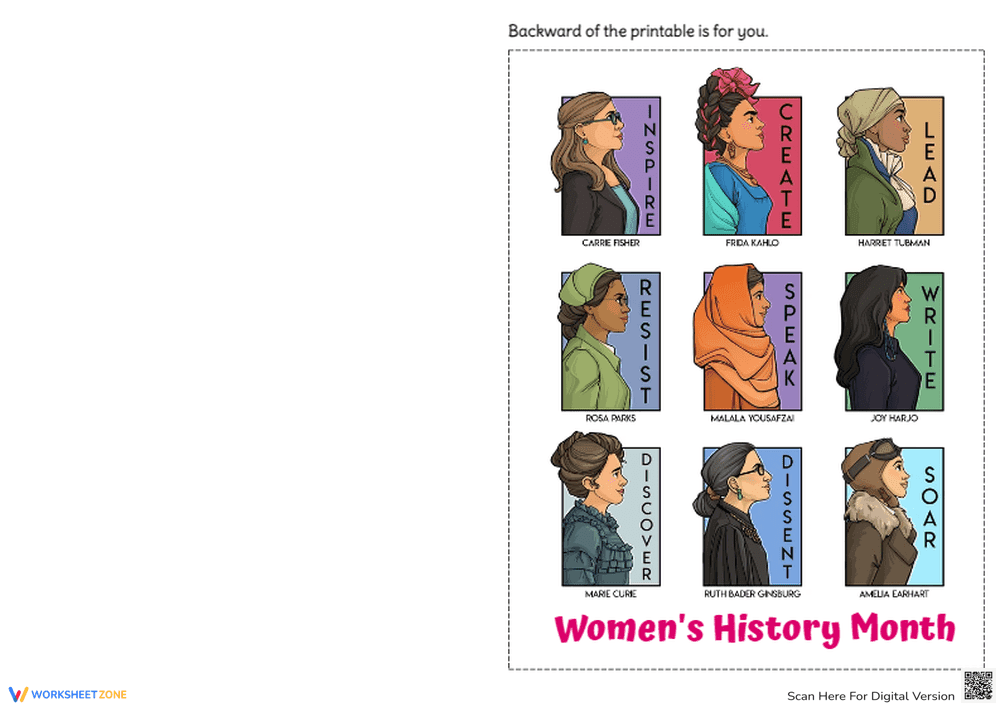
This Women's History Month greeting card provides elementary students with a creative way to honor influential female figures. Students engage with portraits of nine trailblazers, connecting their names to powerful action verbs. This activity transforms historical recognition into a tangible, artistic project that reinforces social studies concepts through hands-on learning.
At a Glance
- Grade: 1-3 · Subject: Social Studies
- Standard:
CCSS.ELA-LITERACY.RI.2.3— Describe connections between historical figures and their specific contributions or traits- Skill Focus: Historical Recognition & Fine Motor Skills
- Format: 1 page · 9 portraits · Creative project · PDF
- Best For: Seasonal Social Studies or Art activity
- Time: 20–30 minutes
What's Inside
The printable features a single-page layout designed for easy folding into a greeting card. It includes high-quality illustrations of nine diverse women: Carrie Fisher, Frida Kahlo, Harriet Tubman, Rosa Parks, Malala Yousafzai, Joy Harjo, Marie Curie, Ruth Bader Ginsburg, and Amelia Earhart. Each portrait is paired with a specific verb like "Resist," "Dissent," or "Soar," providing a vocabulary-rich foundation for the craft.
Zero-Prep Workflow
The zero-prep workflow is designed for immediate classroom implementation. First, print the single-page PDF (30 seconds). Second, distribute the sheets to students along with coloring supplies and scissors (1 minute). Third, facilitate a brief discussion on the women featured before students begin their independent creative work (5 minutes). Total teacher preparation time is under 2 minutes, making it an ideal choice for busy mornings or unexpected sub plans.
Standards Alignment
This resource aligns with `CCSS.ELA-LITERACY.RI.2.3`, which requires students to describe the connection between a series of historical events or individuals. By associating specific women with their defining actions, students build a conceptual framework for historical impact. This standard code can be copied directly into lesson plans, IEP goals, or district curriculum mapping tools.
How to Use It
Use this card as a culminating activity after a unit on influential women. Students can color the portraits and write a personal message inside the card to a woman they admire in their own lives. Alternatively, use it as a formative assessment to see if students can identify the achievements of the figures shown during a gallery walk. Completion typically takes 25 minutes.
Who It's For
This activity is tailored for students in Grades 1, 2, and 3. It is particularly effective for visual learners and students who benefit from kinesthetic activities. It pairs naturally with a classroom anchor chart or a read-aloud biography series about the women featured on the card.
According to the RAND AIRS 2024 report, integrating creative arts with social studies content significantly improves student engagement and retention of historical facts. This Women's History Month worksheet utilizes this principle by allowing students to interact physically with the images of nine historical figures. By aligning with CCSS.ELA-LITERACY.RI.2.3, the resource ensures that the "It's Women Time" activity is not just a craft, but a standards-based lesson in historical connections. Research from Fisher & Frey (2014) supports the use of visual scaffolds and action-oriented vocabulary to help young learners internalize complex social concepts. This printable provides those scaffolds through clear portraiture and associated verbs, making the history of these women accessible to early elementary students. The 1-page format ensures that instructional time is maximized on content rather than logistics, supporting a high-impact learning environment during seasonal celebrations.


