


























Views
Downloads

Story Elements Glossary Worksheet | Grade 3 Essential
Paste this activity's link or code into your existing LMS (Google Classroom, Canvas, Teams, Schoology, Moodle, etc.).
Students can open and work on the activity right away, with no student login required.
You'll still be able to track student progress and results from your teacher account.
This Grade 3 story elements glossary provides a structured framework for students to internalize narrative vocabulary. By combining definitions with visual representations and original sentences, learners build a deeper understanding of how stories are constructed. This resource is specifically designed to support English Learners (EL) and students requiring additional scaffolding during reading comprehension lessons.
At a Glance
- Grade: 3 · Subject: ELA
- Standard:
CCSS.ELA-LITERACY.RL.3.9— Compare and contrast the themes, settings, and plots of stories- Skill Focus: Narrative Vocabulary & Story Elements
- Format: 2 pages · 6 tasks · Student-generated content · PDF
- Best For: EL Support and Vocabulary Scaffolding
- Time: 15–20 minutes
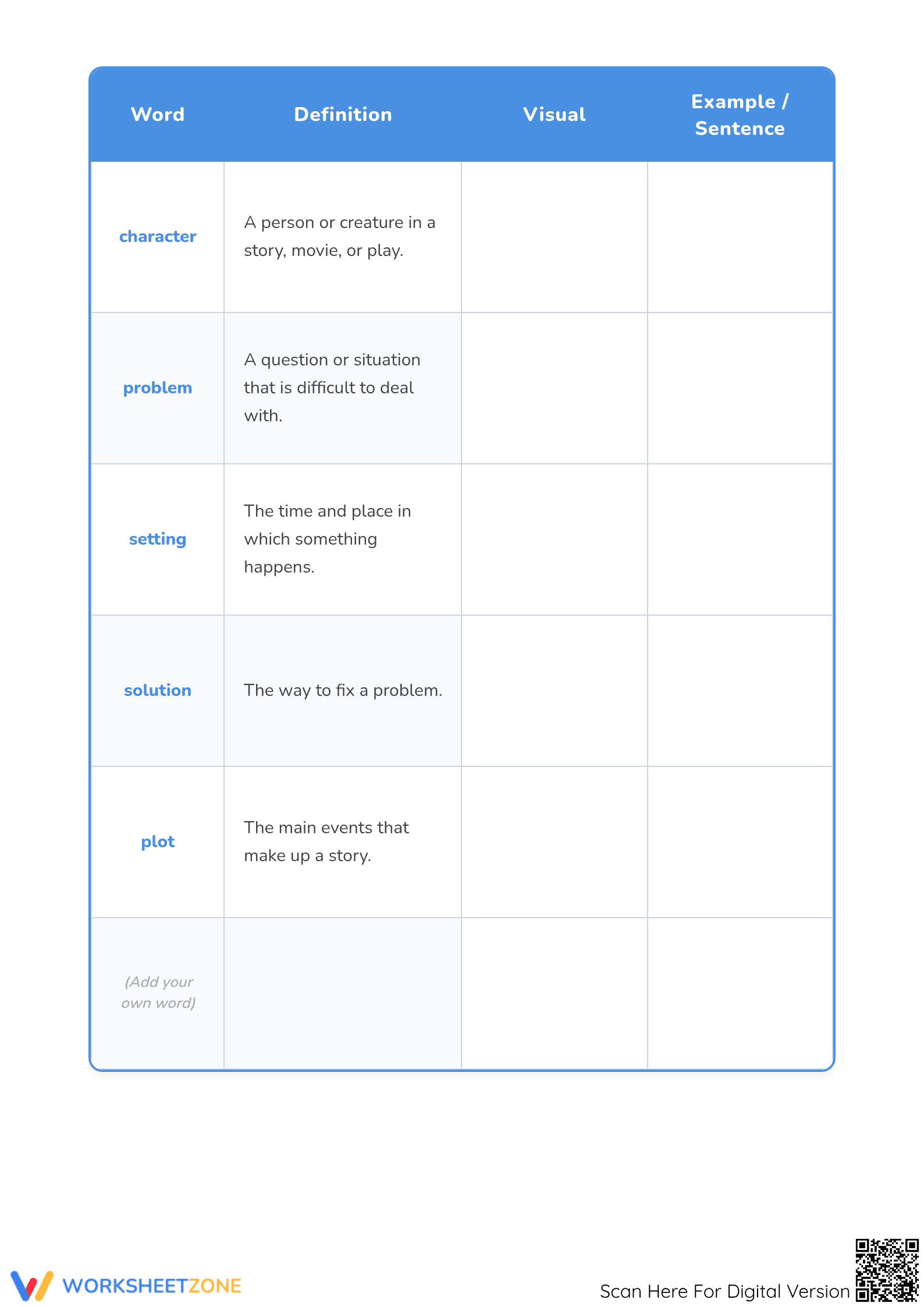
The worksheet consists of a two-page PDF. The first page offers a dedicated space for student notes, allowing for flexible use during direct instruction or group discussions. The second page features a comprehensive glossary table containing five essential narrative terms: character, problem, setting, solution, and plot. Each entry includes a clear definition, a "Visual" column for sketching, and an "Example/Sentence" column for application. A final blank row allows students to add a custom vocabulary word.
This resource is optimized for a zero-prep classroom workflow. Teachers can print the two-page set in less than 30 seconds. Distribution takes approximately one minute, as the layout is self-explanatory for third-grade students. Reviewing the completed glossaries provides an immediate formative assessment of student comprehension, requiring only a brief walk-through or a 5-minute peer-sharing session. Total teacher preparation time is under 2 minutes, making it an ideal choice for sub plans or last-minute literacy centers.
Standards Alignment: Aligned to CCSS.ELA-LITERACY.RL.3.9, this worksheet supports the requirement that students compare and contrast the themes, settings, and plots of stories written by the same author about the same or similar characters. By first mastering the individual definitions of these elements, students are better prepared for the higher-order task of comparison. This standard code can be copied directly into lesson plans, IEP goals, or district curriculum mapping tools.
How to Use It: Use this glossary as a front-loading activity before starting a new fiction unit. Students complete the visual and sentence columns to activate prior knowledge. Alternatively, use it as a formative assessment tool during an EL support lesson. Observe students as they draw their visuals; a student who struggles to illustrate a solution may need targeted intervention on plot resolution before moving to independent reading. The expected completion time is 15 to 20 minutes.
Who It's For: This resource is ideal for Grade 3 general education classrooms, particularly those with a high population of English Language Learners. It serves as an excellent companion to anchor charts or short story passages. Pairing this glossary with a graphic organizer for story mapping creates a comprehensive support system for students who struggle with abstract literary concepts.
According to research from Fisher & Frey (2014) on the gradual release of responsibility, providing students with clear linguistic scaffolds like glossaries is essential for developing academic literacy. This Grade 3 worksheet targets CCSS.ELA-LITERACY.RL.3.9 by ensuring students have a concrete grasp of narrative components before attempting complex comparisons. By requiring both a visual representation and a contextual sentence, the resource leverages dual-coding theory to improve long-term retention of vocabulary. The inclusion of a student-generated notes section further encourages active engagement with the material. Educational analysis suggests that structured vocabulary support reduces the cognitive load on EL students, allowing them to focus on the analytical demands of the standard. This printable tool provides a reliable, research-backed method for bridging the gap between basic word recognition and deep reading comprehension in the elementary classroom.


