




























Views
Downloads

Kindergarten Counting Worksheet — Printable Halloween Math

Paste this activity's link or code into your existing LMS (Google Classroom, Canvas, Teams, Schoology, Moodle, etc.).
Students can open and work on the activity right away, with no student login required.
You'll still be able to track student progress and results from your teacher account.
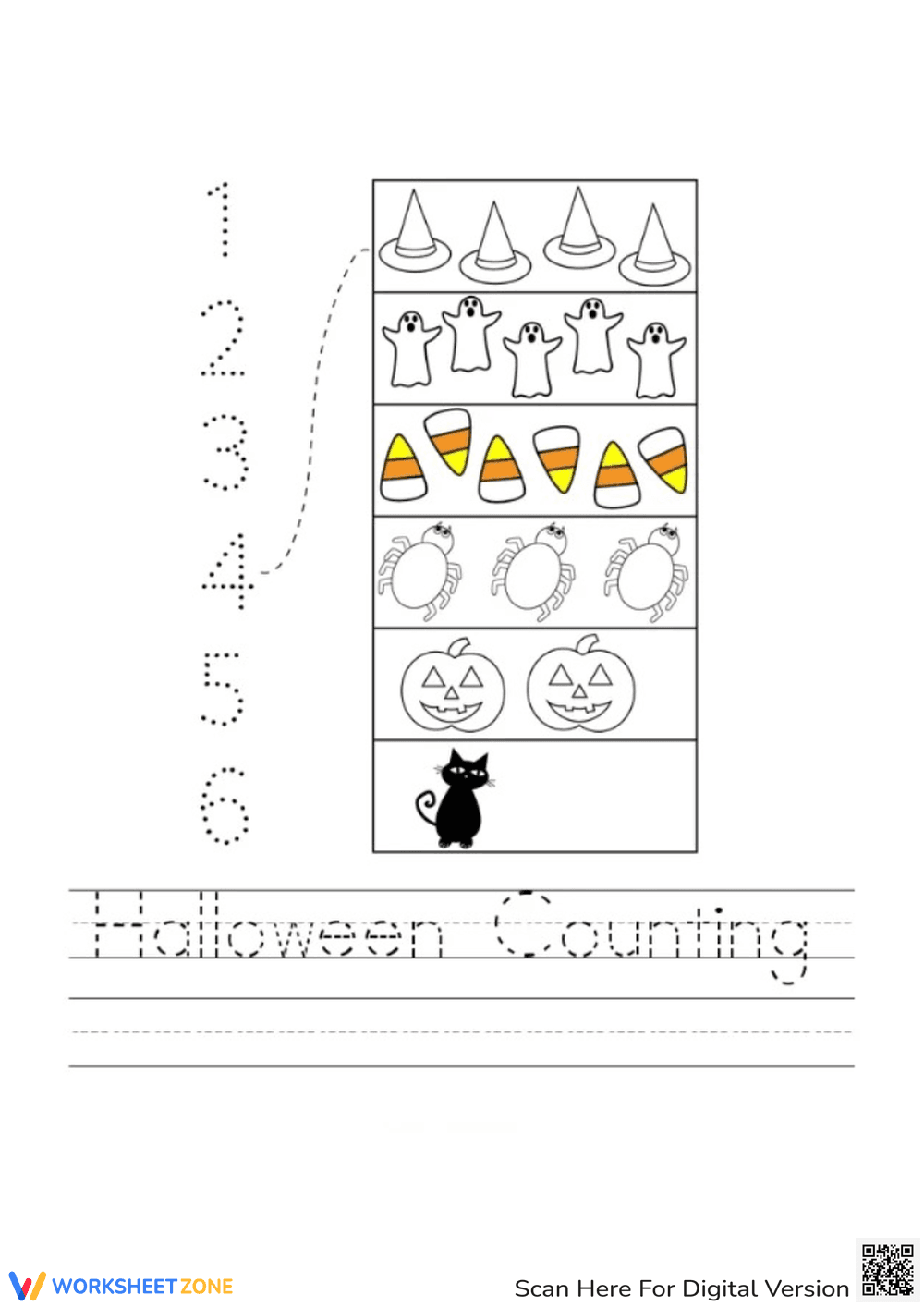
This Kindergarten math worksheet helps students practice counting objects and matching them to the correct numerals. By connecting numbers one through six with fun Halloween-themed pictures like ghosts and pumpkins, early learners build foundational number sense and fine motor skills through tracing.
At a Glance
- Grade: Kindergarten · Subject: Math
- Standard:
CCSS.MATH.CONTENT.K.CC.B.4— Connect counting to cardinality- Skill Focus: Counting objects and number matching
- Format: 1 page · 6 problems · Answer key included · PDF
- Best For: Independent practice and morning work
- Time: 10–15 minutes
This single-page resource features six matching tasks where students count sets of Halloween items, including witch hats, ghosts, candy corn, spiders, pumpkins, and a black cat. Alongside the counting activity, the worksheet includes dotted numerals from one to six and the words "Halloween Counting" at the bottom for handwriting and tracing practice. A complete answer key is provided for quick grading.
Designed for a zero-prep classroom experience:
- Print (1 minute): Download the PDF and print. The black-and-white design saves ink while keeping illustrations clear.
- Distribute (1 minute): Hand out during math centers. The visual layout is self-explanatory for early learners.
- Review (1 minute): Use the included answer key to quickly check student work.
With under two minutes of total teacher prep time, this worksheet is an excellent addition to any emergency sub plan or busy holiday week schedule.
This worksheet is aligned to primary standard CCSS.MATH.CONTENT.K.CC.B.4, requiring students to understand the relationship between numbers and quantities and connect counting to cardinality. It also supports fine motor development through number and letter tracing. Both standard codes can be copied directly into lesson plans, IEP goals, or district curriculum mapping tools.
Use this worksheet during independent math centers after direct instruction on counting to ten. It serves as an engaging follow-up activity where students demonstrate one-to-one correspondence. Alternatively, assign it as morning work in October to establish a focused routine. For formative assessment, observe whether students touch each item as they count or subitize smaller groups like the two pumpkins. Expected completion time is ten to fifteen minutes.
This resource is primarily designed for Kindergarten students developing early math and counting skills. It is also appropriate for Pre-K students who are ready for a challenge, or first graders needing a quick review of numbers up to six. For differentiation, teachers can provide physical manipulatives like counting bears for students who need tactile support before drawing lines. This worksheet pairs naturally with a read-aloud of a Halloween counting book or a whole-group counting anchor chart.
Developing strong foundational number sense is a critical milestone in early childhood education. This worksheet targets CCSS.MATH.CONTENT.K.CC.B.4, helping students connect counting to cardinality by matching numerals to specific quantities of objects. According to a recent EdReports 2024 analysis of early math curricula, integrating thematic and visual elements into counting exercises significantly increases student engagement and retention of one-to-one correspondence principles. When young learners practice counting with familiar or exciting themes, such as holiday imagery, they are more likely to persist through the cognitive demand of matching and tracing tasks. By combining fine motor tracing with visual counting, this resource provides a multimodal approach to early numeracy. Consistent practice with these targeted, standard-aligned activities ensures that students build the automaticity required for more advanced addition and subtraction concepts in later grades.


