


























Views
Downloads

SEL Feelings Worksheet: For Better or Worse | Grade 2 Ready
Paste this activity's link or code into your existing LMS (Google Classroom, Canvas, Teams, Schoology, Moodle, etc.).
Students can open and work on the activity right away, with no student login required.
You'll still be able to track student progress and results from your teacher account.
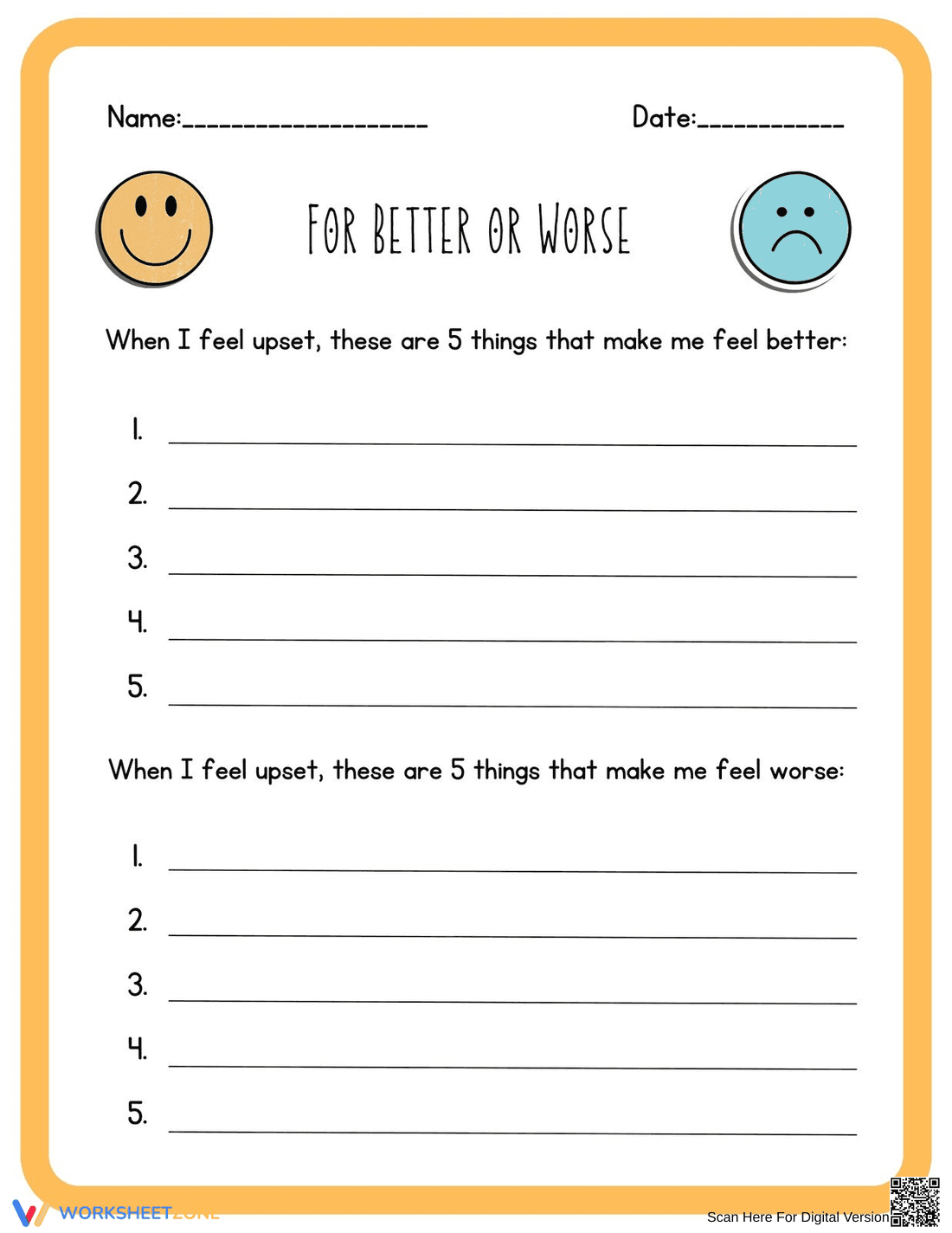
This Grade 2 SEL feelings worksheet helps students identify personal coping strategies and emotional triggers. By listing specific actions that improve or worsen their mood when upset, children develop essential self-awareness and self-management skills. This reflective activity encourages students to articulate internal experiences through structured writing and personal reflection.
At a Glance
- Grade: 2 · Subject: SEL / ELA
- Standard:
CCSS.ELA-LITERACY.W.2.8— Recall information from experiences to answer a question- Skill Focus: Emotional Self-Regulation
- Format: 1 page · 10 problems · Open-ended · PDF
- Best For: Morning meetings or counseling sessions
- Time: 10–15 minutes
The resource consists of a single-page PDF featuring two distinct reflection sections. Students are prompted to generate five items for each category: things that make them feel better and things that make them feel worse. The clean layout includes clear numbering and ample writing space, making it accessible for young learners developing their fine motor and expressive language skills.
This worksheet is designed for immediate classroom implementation with a total teacher prep time of under 2 minutes. First, print the single-page PDF for your class. Second, distribute the sheets during a transition or SEL block. Third, review the responses individually or in small groups to identify common classroom stressors. It serves as an excellent emergency sub plan or calm-down corner resource.
The primary alignment is CCSS.ELA-LITERACY.W.2.8, which requires students to recall information from experiences or gather information from provided sources to answer a question. By reflecting on their own emotional history, students practice informational writing and self-reflection. This standard code can be copied directly into lesson plans, IEP goals, or district curriculum mapping tools.
Use this worksheet during a dedicated Social Emotional Learning block after a direct instruction lesson on managing big feelings. It provides a concrete way for students to build a personal coping toolbox. As a formative assessment, observe which students struggle to identify positive coping mechanisms, as this may indicate a need for additional tier-two support or counseling intervention.
This resource is ideal for general education second-grade students, but it is also highly effective for students with IEPs focusing on emotional regulation or social skills. It pairs naturally with an anchor chart about the Zones of Regulation or a read-aloud book about managing anger and sadness. The simple format ensures all students can participate regardless of reading level.
According to the RAND AIRS 2024 report, explicit instruction in self-awareness and self-management significantly improves student academic engagement and reduces behavioral incidents in elementary settings. This worksheet addresses the CCSS.ELA-LITERACY.W.2.8 standard by asking students to recall personal experiences to identify emotional triggers and regulation strategies. By documenting 10 specific factors that influence their mood, students move from abstract feelings to concrete, actionable self-knowledge. Research from Fisher & Frey (2014) emphasizes that such reflective writing tasks serve as a bridge between internal emotional states and external communication skills. This 1-page tool provides a structured framework for this development, ensuring that even young learners can participate in meaningful self-analysis. Educators can use these findings to justify the inclusion of SEL-focused writing prompts within the standard ELA curriculum to support the whole child.


