




























Essential Ecology Interactions Worksheet | Grade 6-12
Paste this activity's link or code into your existing LMS (Google Classroom, Canvas, Teams, Schoology, Moodle, etc.).
Students can open and work on the activity right away, with no student login required.
You'll still be able to track student progress and results from your teacher account.
Students explore the four classic ecological interactions—mutualism, commensalism, parasitism, predation, and competition—by sequencing each process step‑by‑step. The worksheet guides them to identify cause‑effect relationships, compare outcomes, and articulate why each interaction follows a predictable pattern through data tables, narrative scenarios, and guided questions that reinforce scientific reasoning.
At a Glance
- Grade: 6‑12 · Subject: Science
- Standard:
— sequence ecological interactions, describe cause‑effect steps, compare outcomes- Skill Focus: Sequence or Process analysis of symbiotic relationships
- Format: 4 pages · 25 problems · Answer key included · PDF ready for printing
- Best For: Small‑group labs, independent practice, or quick review sessions
- Time: 30‑45 minutes of focused student work
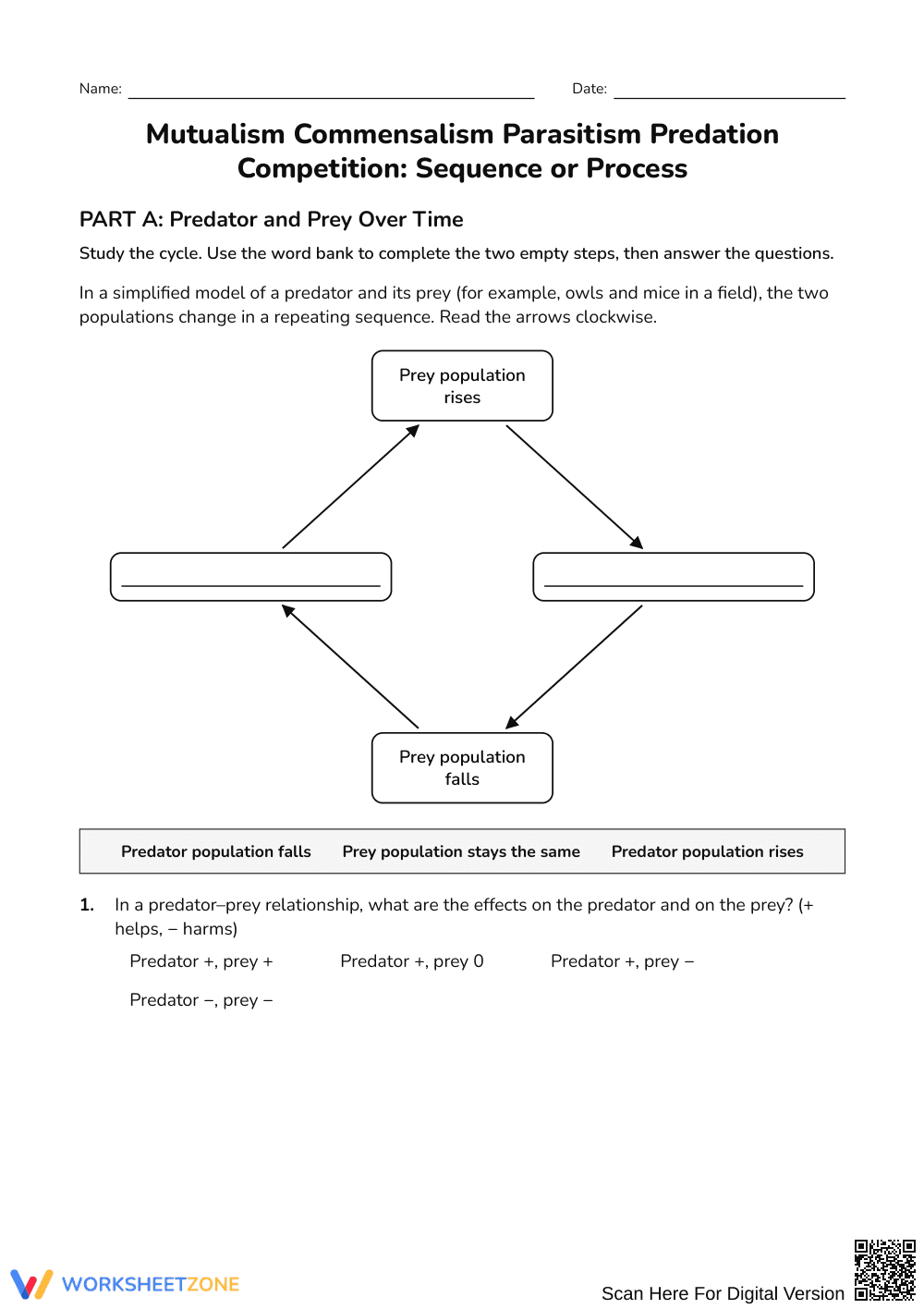
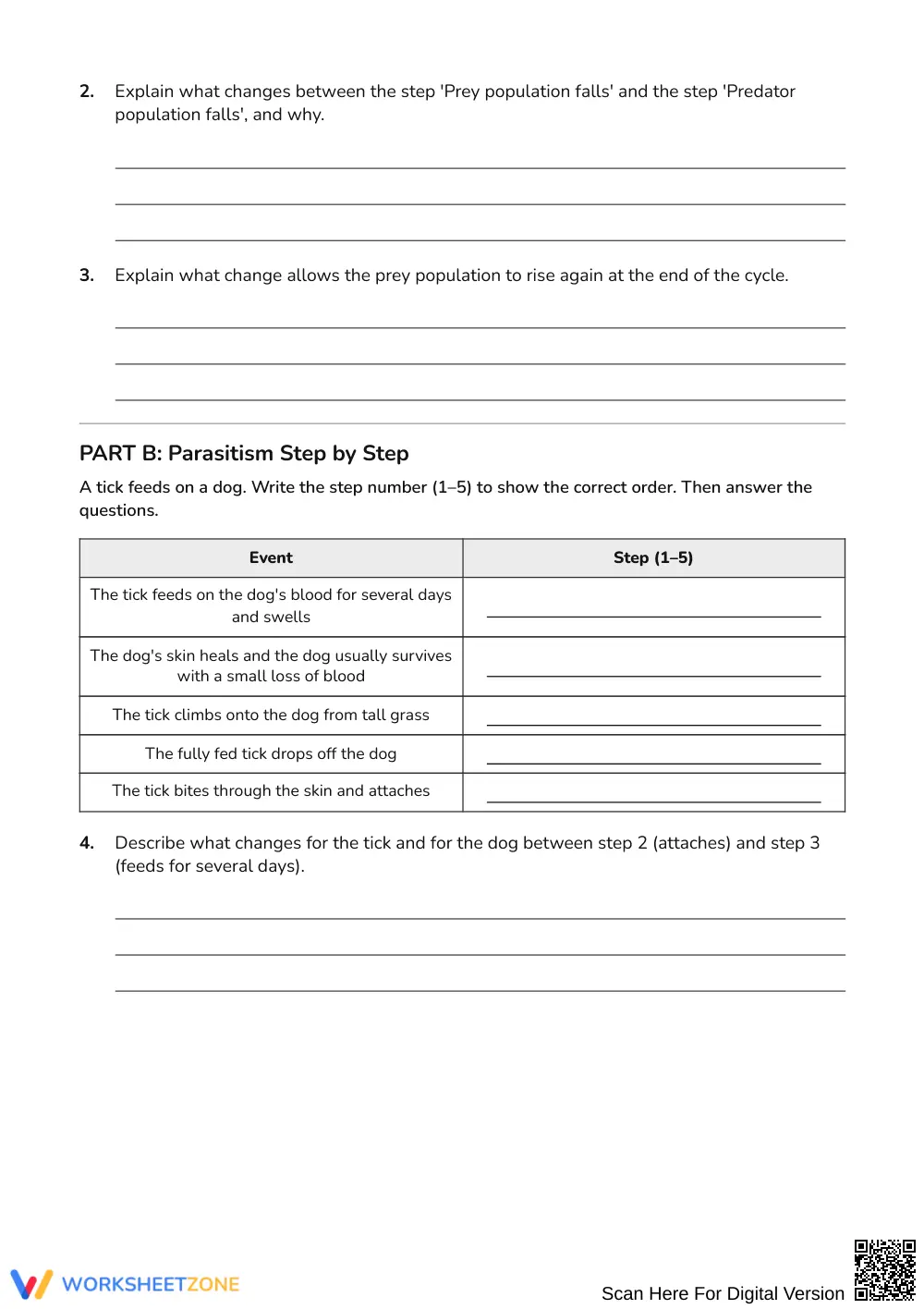
The packet contains four double‑sided pages: an introductory diagram of predator‑prey cycles, three step‑ordering tables for parasitism, mutualism, and competition, and a data‑analysis chart for plant growth. Each part includes a brief worked example, a word bank, and a concise answer key on the final page.
- Guided practice – 8 starter problems with a word bank and step‑by‑step prompts.
- Supported practice – 9 intermediate items that remove the word bank but keep sentence frames.
- Independent practice – 8 challenge questions that require students to generate the sequence without scaffolds.
These tasks follow the classic I Do, We Do, You Do release model, moving students from teacher‑led examples to autonomous reasoning.
Students sequence ecological interactions, identifying cause‑effect relationships and explaining why each step follows logically. This aligns with NGSS MS‑LS2‑2, which requires constructing explanations of interdependence among organisms. Both standard codes can be copied directly into lesson plans, IEP goals, or district curriculum mapping tools.
Use the worksheet as a quick formative check after a direct‑instruction lesson on symbiotic relationships. First, have students work in pairs to complete Part A and Part B, then circulate to note misconceptions; collect the answer sheets for immediate scoring. Later, during a lab on plant competition, assign Part D as an independent activity, then discuss the data as a class to reinforce the concept of limited resources.
Designed for middle and high school science students (grades 6‑12), the tasks support learners who need visual sequencing cues as well as those ready for abstract reasoning. The word bank and worked example aid struggling readers, while the challenge questions stretch advanced learners. Pair the worksheet with a short video on ecological niches or an anchor chart of interaction symbols for a cohesive lesson.
Research shows that explicit sequencing activities improve students’ ability to construct scientific explanations (Fisher & Frey 2014). This worksheet aligns with NGSS MS‑LS2‑2, which calls for learners to “develop and use models to describe the cycling of matter and flow of energy among organisms in an ecosystem.” By requiring students to order steps, compare outcomes, and justify changes, the tasks provide the concrete‑concrete‑abstract progression that Fisher & Frey identify as essential for deep conceptual change. The included answer key enables rapid feedback, supporting formative assessment cycles that drive mastery. Teachers can integrate the resource into any 30‑45‑minute block, whether as a stand‑alone activity or as reinforcement after a lab on interspecific interactions. Downloading and printing the PDF gives immediate access to a research‑backed, standards‑aligned tool for developing process‑orientation in science classrooms across grade levels.


