




























Essential Ecological Pyramids Worksheet | Grade 6-12 Science
Paste this activity's link or code into your existing LMS (Google Classroom, Canvas, Teams, Schoology, Moodle, etc.).
Students can open and work on the activity right away, with no student login required.
You'll still be able to track student progress and results from your teacher account.
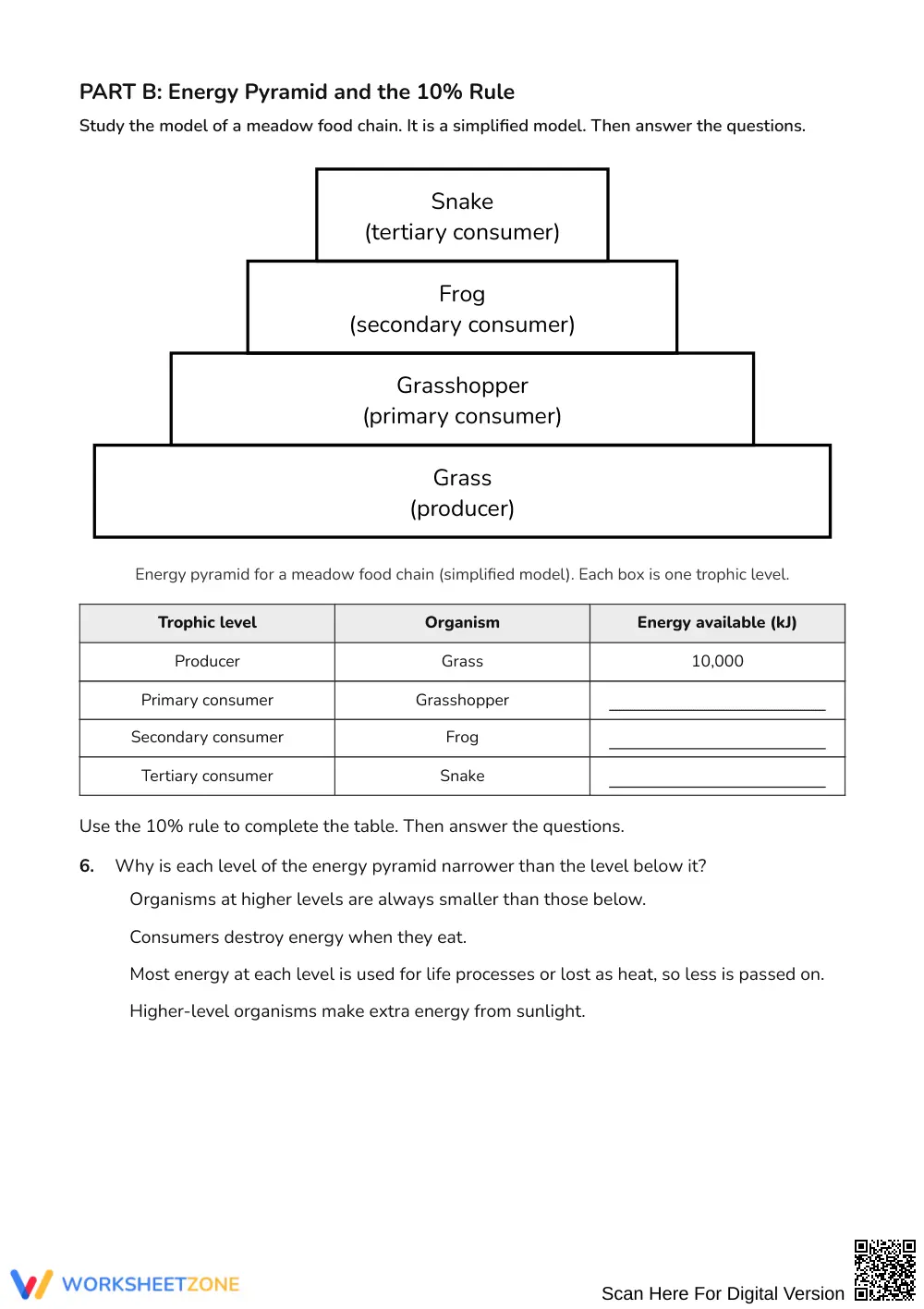
Students master the foundations of ecological pyramids, essential vocabulary, and the 10% energy rule through 21 targeted tasks that build conceptual understanding and factual recall. Each activity guides learners from basic definitions to applied reasoning, ensuring they can explain energy flow and correct common misconceptions.
At a Glance
- Grade: 6‑12 · Subject: Science
- Standard:
— Identify and explain ecological pyramid components and the 10% energy rule in real‑world contexts- Skill Focus: Ecological pyramids foundations and vocabulary
- Format: 4 pages · 21 problems · Answer key included · PDF
- Best For: Review after unit, pre‑test practice, or small‑group discussion
- Time: 10‑15 minutes
What’s Inside
The worksheet is organized into three parts—Key Terms, Energy Pyramid calculations, and a Misconception Check—spanning four PDF pages. It offers a word bank, tick‑box selections, short‑answer prompts, and a full answer key on a separate four‑page section.
Skill Progression
- Guided practice (7 tasks) with word bank and sentence frames.
- Supported practice (7 tasks) with partially completed tables.
- Independent practice (7 tasks) requiring full answers.
The sequence follows the gradual‑release model: I Do, We Do, You Do.
Standards Alignment
This worksheet aligns with general science curriculum expectations for understanding energy flow in ecosystems. It supports core life science topics and can be mapped to local standards on energy transfer. Objectives can be copied directly into lesson plans, IEP goals, or district curriculum mapping tools.
How to Use It
1. Before a unit lesson, have students complete the Key Terms section as a quick‑check to activate prior knowledge (5 minutes). 2. After direct instruction on energy flow, assign the Energy Pyramid and Misconception Check for guided practice (10 minutes). Observe student explanations to inform immediate feedback.
Who It’s For
Designed for Grades 6‑12 science learners, the worksheet supports diverse abilities with clear vocabulary prompts and optional sentence frames. Pair it with an anchor chart of trophic levels or a short video on ecosystem energy to reinforce concepts.
Educational research indicates that explicit vocabulary instruction combined with structured practice dramatically improves secondary science comprehension (Fisher & Frey 2014). This printable worksheet operationalizes that research-based strategy by delivering repeated exposure to foundational terminology, scaffolded computational tasks, and rapid error correction via the complete teacher answer key. By actively addressing the ten percent energy transfer rule and unpacking common trophic misconceptions, this activity mirrors evidence-based pedagogical practices that secure student mastery across ecological units. Working through twenty-one tiered problems enables middle school and high school learners to bridge the gap between simple memorization and complex analytical explanation. Science educators can confidently deploy this focused instructional resource to support struggling readers, reinforce primary classroom instruction, prepare classes for cumulative exams, and build enduring conceptual frameworks regarding energy flow in natural ecosystems throughout the academic year as students explore complex living systems.


