


























Views
Downloads
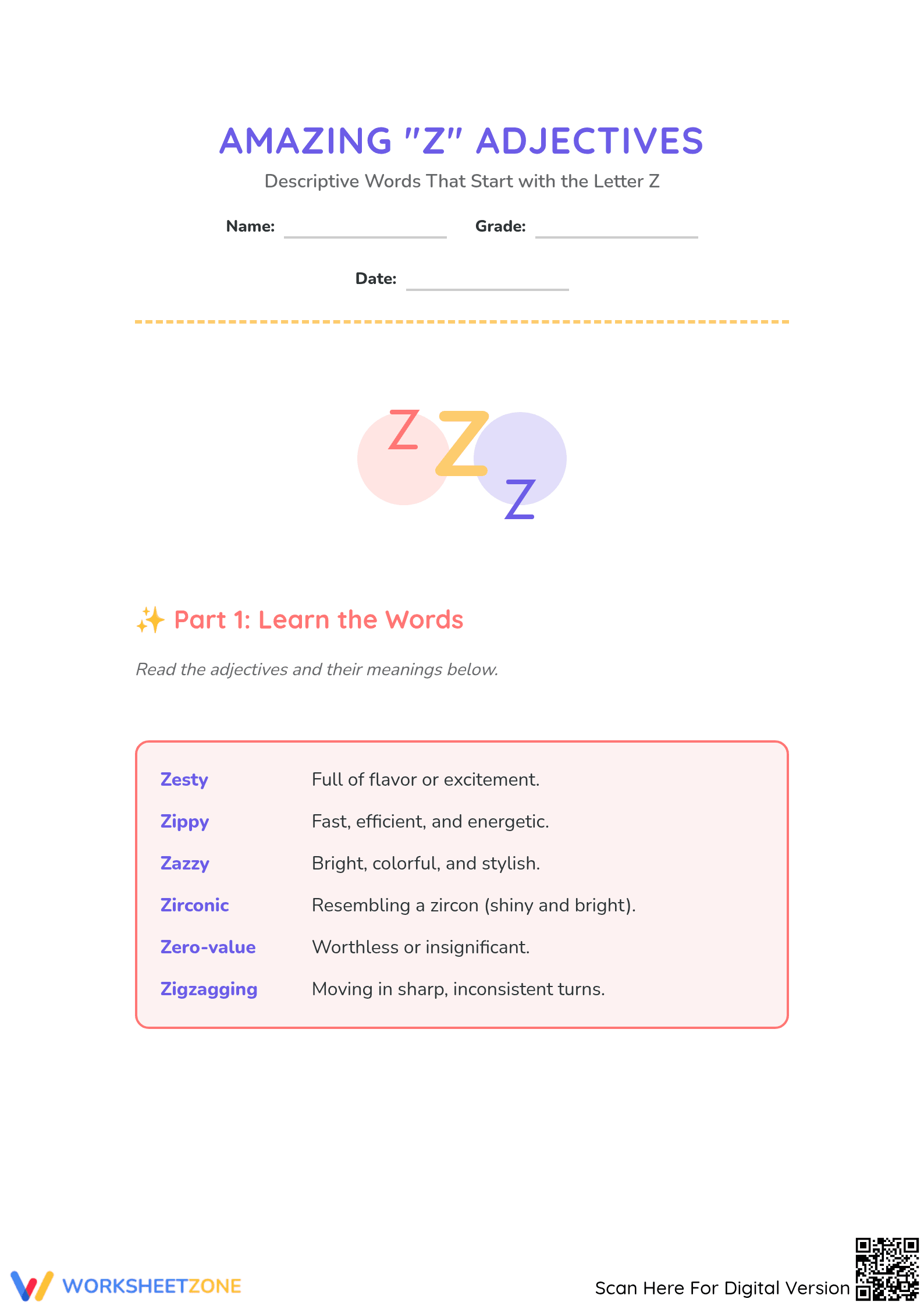



Z Adjectives Worksheet | Grade 2 ELA Printable
Paste this activity's link or code into your existing LMS (Google Classroom, Canvas, Teams, Schoology, Moodle, etc.).
Students can open and work on the activity right away, with no student login required.
You'll still be able to track student progress and results from your teacher account.
This descriptive Z adjectives worksheet helps second-grade students expand their vocabulary and enhance their descriptive writing skills. By introducing unique words like "zesty" and "zippy," this resource empowers young learners to replace common adjectives with more vibrant alternatives, ultimately improving their sentence construction and reading comprehension.
At a Glance
- Grade: 2 · Subject: ELA
- Standard:
CCSS.ELA-LITERACY.L.2.6— Use newly acquired adjectives to describe things- Skill Focus: Vocabulary and Adjectives
- Format: 3 pages · 10 problems · Answer key included · PDF
- Best For: Independent practice and vocabulary building
- Time: 15–20 minutes
This comprehensive three-page packet features a clear, student-friendly layout designed to introduce and reinforce new vocabulary. It begins with a reference word bank defining six unique Z adjectives. Students then complete four matching questions, five fill-in-the-blank sentence exercises, and one original sentence-writing task. A complete answer key is provided to ensure quick and accurate grading.
Skill Progression
- Guided practice: Students start by reviewing the provided definitions and matching four adjectives to their correct meanings, building foundational recognition.
- Supported practice: Next, learners tackle five fill-in-the-blank sentences, using context clues to select the appropriate Z adjective from their newly acquired vocabulary.
- Independent practice: Finally, students choose their favorite Z word to construct an original, descriptive sentence from scratch.
This gradual-release structure follows the proven I Do, We Do, You Do model to ensure students confidently grasp the new vocabulary.
Standards Alignment
This resource is directly aligned to CCSS.ELA-LITERACY.L.2.6: "Use words and phrases acquired through conversations, reading and being read to, and responding to texts, including using adjectives and adverbs to describe." It also supports foundational grammar skills by reinforcing the role of adjectives in modifying nouns. Both standard codes can be copied directly into lesson plans, IEP goals, or district curriculum mapping tools.
How to Use It
Deploy this worksheet during your morning work routine or as a dedicated vocabulary station during literacy centers. It works exceptionally well after a direct instruction mini-lesson on using vivid adjectives to make writing more interesting. As a formative assessment tip, observe which words students choose for their independent sentence-writing task; this will quickly reveal whether they understand the nuanced meaning of words like "zirconic" versus "zazzy." Most students will complete the full progression in 15 to 20 minutes.
Who It's For
This activity is primarily designed for first and second-grade students who are ready to move beyond basic descriptive words like "good" or "fast." It provides excellent differentiation for early finishers who need an extra vocabulary challenge. Pair this worksheet with a mentor text that features strong, descriptive language or a classroom anchor chart highlighting vivid adjectives.
Explicit vocabulary instruction is a critical component of early literacy development. According to the RAND AIRS 2024 report on reading comprehension, providing students with structured opportunities to learn and apply tier-two vocabulary words significantly improves their ability to understand complex texts. This worksheet supports that research by focusing on CCSS.ELA-LITERACY.L.2.6, requiring students to use newly acquired adjectives to describe things in context. By moving students from basic definition recognition to applied sentence writing, educators can foster deeper semantic mapping. The inclusion of unique, high-interest words starting with the letter Z naturally engages young learners while building the descriptive language skills necessary for advanced reading and writing tasks. Consistent practice with targeted vocabulary resources ensures students develop the linguistic tools required for long-term academic success.


