



























Complete Ecological Pyramids Worksheet | Grade 6-12 Science
Paste this activity's link or code into your existing LMS (Google Classroom, Canvas, Teams, Schoology, Moodle, etc.).
Students can open and work on the activity right away, with no student login required.
You'll still be able to track student progress and results from your teacher account.
This comprehensive science worksheet guides secondary students through constructing, interpreting, and critiquing ecological pyramid models. Students quantify energy transfer across trophic levels using the 10 percent rule, detect structural errors in energy diagrams, and analyze real-world biomass and number pyramids. The tasks prepare learners to model ecosystem energy dynamics accurately.
At a Glance
- Grade: Grades 6–12 · Subject: Science
- Standard: Construct and revise models showing energy and matter flow across trophic levels
- Skill Focus: Constructing and revising ecological pyramid models
- Format: 4 pages · 17 problems · Answer key included · PDF
- Best For: Secondary ecology units, model revision practice, and formative assessment
- Time: 40–55 minutes of instructional time
What's Inside: This 4-page worksheet features 17 questions divided across three sections. Students examine a grassland food chain with quantitative energy values, evaluate a faulty student draft to correct structural errors, and interpret data tables showing inverted pyramids of biomass and numbers. A 4-page answer key provides complete model illustrations and explanatory solutions.
Skill Progression
- Guided Practice (Part A): Students calculate energy flow using a grassland food chain table, applying the 10 percent rule across four trophic levels with numerical prompts.
- Supported Practice (Part B): Learners identify errors in an inverted energy diagram, redraw the corrected upright model, and explain why energy loss restricts trophic levels.
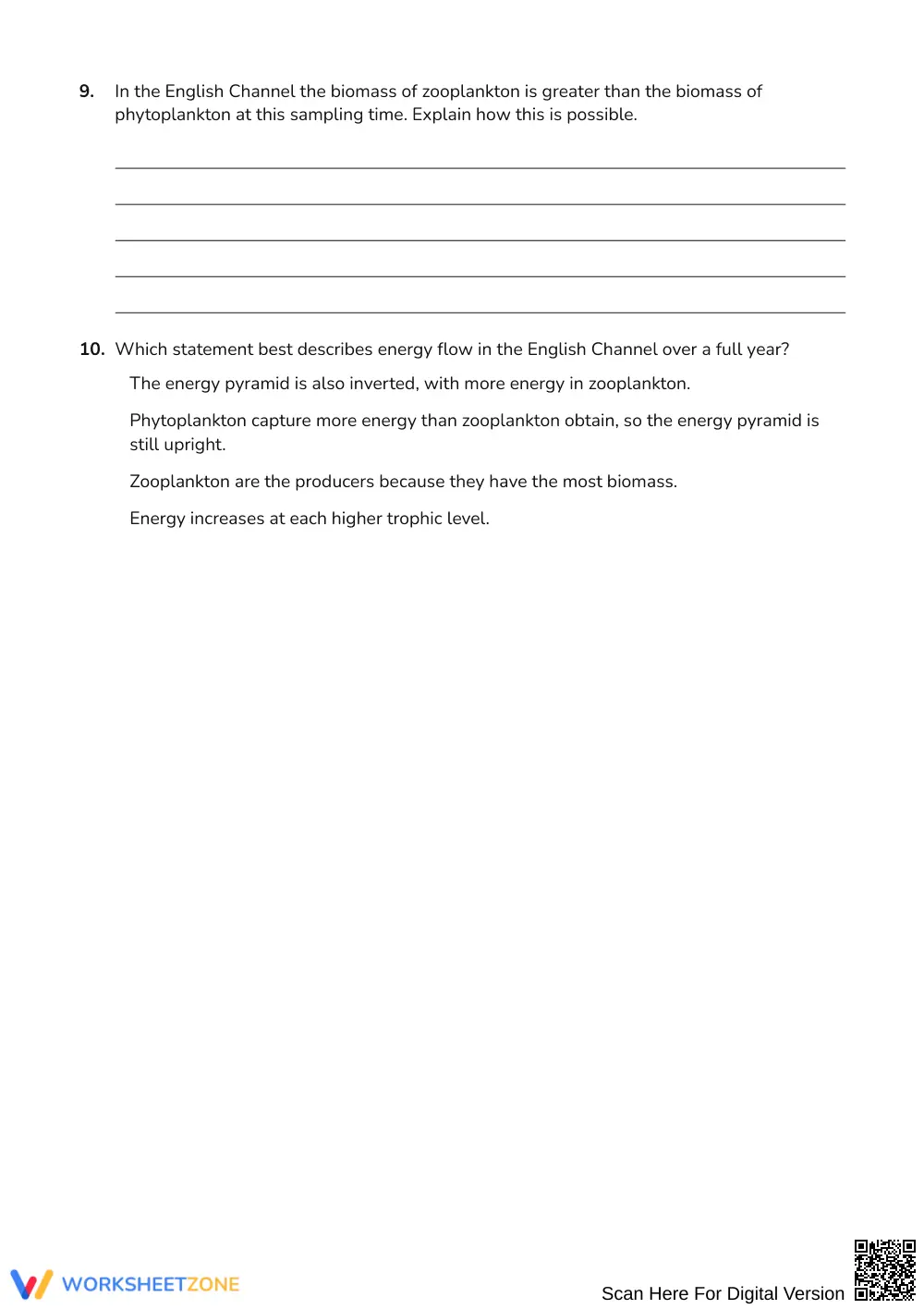
- Independent Practice (Part C): Students analyze data for oak woodlands and marine ecosystems to explain inverted number and biomass pyramids.
This sequence follows a gradual-release framework, advancing students from formulaic energy calculations to independent ecosystem model analysis.
Standards Alignment
This resource aligns directly with national life science standards requiring students to develop models illustrating the cycling of matter and flow of energy in ecosystems. Students trace how energy transfers through trophic levels and explain quantitative limits on consumer populations. These alignment details can be incorporated into lesson plans and curriculum mapping tools.
How to Use It
Use this worksheet after direct instruction on food chains to reinforce quantitative modeling skills. Alternatively, assign Part B and Part C as a mid-unit formative check to evaluate whether students conflate organism counts with available energy. During work time, observe whether students correctly position producers at the base. Expected completion time is 40 to 55 minutes.
Who It's For
This resource supports middle and high school life science classrooms, including general biology, honors courses, and academic intervention. Built-in scaffolds assist struggling learners through explicit mathematical values, while marine biomass scenarios challenge advanced students. Pair this activity with an ecosystem food web diagram or interactive simulation to deepen conceptual understanding.
Fisher & Frey (2014) emphasize that model-based inquiry and structured error analysis accelerate conceptual mastery in secondary science by requiring students to make their internal reasoning visible. This 4-page ecological pyramids worksheet operationalizes that research through 17 sequenced tasks. Students construct, revise, and critique trophic representations by calculating energy losses under the 10 percent rule, redrawing flawed student drafts, and evaluating inverted biomass pyramids in marine food chains. By transitioning from concrete numerical calculations to abstract model evaluation, the resource strengthens student capacity to represent energy transfers and matter conservation across trophic levels. The tasks provide observable formative evidence of whether learners distinguish individual organism counts from standing biomass and continuous energy throughput. Consequently, this worksheet gives educators a rigorous, research-aligned tool that builds durable life science literacy and reinforces core scientific modeling practices across grades 6 through 12.


