




























Complete Ecological Pyramids Worksheet | Grade 6-12 Science
Paste this activity's link or code into your existing LMS (Google Classroom, Canvas, Teams, Schoology, Moodle, etc.).
Students can open and work on the activity right away, with no student login required.
You'll still be able to track student progress and results from your teacher account.
This science worksheet trains students to interpret, calculate, and evaluate ecological data across trophic levels. Learners examine quantitative tables showing energy loss, biomass ratios, and organism counts to explain food chain dynamics. The 16-task sequence reinforces ecosystem modeling through structured data analysis.
At a Glance
- Grade: 6–12 · Subject: Science
- Standard: Life Science — Analyze and interpret empirical data showing energy transfer and biomass across ecological trophic levels
- Skill Focus: Data Table Analysis
- Format: 4 pages · 16 problems · Answer key included · PDF
- Best For: High school biology and middle school ecology data practice
- Time: 45–60 minutes
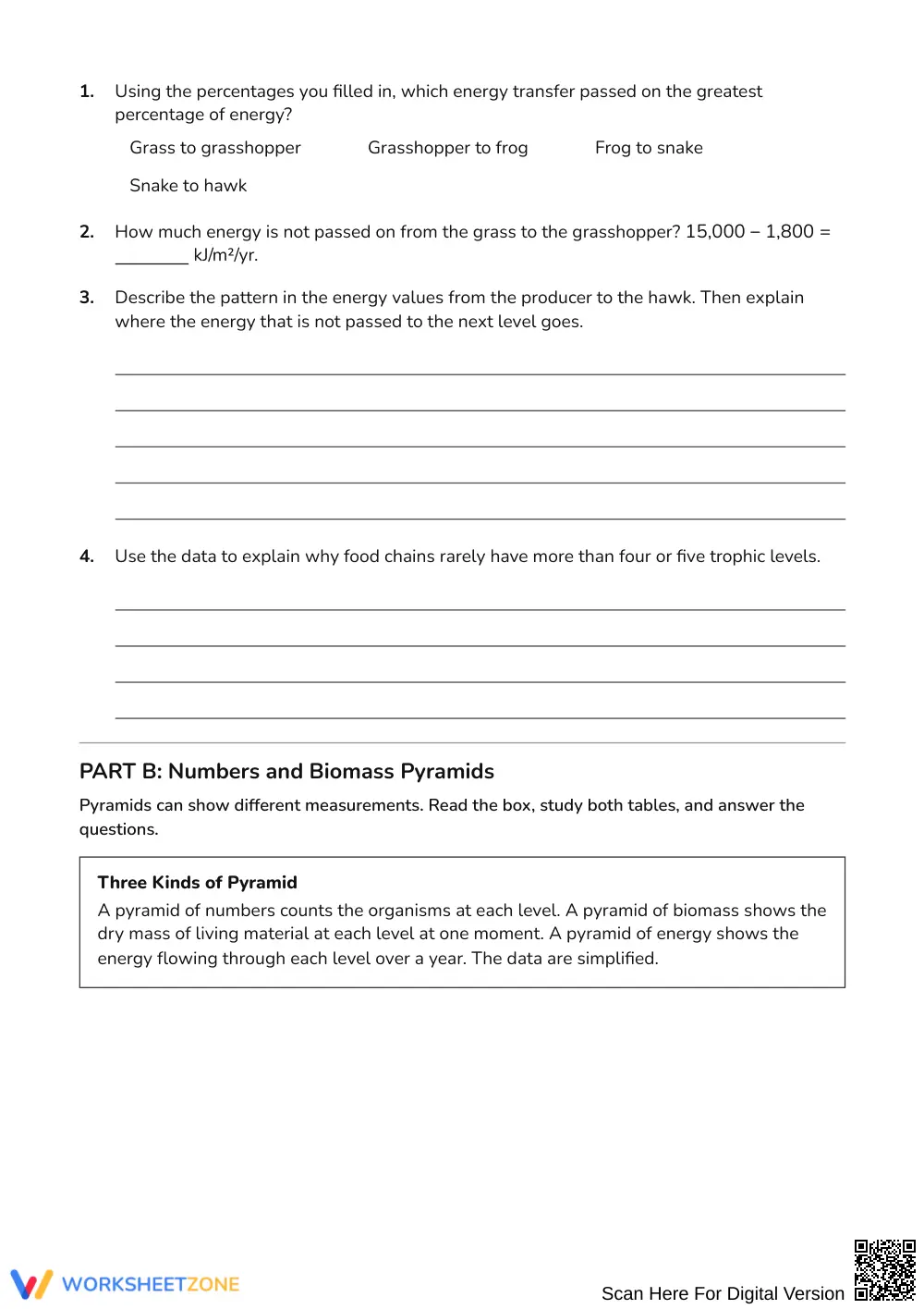
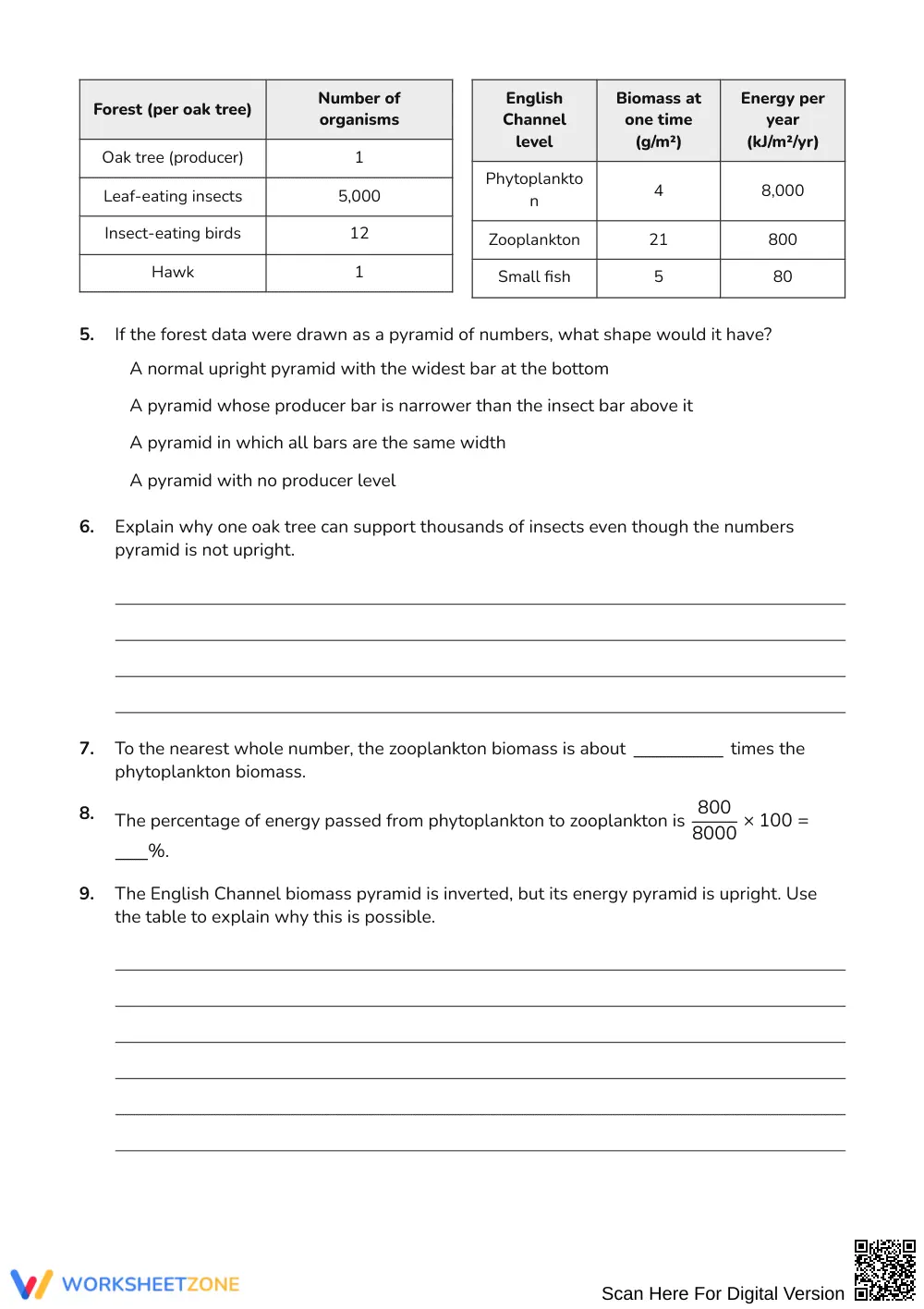
The 4-page activity presents two quantitative scenarios pairing data tables with analytical questions. Part A focuses on energy dissipation in a grassland food chain, requiring students to compute transfer percentages across five trophic levels. Part B introduces comparative tables for forest numbers and marine biomass pyramids. The layout features data reference boxes, calculations, and open-ended synthesis prompts, backed by a 4-page answer key.
Skill Progression
- Guided practice (Tasks 1–4): Students extract values from a grassland energy table, compute exact energy loss, and identify highest efficiency transfers with explicit numerical scaffolds.
- Supported practice (Tasks 5–10): Learners describe energy trends across trophic tiers and evaluate inverted number pyramids using structured multiple-choice questions.
- Independent practice (Tasks 11–16): Students independently compute marine biomass ratios, calculate trophic efficiency percentages, and synthesize written justifications for inverted pyramids.
This sequence implements gradual-release instruction, advancing students from basic table reading to complex ecological reasoning.
Standards Alignment
This worksheet aligns with middle and high school Life Science standards focusing on energy and matter transfer in ecosystems. Students analyze data to demonstrate how energy decreases across trophic levels, explaining thermodynamic constraints on food chain length. Both standard descriptions can be copied directly into lesson plans, IEP goals, or district curriculum mapping tools.
How to Use It
Deploy this worksheet after direct instruction on the 10 percent rule. Use it during paired lab analysis or independent practice. During circulation, check task 3 to confirm students recognize that unpassed energy releases as metabolic heat. Expected completion time is 45 to 60 minutes.
Who It's For
This resource supports biology, environmental science, and middle school life science classes mastering quantitative data interpretation. Pair this activity with an introductory food web lesson or an ecosystem energy anchor chart.
According to Fisher & Frey (2014), structured data analysis tasks that integrate mathematical computation with scientific reasoning significantly strengthen secondary students' conceptual retention. This worksheet guides learners through interpreting trophic energy transfer, calculating percentage efficiency, and explaining why numbers, biomass, and energy pyramids exhibit contrasting shapes. Rather than memorizing static definitions, students evaluate quantitative models showing how energy dissipation limits food chain length to four or five tiers. The intentional progression from direct subtraction to comparative ecological synthesis supports deep conceptual mastery of ecosystem dynamics. By bridging numerical evidence with explanatory writing, students develop the analytical competencies necessary for advanced biological inquiry. Teachers can integrate these 16 data tasks during guided inquiry or formative assessment cycles to diagnose misconceptions regarding marine biomass inversions and metabolic heat loss across trophic systems effectively.


