




























Complete Ecological Pyramids Worksheet | Grade 6-12 Science
Paste this activity's link or code into your existing LMS (Google Classroom, Canvas, Teams, Schoology, Moodle, etc.).
Students can open and work on the activity right away, with no student login required.
You'll still be able to track student progress and results from your teacher account.
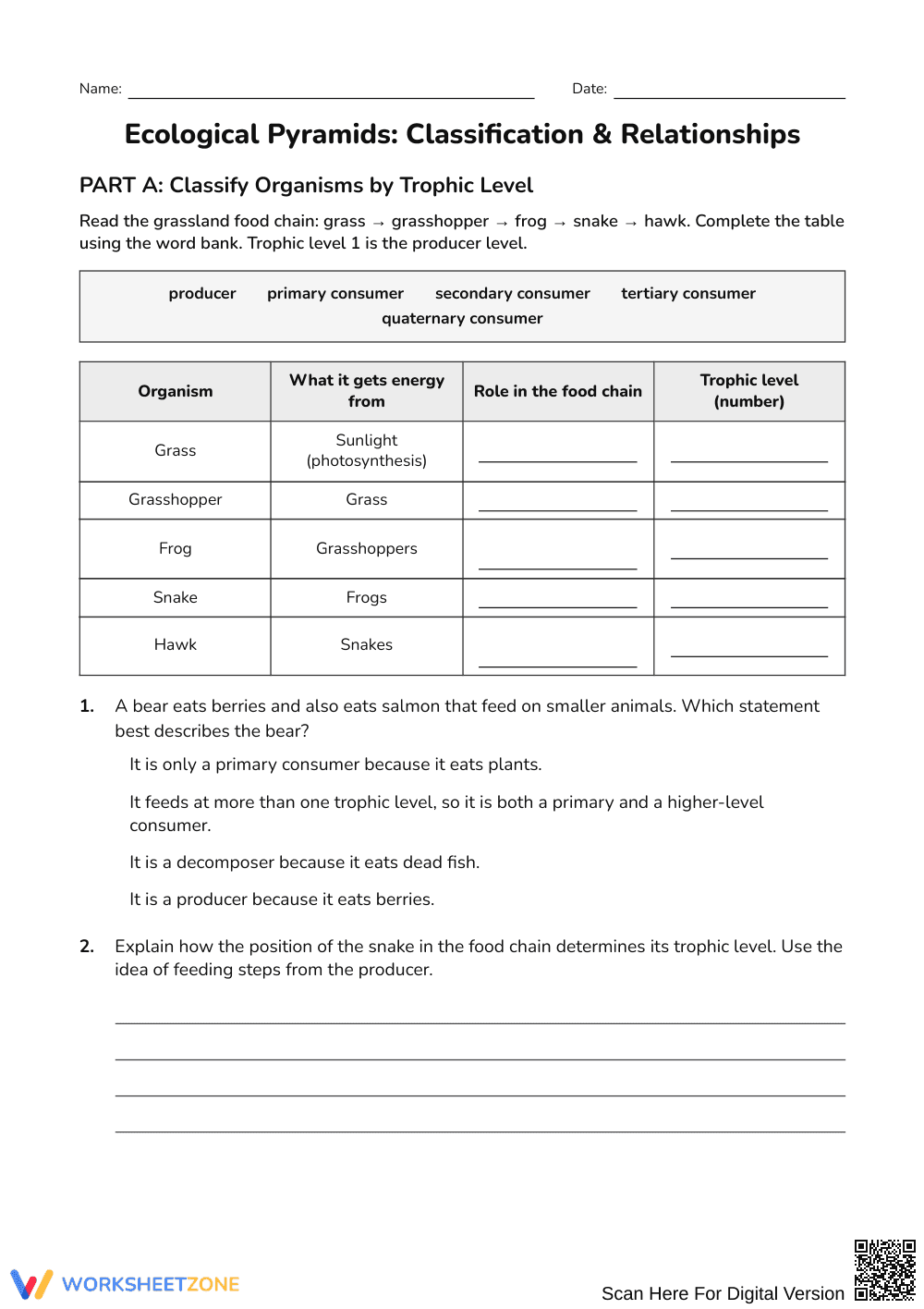
This ecological pyramids practice worksheet guides students to classify organisms by trophic level, calculate energy distribution using the 10 percent rule, and analyze biomass relationships. Learners examine real-world ecosystem models to build a conceptual understanding of how matter and energy circulate through food chains, moving from basic identification to deep ecological explanations.
At a Glance
- Grade: Grades 6–12 · Subject: Science
- Standard: Ecosystem Dynamics — Model trophic levels, energy transfer, and biomass dynamics in ecosystems
- Skill Focus: Classifying trophic levels and explaining ecological pyramid relationships
- Format: 4 pages · 26 problems · Answer key included · PDF
- Best For: Energy flow mastery and ecosystem modeling
- Time: 45–60 minutes
What's Inside
This comprehensive 4-page worksheet contains 26 structured tasks arranged into three distinct sections. Students complete classification tables with word bank support, calculate energy transfers in kilojoules across trophic tiers, evaluate multiple-choice scenarios, and write detailed short-answer explanations analyzing inverted biomass pyramids. A complete 4-page answer key provides full model responses for every prompt.
Skill Progression
- Guided practice (Part A — 8 tasks): Organism classification using a structured word bank, baseline identification of producer and consumer roles, and guided explanation of feeding steps from primary producers.
- Supported practice (Part B — 8 tasks): Quantitative energy calculations across four trophic levels applying the 10 percent rule, accompanied by conceptual evaluation of ecological heat loss.
- Independent practice (Part C — 10 tasks): Matching pyramid types (energy, numbers, biomass) and writing evidence-based explanations of inverted marine biomass pyramids.
This sequence reinforces the gradual-release framework, guiding students systematically from guided foundational classification to independent structural analysis.
Standards Alignment
This resource aligns with secondary life science standards focusing on ecosystem interactions, energy dynamics, and matter flow. Students construct explanations and evaluate mathematical models showing how trophic limitations restrict food chain length and influence ecosystem stability. Standard descriptions can be copied directly into lesson plans, IEP goals, or district curriculum mapping tools.
How to Use It
Deploy this resource directly after direct instruction on food chains and the second law of thermodynamics. It functions effectively as paired collaborative practice or an independent mid-unit check. Formative assessment tip: inspect student explanations in Part B regarding the missing 90 percent of energy to diagnose whether learners understand metabolic heat loss versus energy destruction. Expected completion time is 45 to 60 minutes.
Who It's For
Designed for middle and high school biology or environmental science classes, this worksheet supports diverse learners through structured tables and visual models before requiring complex writing. Pair this resource with an anchor chart showing aquatic versus terrestrial energy pyramids to provide additional context during independent work.
According to Fisher & Frey (2014), the gradual release of responsibility model systematically builds scientific reasoning when instructional materials transition deliberately from scaffolded classification tables to unprompted evaluative writing. In middle and high school life science courses, students often harbor persistent misconceptions regarding energy conservation, frequently confusing instantaneous standing biomass with cumulative energy transfer over time. This 26-task worksheet operationalizes empirical learning principles by anchoring abstract thermodynamic constraints within concrete grassland and marine ecosystem datasets. By prompting secondary students to compute energy values across trophic tiers before resolving the apparent paradox of inverted biomass pyramids, the curriculum materials reinforce robust cognitive schemas. Teachers obtain immediate, high-fidelity diagnostic data on student mastery, ensuring that learners grasp why energy pyramids must remain upright even when numbers or biomass invert.


